In this guide
- What this guide covers
- Key points at a glance
- What “added” and “natural” sugar mean
- Why the difference matters
- How to read the label: a simple step‑by‑step
- Practical examples and swaps
- A reusable comparison framework
- Limitations and when to ask a clinician
- How to compare products later
- Bottom line
- Editorial note
- References
- Related VitaEvidence reading
Added sugar vs natural sugar is a common label question: added sugars are those put into foods during processing or preparation, while naturally occurring sugars are the intrinsic sugars found in whole foods like fruit and milk. This guide explains the practical difference, how to read Nutrition Facts and ingredient lists, and simple examples for everyday swaps.
What this guide covers
- Definitions and why the distinction matters for health and calories
- Step‑by‑step tips for reading labels and ingredient lists
- Practical examples (juices, yogurt, cereal, canned fruit) and a comparison framework you can reuse
- Limits of labels, when the distinction doesn’t tell the whole story, and when to ask a clinician
Key points at a glance
- The U.S. Dietary Guidelines recommend keeping added sugars to less than 10% of daily calories for people ages 2 and older; for a 2,000‑kcal diet that equals about 50 g of added sugars per day [1].
- Nutrition Facts labels now list “Added Sugars” in grams and % Daily Value; the %DV is based on 50 g per day for a 2,000‑kcal diet [2].
- Naturally occurring sugars (in whole fruit, vegetables, milk) come with nutrients and often fiber; added sugars add calories without the same nutrient package. Use both the “Added Sugars” line plus the ingredients list to spot added sugar sources [2,3].
- For infants, children under 2, pregnancy, diabetes, or specific medical conditions, discuss sugar targets with a clinician because needs and recommendations differ.
What “added” and “natural” sugar mean
Definitions and regulatory framing
– Added sugars (regulatory)
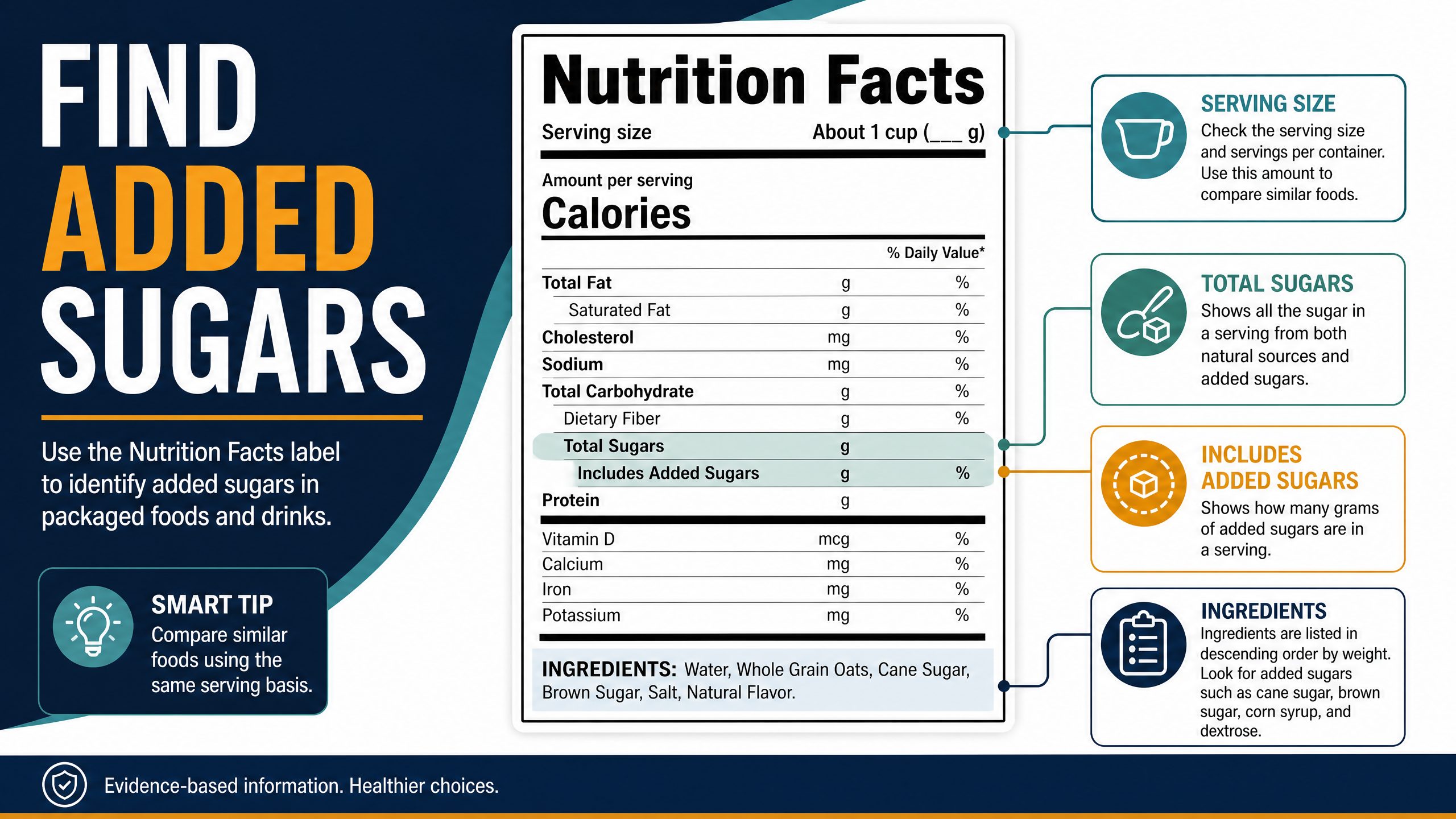
The FDA defines added sugars as sugars that are added during the processing of foods, packaged as such, or are sugars from syrups, honey, or concentrated fruit or vegetable juices that are added to foods [2]. These must be declared on the updated Nutrition Facts label as “Added Sugars” (g and %DV).
– Naturally occurring sugars
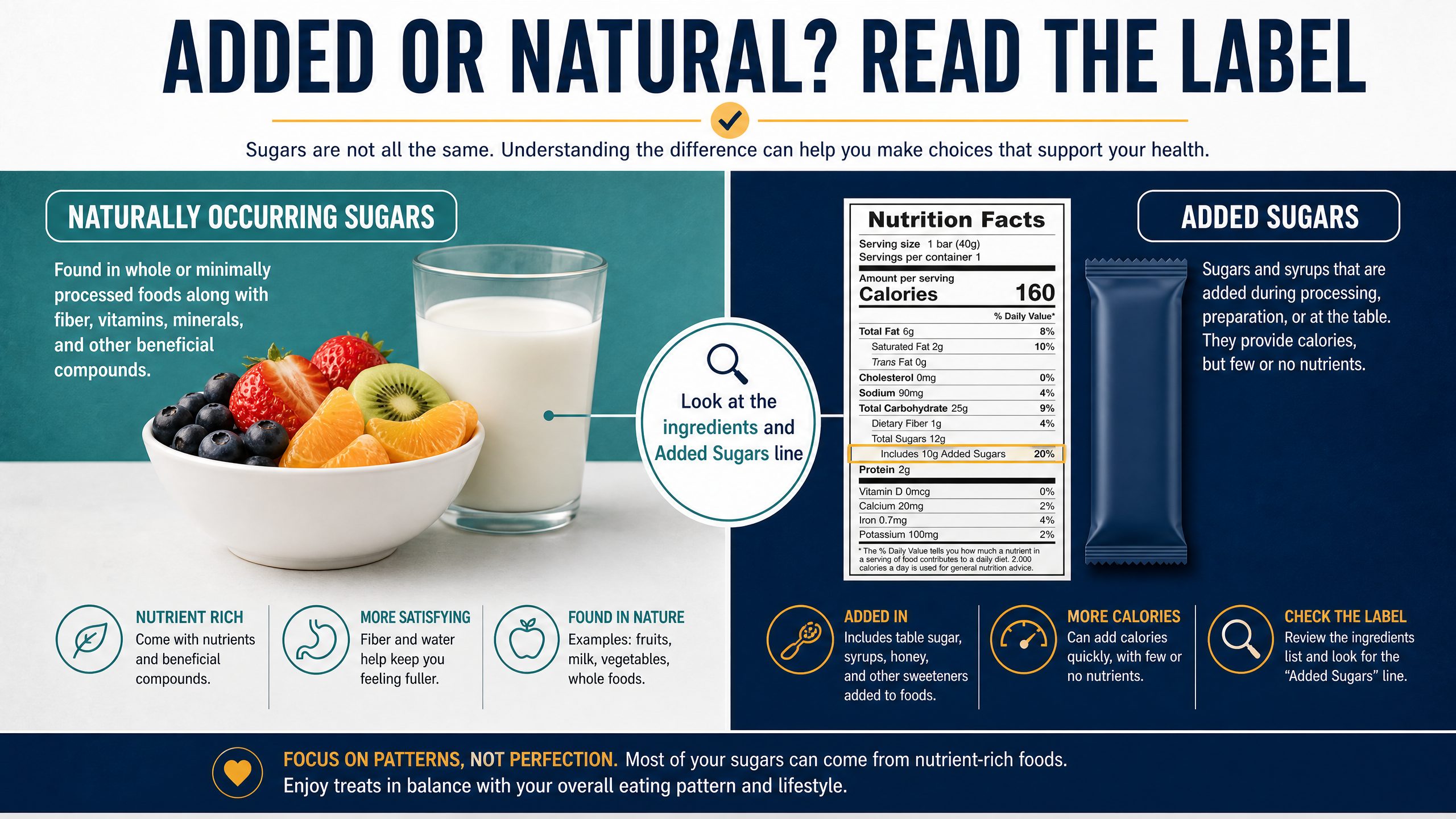
These are the sugars that exist inherently in whole foods — for example, fructose in whole fruit and lactose in milk. They are not counted as “added sugars” on the label but still count toward total carbohydrate and calorie intake.
Why the difference matters
Calories, nutrients, and food context
– Added sugars supply calories with few other nutrients; diets high in added sugars can make it harder to meet recommended nutrient intakes while staying within calorie goals [1].
– Whole foods with naturally occurring sugars (fruit, plain dairy) also provide vitamins, minerals, fiber, and protein that influence satiety and metabolism differently than a sugar‑sweetened beverage or candy.
Public health targets
– The Dietary Guidelines for Americans recommend limiting added sugars to less than 10% of calories per day for those aged 2 and older and advise that infants and toddlers avoid added sugars entirely when possible [1]. The Nutrition Facts label shows added sugars to help consumers follow these recommendations [2].
How to read the label: a simple step‑by‑step
Step 1 — Check serving size first
– Serving size determines how much sugar the gram amounts represent. If you consume more than one serving, multiply the grams and %DV accordingly.
Step 2 — Look at “Added Sugars” (g and %DV)
– The label lists both grams and %DV for added sugars based on a 50 g daily value. Example: 12 g added sugars is 24% DV (12 ÷ 50 = 0.24). That helps you see how a serving fits into your day [2].
Step 3 — Scan the ingredients list for sugar synonyms
– Ingredients are listed by weight. If a sugar source appears near the top, the product is likely high in that ingredient. Watch for names such as: sugar, sucrose, high‑fructose corn syrup, cane sugar, corn syrup, fruit juice concentrate, honey, molasses, maltose, dextrose, and syrups. Fruit juice concentrate listed as an ingredient counts as added sugar [2].
Step 4 — Contrast total sugars with added sugars
– “Total Sugars” includes both natural and added sugars. If total sugars are high but added sugars are low or zero (for example, plain milk), most of that sugar is naturally occurring.
Practical examples and swaps
Juice vs whole fruit
– Why it matters: One cup of 100% fruit juice can contain as much sugar as a whole fruit serving but lacks the fiber and chewing structure of whole fruit. Choosing whole fruit gives fiber and often leads to greater satiety and slower sugar absorption.
– Swap suggestion: Choose a whole piece of fruit or dilute a small serving of juice with sparkling water to reduce total sugar per serving.
Yogurt — plain vs flavored
– Why it matters: Plain yogurt contains naturally occurring lactose; flavored or fruit‑on‑the‑bottom yogurts commonly add sugar or fruit concentrates. Compare the “Added Sugars” line and ingredients to see how much of the sugar is added.
– Swap suggestion: Choose plain yogurt and add fresh fruit or a small drizzle of honey (and account for that added sugar) if you want sweetness.
Breakfast cereal and granola
– Why it matters: Many cereals and granolas add sugars and syrups; granola often has concentrated sweeteners even though it includes whole grains and nuts.
– Swap suggestion: Look for cereals with low added sugars and higher fiber, or mix a small portion of a sweeter cereal with a low‑sugar base.
Canned fruit and packaged snacks
– Why it matters: Canned fruit in heavy syrup is higher in added sugars than fruit packed in water or its own juice (and some “in juice” versions still count as added sugars if juice concentrate is used).
– Swap suggestion: Choose water‑packed or frozen fruit without added sugars.
A reusable comparison framework
Quick checklist to compare two products
– Serving size — does the listed serving match what you actually eat?
– Added Sugars (g and %DV) — how much of your 50 g DV per serving? [2]
– Ingredients — where do sugar sources appear in the list and what names are used?
– Fiber and protein — do they moderate the sugar’s effect on appetite and blood glucose?
– Whole‑food content — does the product primarily contain whole fruits, whole grains, or dairy versus refined grains and syrups?
Use these attributes together; no single number tells the whole story.
Limitations and when to ask a clinician
Label limits and diet context
– Labels quantify added sugars but not overall dietary pattern or portion sizes. Foods with similar added‑sugar grams can affect people differently depending on fiber, fat, and protein content.
– For people with medical conditions (diabetes, metabolic disease, chronic kidney or liver disease), for pregnant or breastfeeding people, infants and young children, or those with eating disorders, individualized advice is important. Discuss sugar targets, carbohydrate counting, and replacement strategies with a clinician or registered dietitian.
When to seek professional help
– If you have chronic conditions, take medications that affect blood sugar, are pregnant or breastfeeding, or care for infants and toddlers, ask your clinician about appropriate daily sugar targets and how to interpret labels in your situation.
How to compare products later
When you shop next, compare the following label attributes: serving size, Added Sugars (g and %DV), Total Sugars, ingredient order and sugar synonyms, fiber content, protein, and calories. Track how a typical portion contributes to the <10% of calories from added sugars recommendation for your calorie needs (the %DV is based on 50 g for a 2,000‑kcal diet). [Affiliate product comparison block—add verified iHerb links after approval]
Bottom line
The practical difference between added sugar and naturally occurring sugar is mostly about food context: added sugars increase calorie density without the vitamins, minerals, or fiber that whole foods provide. Use the Nutrition Facts label—especially the “Added Sugars” line and the ingredient list—along with serving size and nutrient balance to make choices that fit your dietary targets. For infants, young children, pregnancy, chronic disease, or medication use, get personalized guidance from a clinician or registered dietitian.
Editorial note
VitaEvidence Editorial Team. Last reviewed: August 2026. For general education, not personal medical advice. Read our Editorial Policy.
References
[1] Dietary Guidelines for Americans 2020–2025. U.S. Department of Agriculture and U.S. Department of Health and Human Services. https://www.dietaryguidelines.gov/
[2] FDA. Added Sugars on the Nutrition Facts Label. U.S. Food and Drug Administration. https://www.fda.gov/food/new-nutrition-facts-label/added-sugars-nutrition-and-supplement-facts-labels
[3] FDA. Changes to the Nutrition Facts Label. U.S. Food and Drug Administration. https://www.fda.gov/food/food-labeling-nutrition/changes-nutrition-facts-label
[4] MyPlate — Fruits. U.S. Department of Agriculture. https://www.myplate.gov/eat-healthy/fruits