In this guide
- Key Takeaways
- Why Potlucks Need a Time-and-Temperature Plan
- Safe Transport: Keep Cold Foods Cold and Hot Foods Hot
- For cold dishes
- For hot dishes
- Buffet Timing: Make the Clock Visible
- Leftover Decisions: Refrigerate, Reheat, or Discard
- What the Evidence Supports—and What Is Uncertain
- Safety/When to Seek Care
- A Practical Potluck Checklist
- References
Holiday potlucks combine large portions, long drives, crowded refrigerators, and guests who arrive at different times. The practical goal is to keep perishable food out of the range where bacteria multiply quickly and to make a clear plan for leftovers.
This is general education for U.S. readers, not individualized medical advice.
Key Takeaways
- Transport cold perishable foods in a cooler with ice or gel packs, and keep them at 40°F or below. Keep hot foods at 140°F or above in an insulated container or suitable warming equipment. 1
- The usual time limit for perishable food at room temperature is 2 hours, or 1 hour when the temperature is above 90°F. Food held safely hot or cold is the exception. 2
- At a buffet, use small dishes and replace nearly empty dishes instead of topping them off. Keep backup cold dishes refrigerated and hot dishes hot. 2
- Refrigerate leftovers promptly in shallow containers. Properly refrigerated leftovers are generally usable for 3 to 4 days; reheat them to 165°F. 4
- When the time or temperature history is unknown, discard the perishable food rather than relying on smell, appearance, or a “small taste.”
Why Potlucks Need a Time-and-Temperature Plan
Bacteria can multiply rapidly between 40°F and 140°F, often called the “danger zone.” The risk is not limited to meat: egg dishes, dairy-based foods, seafood salads, cut fruit, cooked vegetables, gravies, casseroles, and cooked leftovers also need time and temperature control. 1
The basic framework is CDC’s four-step approach: clean, separate, cook, and chill. Wash hands and surfaces, keep raw meat and its juices away from ready-to-eat foods, use a food thermometer rather than color to judge doneness, and refrigerate perishables promptly. 1
Safe Transport: Keep Cold Foods Cold and Hot Foods Hot
For cold dishes
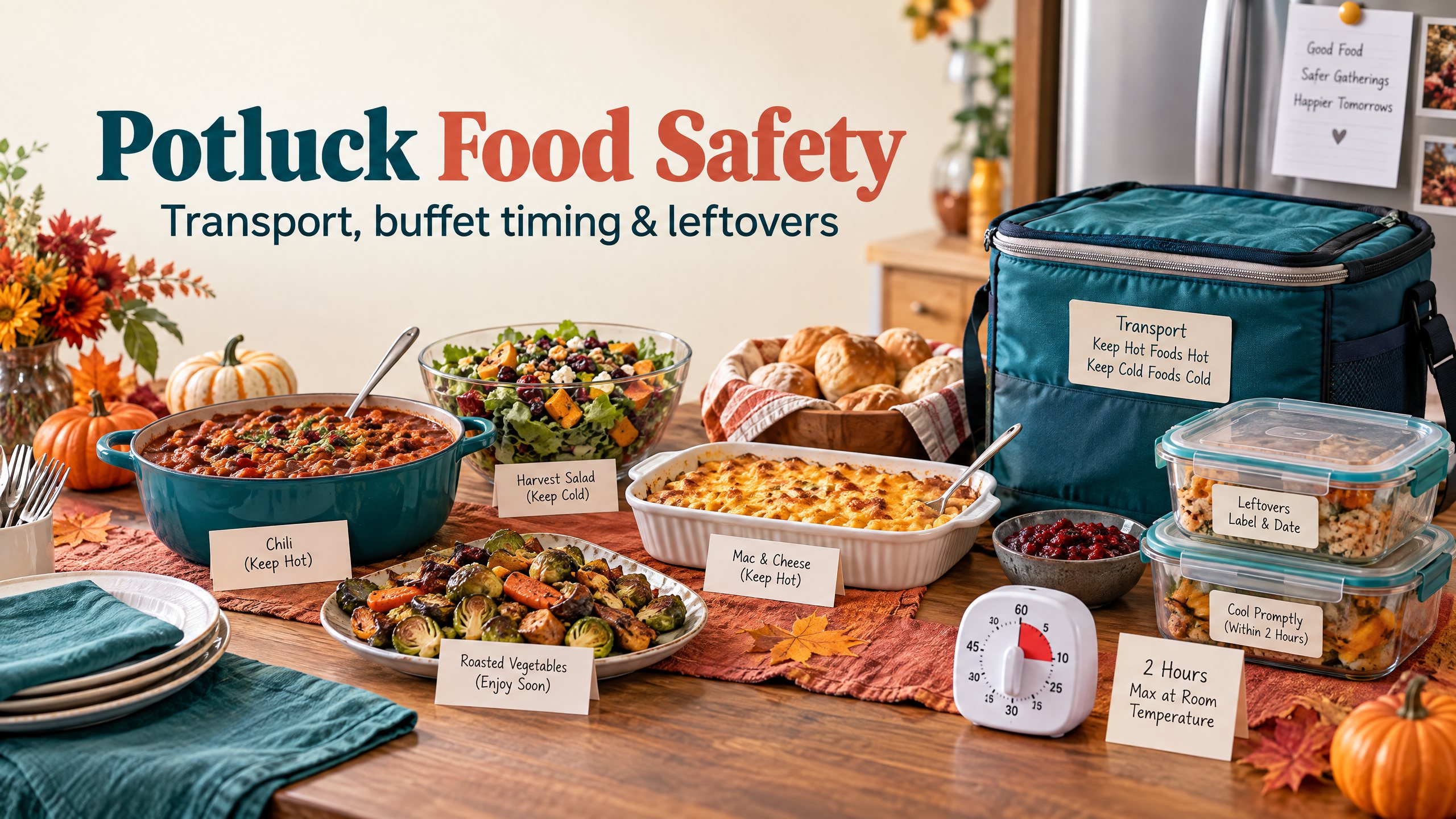
Finish chilling foods such as egg salad, chicken salad, seafood salad, deviled eggs, dairy-based dips, and cut fruit before leaving home. Place them directly from the refrigerator into a cooler packed with ice or frozen gel packs. USDA advises maintaining 40°F or below and carrying the cooler in the air-conditioned passenger compartment rather than a hot trunk. 3
Use leak-resistant containers and keep raw ingredients separate from ready-to-eat dishes. A closed cooler is not automatically safe; it must stay cold enough, with sufficient ice or frozen packs around the food.
At the destination, move cold foods into a refrigerator or onto ice. If a dish may sit out longer than two hours, serve it in smaller batches and keep the rest chilled.
For hot dishes
Cook the food thoroughly, then use a food thermometer to verify its temperature where appropriate. Transport hot food at 140°F or above by using an insulated bag or container, wrapping the covered dish well, or moving it promptly into a preheated slow cooker, warming tray, or chafing dish. 2
Do not treat an insulated carrier as a substitute for temperature control. Some warmers hold only 110°F to 120°F, so check the equipment and confirm that food remains at least 140°F. 2
For a long or unpredictable drive, consider a nonperishable option such as whole fruit, chips, nuts, or dried fruit. 3
Buffet Timing: Make the Clock Visible
Note when perishable foods leave the refrigerator, oven, or warming appliance. Unless held at safe hot or cold temperatures, discard them after 2 hours at room temperature, or 1 hour above 90°F. 1 4
Keep hot foods at 140°F or warmer in chafing dishes, slow cookers, or warming trays. Keep cold foods at 40°F or colder in a refrigerator, cooler, or a serving dish nested in ice. Stirring or covering food may improve quality, but it does not replace measuring temperature or tracking time. 2
Small serving dishes are safer and often more appealing than one large, repeatedly handled platter. FDA recommends preparing several small dishes, keeping backups cold or hot, and replacing nearly empty dishes with freshly filled ones. Do not pour a fresh batch into an old serving dish; the original dish and utensil may have been contaminated during serving. 2
Use clean serving utensils for every dish. Keep raw foods and their utensils away from ready-to-eat foods. Recipes containing raw or lightly cooked eggs—such as some homemade eggnogs, custards, mousse, or dressings—deserve extra caution. Use pasteurized eggs or products, or cook the egg mixture to a safe temperature according to reliable food-safety guidance. 2
Leftover Decisions: Refrigerate, Reheat, or Discard
When the meal ends, make leftovers a planned step rather than an afterthought. Refrigerate perishable food within two hours of cooking, serving, or removal from a hot-holding appliance—or within one hour if the temperature is above 90°F. A guest taking food home should refrigerate it promptly after arriving. 2
Divide large amounts into shallow containers so they cool faster. It is acceptable to place small portions of hot food directly in the refrigerator; a large, deep pot cools more slowly and can keep the center in the danger zone. Cover containers or use airtight packaging, then label them with the date. 1
USDA says refrigerated leftovers can generally be kept for 3 to 4 days, while frozen leftovers can be kept for 3 to 4 months for best quality. Reheat leftovers to 165°F, measured with a food thermometer. Reheat sauces, soups, and gravies to a rolling boil. In a microwave, cover and rotate food, allow standing time, and check more than one spot because cold areas can remain. 4
Discard food when it has been at room temperature beyond the applicable limit, when a cooler no longer kept it at 40°F or below, or when you cannot reconstruct how long it was out. Do not use smell, appearance, or taste as a safety test. Harmful bacteria may be present without obvious changes, and tasting a questionable dish is not a reliable way to evaluate it.
What the Evidence Supports—and What Is Uncertain
Federal food-safety recommendations use microbial-growth principles and validated cooking, holding, cooling, and reheating temperatures. These thresholds reduce risk but cannot guarantee safety at every meal. 1 4
The uncertain part is a meal’s contamination history: a dish may have been handled, moved, or left out before anyone tracked the clock. No home “freshness test” can reconstruct that history, so discard food when key information is missing.
People at higher risk for severe foodborne illness include adults 65 and older, children under 5, pregnant people, and people with weakened immune systems. For these guests, careful temperature control and avoiding foods with higher contamination risk are especially important. 5
Safety/When to Seek Care
Food poisoning can cause diarrhea, stomach cramps, nausea, vomiting, and fever. Drink fluids if vomiting or diarrhea occurs, but seek medical care for bloody diarrhea, diarrhea lasting more than three days, a fever above 102°F, vomiting that prevents keeping liquids down, or signs of dehydration such as very little urination, dry mouth or throat, or dizziness when standing. 6
Pregnant people should contact a clinician for fever and flu-like symptoms after a possible foodborne exposure. A young child, older adult, or person with a weakened immune system may need prompt medical advice even when symptoms seem less dramatic. Severe symptoms, confusion, fainting, trouble breathing, or inability to stay awake warrant urgent evaluation.
A Practical Potluck Checklist
Before leaving home, chill cold foods, verify hot-food temperatures, pack the right cooler or insulated carrier, and separate raw ingredients from ready-to-eat foods. At the gathering, record the time foods go onto the buffet, keep hot foods at 140°F or above and cold foods at 40°F or below, use clean utensils, and replace small dishes instead of topping them off. At the end, refrigerate food within the time limit in shallow containers, label it, and plan to use it within 3 to 4 days—or freeze it.
The simplest rule is also the most useful: when you cannot verify time or temperature, do not serve or save the food. A thoughtful plan protects the meal and the celebration.