
In this guide
- What this guide covers
- Key points at a glance
- Why timing matters: the biology in brief
- Practical steps to build a consistent sleep schedule
- 1) Set a realistic anchor: start with wake time
- 2) Treat bedtime as a target zone, not a strict deadline
- 3) Use a short pre-sleep routine (20–45 minutes)
- 4) Shift gradually when you need to change the schedule
- 5) Manage weekend variability
- 6) Special situations: shift work, caregiving, and travel
- What a consistent sleep schedule can and can’t do
- Comparison framework: choosing tools or approaches
- How to compare products later
- Limitations and when to ask a clinician
- Bottom line
- Editorial note
- References
- Related VitaEvidence reading
Keeping your sleep and wake times consistent — going to bed and getting up at roughly the same times every day — is a simple behavior that can improve how quickly you fall asleep, how restorative your sleep feels, and how alert you are during the day. This guide explains what a consistent sleep schedule is, why it may help, practical ways to build one, how to compare sleep-support tools, and when to discuss sleep timing with a clinician.
What this guide covers
- What “consistent sleep schedule” and “same bedtime every night” mean in practice
- Evidence-based benefits and realistic limits of regular timing
- Practical, example-based strategies to set and stick to a routine
- A comparison framework for tools and products you might use later
- When to seek clinical advice
Key points at a glance
- Regular sleep timing supports the body’s circadian rhythm and often makes it easier to fall asleep and wake feeling alert; the CDC highlights consistent schedules as a key sleep habit.[1]
- Small, gradual changes (15–30 minutes per night) are easier to maintain than abrupt shifts.
- Week-to-week variability (“social jet lag”) is linked to poorer sleep and may associate with mood and metabolic markers, but many findings are observational and don’t prove cause.[4][5]
- Tools (trackers, white noise, sleep hygiene checklists) can help, but choose them using a clear comparison framework and check safety/label information for supplements.[3]
Why timing matters: the biology in brief
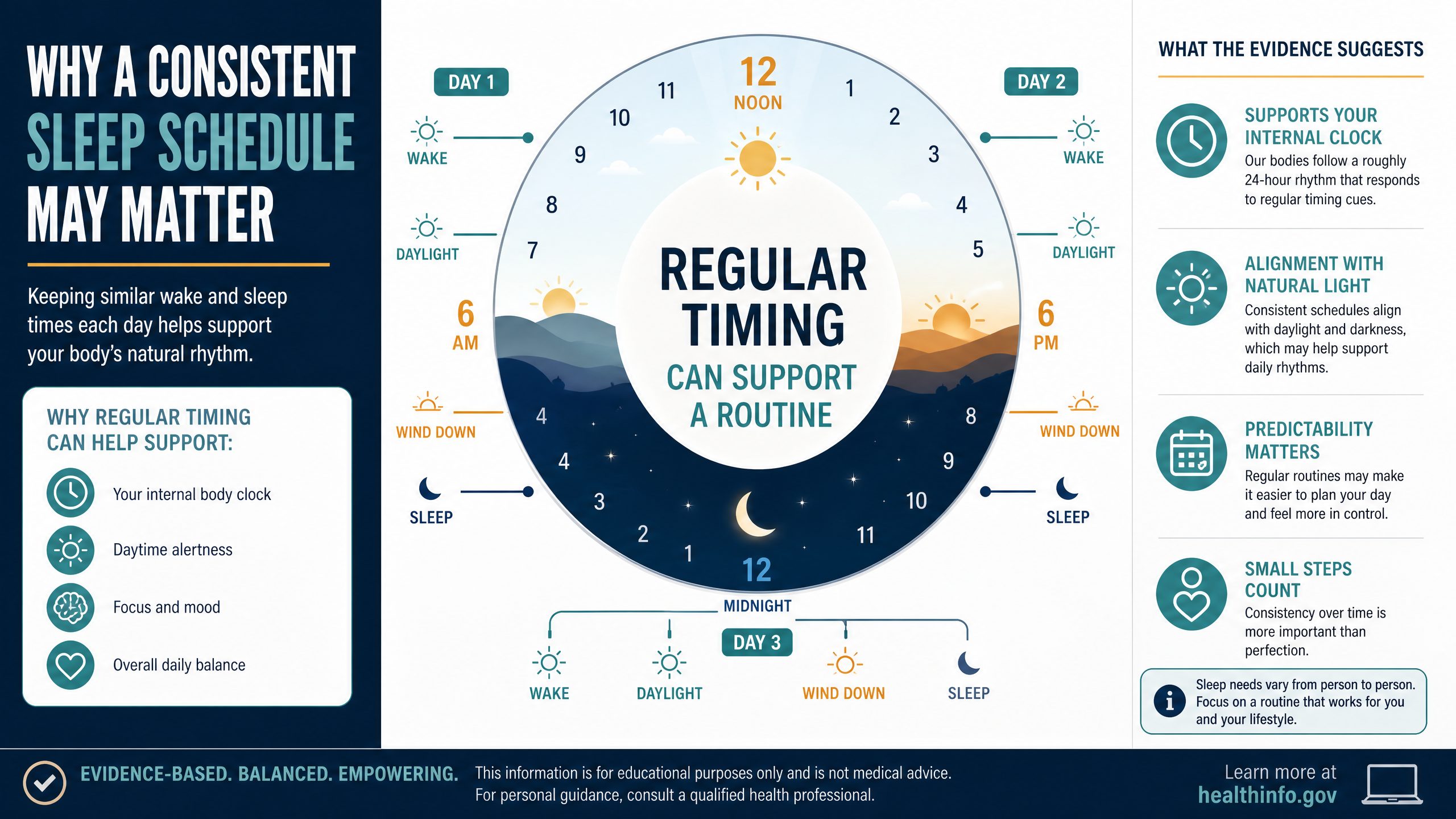
The body relies on a circadian clock — a roughly 24-hour internal timing system — to coordinate hormones, body temperature, digestion, and sleep propensity. Going to bed and waking at regular times keeps that clock synchronized with your daily routine, which tends to:
- Promote a predictable rise in sleep pressure and melatonin onset at night.
- Improve sleep consolidation (fewer awakenings) and efficiency (time asleep / time in bed).
- Reduce daytime sleepiness and variability in mood and cognition.
Many of these mechanistic ideas come from circadian biology and human sleep research; however, real-world benefits vary by person and circumstances.
Practical steps to build a consistent sleep schedule
1) Set a realistic anchor: start with wake time
Choosing a consistent wake time is often easier than fixing bedtime. Decide what time you need to wake for work, school, or family needs, and plan bedtime by counting backward to allow for the CDC’s recommended sleep duration for your age group (for most adults, 7–9 hours).[1]
Example: If you must wake at 6:30 a.m. and need ~8 hours, aim for lights out near 10:30 p.m.
2) Treat bedtime as a target zone, not a strict deadline
Aim to be in bed within a 15–30 minute window rather than demanding an exact minute. A “same bedtime every night” goal can become discouraging if it’s unattainable; a narrow window preserves consistency while allowing slight nightly variability.
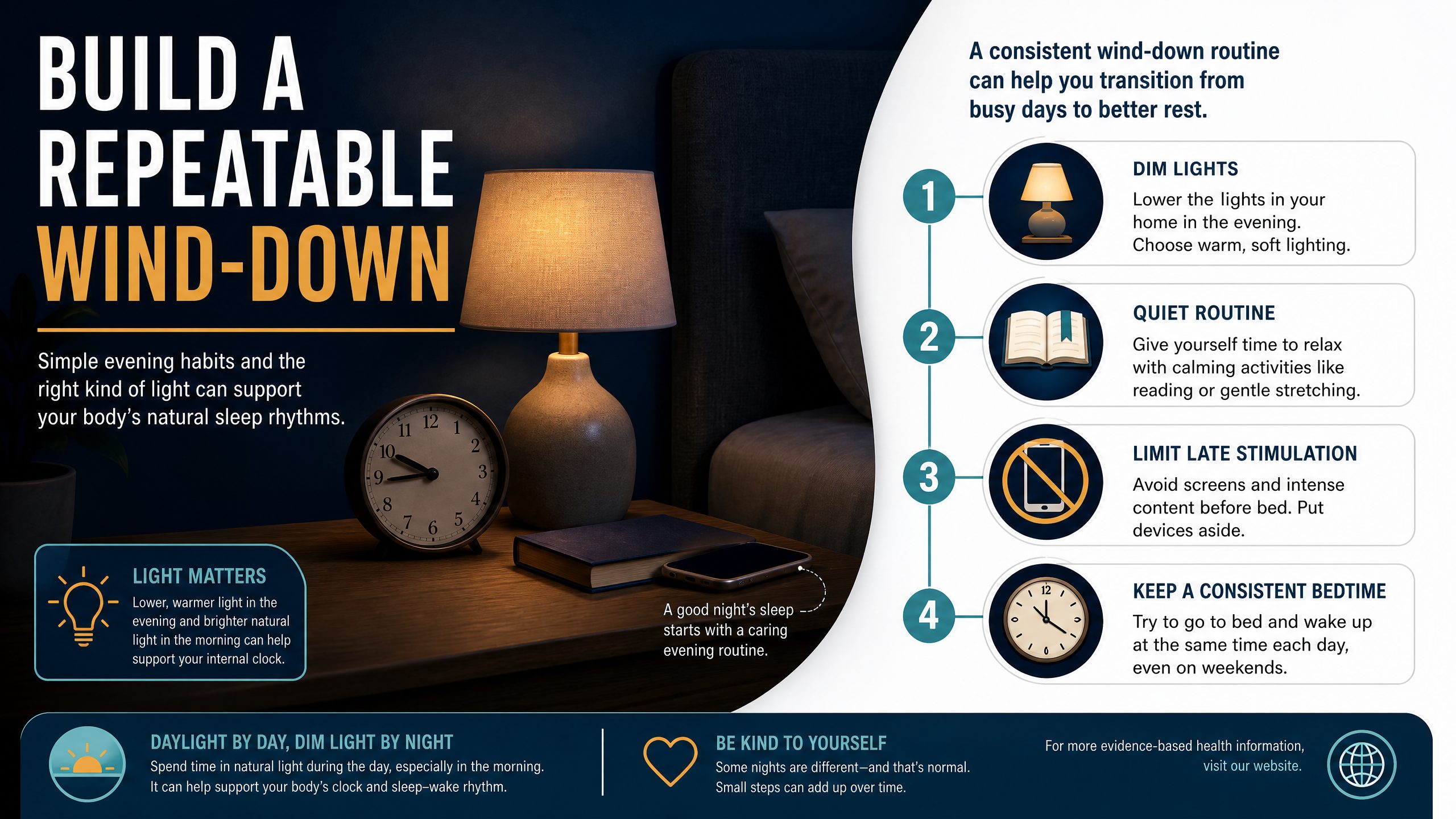
3) Use a short pre-sleep routine (20–45 minutes)
A predictable set of low-arousal activities before bed signals the brain that it’s time to sleep. Examples:
– Dim lights, turn off bright screens, and do low-intensity reading or gentle stretching.
– Keep caffeine and vigorous exercise earlier in the day; if you exercise at night, allow 1–2 hours before bed to wind down.
– Use the same sequence nightly (wash face, change into sleep clothes, 10 minutes breathing/relaxation).
4) Shift gradually when you need to change the schedule
If you need to move your bedtime earlier or later, adjust by 15–30 minutes every 2–3 nights. Rapid shifts often produce temporary insomnia or daytime grogginess.
5) Manage weekend variability
Allowing large differences on weekends — sleeping in several hours — creates “social jet lag,” which is associated with poorer sleep quality and metabolic markers in observational studies.[4] Keep weekend wake times within about an hour of weekday wake times when possible.
 light exposure” loading=”lazy”/>
6) Special situations: shift work, caregiving, and travel
- Shift workers: prioritize a fixed sleep window tied to your main sleep episode, use blackout curtains, and block daytime noise.
- New parents/caregivers: aim for regular “anchor” sleep episodes when possible and recover consistency gradually.
- Travel: plan light exposure and timing of sleep to align with the new time zone; day-based adjustments reduce circadian misalignment.
What a consistent sleep schedule can and can’t do
- Can: improve ease of falling asleep for many people, increase daytime alertness, and make sleep more predictable. The CDC recommends routine timing as part of good sleep hygiene.[1]
- May: be associated with better mood and metabolic outcomes in observational studies, but these are not definitive proof of cause-and-effect; lifestyle factors likely confound associations.[4][5]
- Won’t necessarily: fix sleep disorders such as obstructive sleep apnea, chronic insomnia, restless legs, or circadian rhythm disorders. Those conditions need specific diagnosis and treatment.
Comparison framework: choosing tools or approaches
When considering products or services to support a consistent sleep schedule (mattresses, pillows, sleep trackers, white-noise devices, or supplements), compare along these dimensions:
- Purpose: What problem are you solving (comfort, noise control, tracking, falling asleep)?
- Evidence: Is there peer-reviewed research or authoritative guidance supporting the product’s intended use?
- Safety: For supplements, check active ingredients, interactions, pregnancy/breastfeeding warnings, and third‑party testing; refer to FDA and NIH ODS guidance.[2][3]
- Usability and adherence: Is the product easy to use nightly? Will it support a routine rather than disrupt it?
- Cost and durability: One-time vs ongoing cost, return policies, and warranty.
- Data privacy: For trackers/apps, check data ownership and sharing policies.
Practical example comparisons:
– Sleep tracker vs. sleep diary: Trackers provide objective movement/heart-rate data but can misclassify wakefulness; a simple bedtime/wake log is low-cost and often sufficient when starting a schedule change.
– White-noise machine vs. phone app: Dedicated devices usually avoid blue-light exposure and interruptions; apps are cheaper but can introduce screen time before bed.
– Mattress/pillow: prioritize comfort and spinal alignment; choose trial periods to ensure consistent use supports sleep onset and maintenance.
How to compare products later
When you evaluate mattresses, trackers, apps, noise machines, or supplements later, look for clear labeling, independent testing, privacy policies (for apps), realistic claims, and return/trial policies. For supplements specifically, compare ingredient lists, doses, and third‑party verification. [Affiliate product comparison block—add verified iHerb links after approval]
Limitations and when to ask a clinician
- If you still take more than 30–45 minutes to fall asleep most nights or you wake repeatedly, consult a clinician or sleep specialist — these can be signs of insomnia or an underlying medical condition.
- Excessive daytime sleepiness despite consistent timing may indicate sleep apnea, narcolepsy, or medication effects; seek medical evaluation.
- Talk with a clinician before using sleep medications or supplements if you are pregnant, breastfeeding, a child, have liver/kidney disease, chronic conditions, or take prescription medications — the NIH ODS and FDA provide safety resources on supplements and interactions.[2][3]
- For shift workers or those with irregular schedules, a sleep medicine specialist or occupational health clinician can recommend tailored strategies or light-therapy approaches.
Bottom line
A consistent sleep schedule — aiming for the same bedtime or a narrow bedtime window and a steady wake time — is a low-cost, evidence-supported habit that helps synchronize your internal clock and often improves sleep onset and daytime alertness. It’s a practical first step for most people with sleep complaints, but it cannot resolve every sleep problem: persistent sleep problems, excessive daytime sleepiness, or suspected sleep disorders deserve clinical evaluation.
Editorial note
VitaEvidence Editorial Team. Last reviewed: August 2026. For general education, not personal medical advice. Read our Editorial Policy.
References
[1] Centers for Disease Control and Prevention. About Sleep. https://www.cdc.gov/sleep/about/index.html
[2] National Institutes of Health — Office of Dietary Supplements. Fact Sheets. https://ods.od.nih.gov/factsheets/list-all/
[3] U.S. Food & Drug Administration. Dietary Supplement Information. https://www.fda.gov/food/dietary-supplements
[4] Nutrients. Mini-review: Sleep, Nutrition and Supplementation. https://doi.org/10.3390/nu17111779
[5] Nutrients. Systematic review and meta-analysis: Dietary supplement interventions and sleep quality. https://doi.org/10.3390/nu17243952
[6] U.S. Department of Health & Human Services and U.S. Department of Agriculture. Dietary Guidelines for Americans 2020–2025. https://www.dietaryguidelines.gov/