In this guide
- What this guide covers
- Key points at a glance
- How exercise influences sleep and recovery
- Timing and type: what the evidence shows
- Activity timing comparison
- Practical examples and sample schedules
- Recovery schedule
- A comparison framework to choose timing for your goals
- Limitations and when to ask a clinician
- How to compare products later
- Bottom line
- Editorial note
- References
- Schedule comparison
- Related VitaEvidence reading
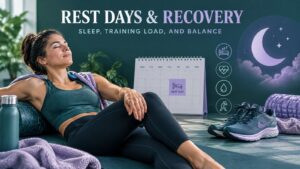
Regular physical activity can improve sleep quality and help the body recover, but when you exercise can change those effects for some people. This guide explains the biological links between movement and sleep, summarizes what the evidence says about timing, and gives practical schedules and decision tools to help you match workouts to recovery goals.
What this guide covers
- How exercise affects sleep and physiological recovery
- What research and public-health guidance say about timing (morning, afternoon, evening)
- Practical examples and sample schedules for different goals and chronotypes
- A comparison framework to choose workout timing and a label checklist for products
- Limitations and when to talk with a clinician
Key points at a glance
- Regular physical activity is associated with better sleep quality and shorter sleep latency in population studies, and it supports processes important for recovery such as hormonal release and tissue repair [1][3].
- Time of day can matter: morning or early-afternoon exercise often aligns with better sleep for many people, but evidence on late-evening workouts is mixed and appears to depend on intensity and individual sensitivity [1][3].
- For recovery-focused training (e.g., strength/hypertrophy, heavy intervals), prioritize consistent sleep opportunities and allow post-workout cooling down and relaxation routines; timing should support—not replace—sleep hygiene [2][3].
- For athletes or shift workers, tailoring exercise timing to chronotype and competition schedule can improve performance and sleep — consult sports-medicine or primary-care clinicians when planning high-volume training [3][7].
How exercise influences sleep and recovery
– Exercise raises body temperature, activates the sympathetic nervous system (increased heart rate and adrenaline), and triggers inflammatory and repair processes that later support adaptation. A decline in core temperature and a shift toward parasympathetic dominance favor sleep onset; the interval between exercise and bedtime influences how these processes interact. For population-level benefits of activity on sleep, see CDC guidance [1].
– Deep sleep (slow-wave sleep) and REM sleep play different roles in physical and cognitive recovery: growth hormone release and tissue repair tend to occur during slow-wave sleep, while sleep consolidation supports motor learning and memory. Regular activity helps preserve sleep architecture that supports these recovery processes [3].
Timing and type: what the evidence shows
Activity timing comparison
| Timing | What to monitor |
|---|---|
| Earlier activity | Energy, sleep onset, and recovery. |
| Later activity | Intensity, alertness, and wind-down time. |
| Any timing | Consistency and individual response. |
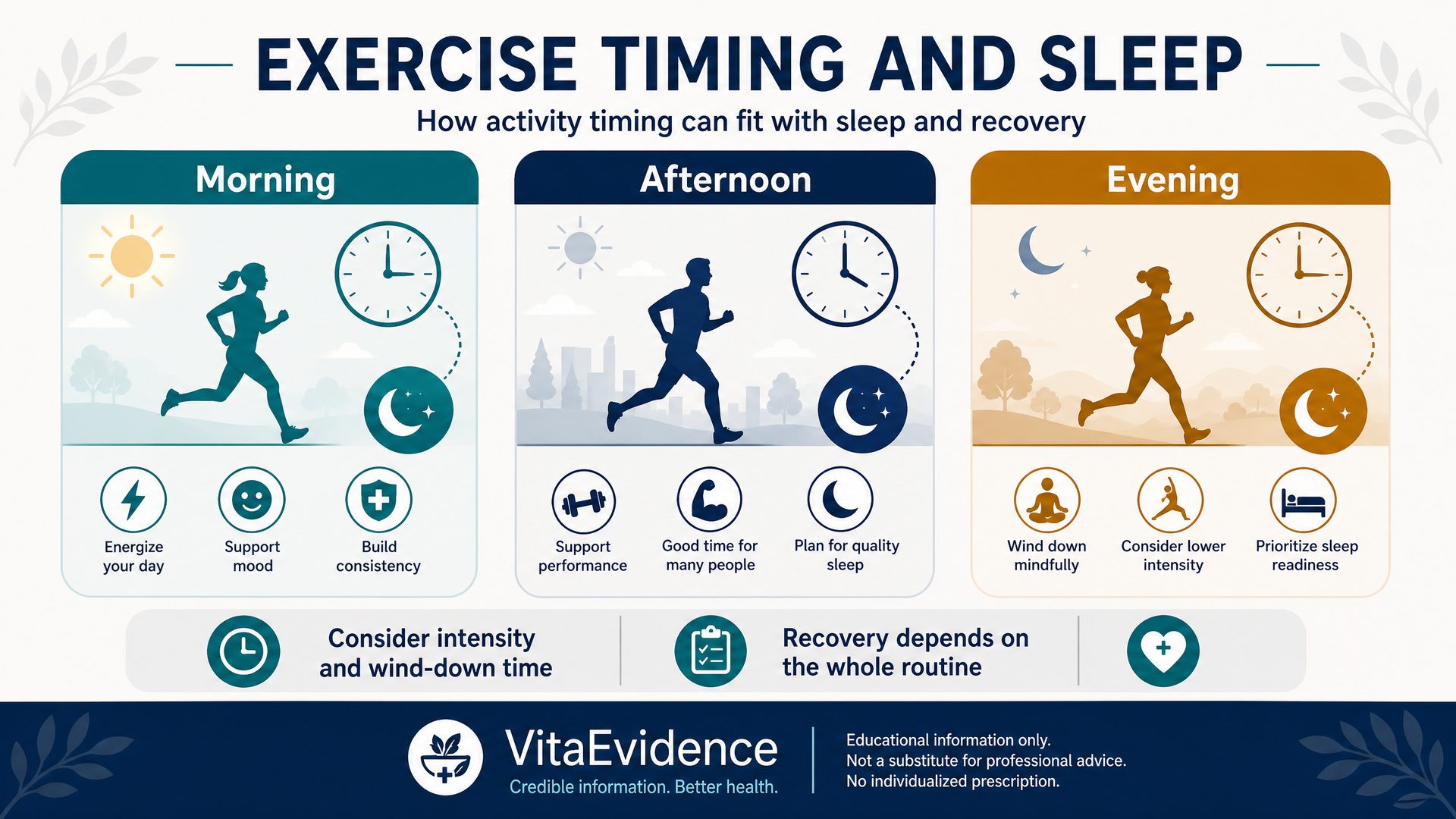
Morning exercise
– Benefits: Morning workouts can strengthen circadian alignment — for many people this advances sleep timing and may improve sleep quality over time. Morning exercise is practical for consistency and may reduce late-day caffeine use that can impair sleep [1][2].
– Best for: people with earlier chronotypes, those seeking consistent training adherence, and individuals aiming to consolidate daytime activity to support nighttime sleep.
Afternoon exercise
– Benefits: Late-afternoon sessions often coincide with optimal muscle strength, flexibility, and body temperature for performance. For some people this timing also supports nighttime sleep, particularly when workouts are finished with time to cool down and relax [3].
– Best for: strength training or high-skill practice where peak performance is wanted, and those who find morning workouts impractical.
Evening workouts
– Evidence overview: Studies show mixed results. Moderate evening exercise does not universally disrupt sleep, but vigorous activity close to bedtime may delay sleep onset or reduce perceived sleep quality in susceptible individuals. The effect size and variability differ across studies and populations; elite athletes and very high-intensity sessions may be more likely to impact sleep if recovery windows are insufficient [1][3][7].
– Practical take: If you prefer evening training, include at least a wind‑down period (cool-down, low lighting, relaxation) and monitor how your sleep responds. Adjust timing or intensity if you notice delayed sleep or unrestorative sleep.
Type and intensity matters
– Aerobic vs resistance: Both can benefit sleep when done regularly. Resistance training may be less likely to raise core temperature for prolonged periods than high-intensity intervals, and some people find weight training closer to bedtime doesn’t disturb sleep as much as very vigorous cardio. Individual responses vary [3].
– Duration and intensity: Longer or very intense sessions late at night are more likely to interfere with sleep in sensitive individuals. Moderate-intensity exercise earlier in the day is the most consistently beneficial pattern in public-health guidance [1][2].
Practical examples and sample schedules
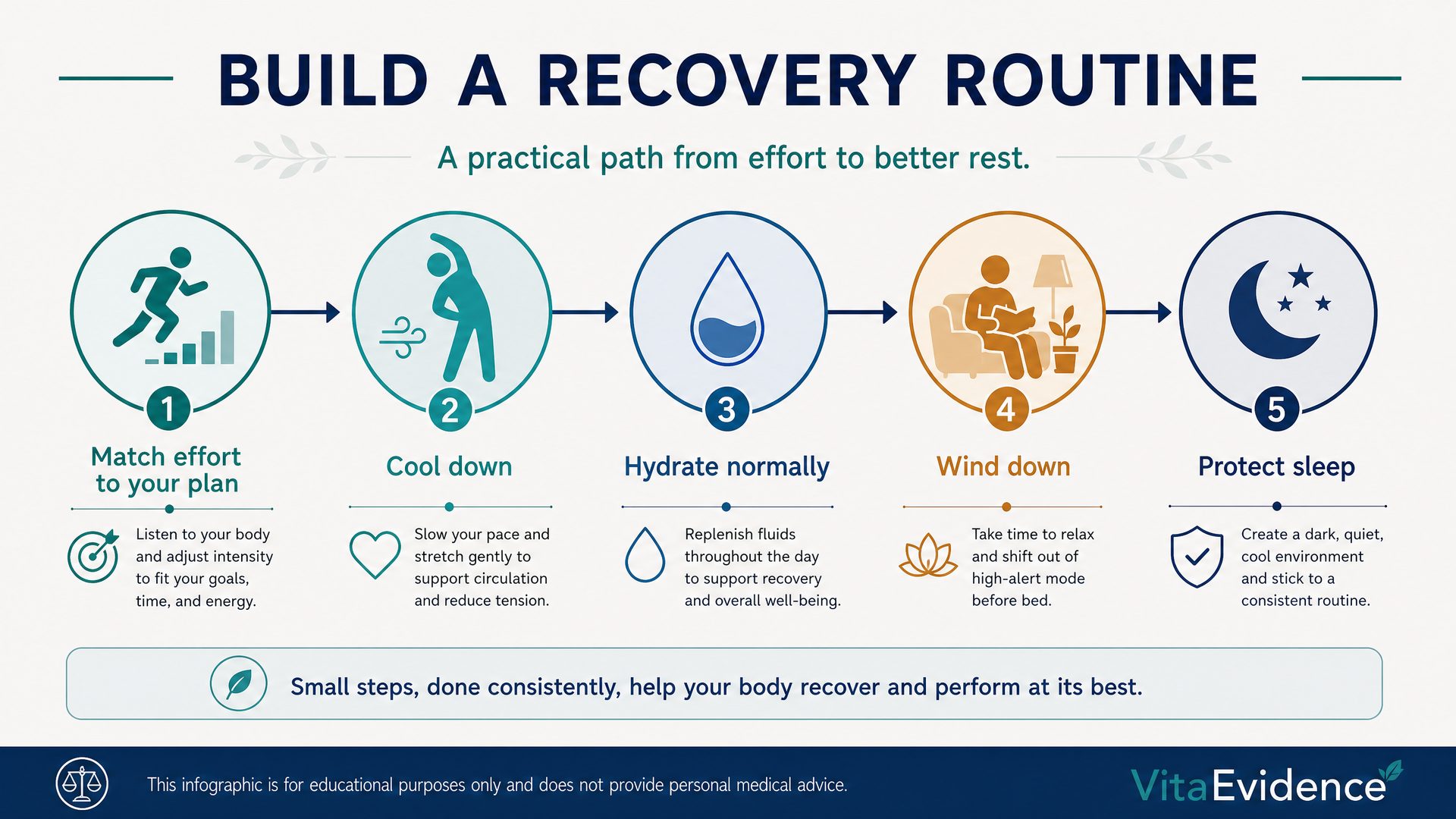
Recovery schedule
- Choose a realistic activity time.
- Match intensity to the day and goal.
- Allow time to wind down if needed.
- Track sleep and recovery patterns rather than assuming one schedule fits everyone.
Example A — General health and better sleep
– Goal: Improve sleep onset and nightly rest with sustainable activity.
– Plan: 30–45 minutes brisk walk, bike, or mixed cardio + mobility in the morning or early afternoon (e.g., 7:00–9:00 AM or 4:00–6:00 PM). Keep evenings low-key—gentle stretching or short yoga if desired. Follow CDC activity targets: aim for 150–300 minutes moderate-intensity per week [2].
Example B — Strength and hypertrophy with recovery priority
– Goal: Maximize muscle adaptation while protecting nightly sleep.
– Plan: Schedule resistance training in the afternoon when strength peaks (e.g., 3:00–6:00 PM). End sessions at least 1–2 hours before intense social or screen exposure; use a quiet cool-down and prioritize a consistent bedtime window. Allow 48 hours between heavy sessions for the same muscle groups [3].
Example C — Evening-only exerciser or shift worker
– Goal: Fit workouts into an evening routine without wrecking sleep.
– Plan: If training late, opt for moderate intensity and include a 30–60 minute low-activity wind-down (cool shower, dim lights, relaxation breathing). Track sleep for several weeks to see if timing needs earlier shifting; consider short naps strategically for shift recovery but avoid long naps close to main sleep.
Monitoring and adaptation
– Use simple metrics: time to fall asleep, number of awakenings, perceived sleep quality, daytime energy and performance. Adjust intensity or move the session earlier if you notice consistent negative changes.
A comparison framework to choose timing for your goals
Compare these attributes when deciding when to exercise:
– Goal alignment: Is the priority general health, performance, or recovery?
– Chronotype: Are you a morning lark, evening owl, or in between? People often perform better and sleep better when workouts fit their circadian preference.
– Session intensity and duration: Higher intensity and longer duration favor earlier timing for sensitive sleepers.
– Recovery needs: High-volume training cycles require predictable, high-quality sleep windows — schedule harder sessions when you can reliably sleep afterward.
– Practical constraints: Work schedule, family responsibilities, and daylight can determine feasibility.
– Objective feedback: Use a sleep journal or wearable metrics over 2–4 weeks to assess effects.
Limitations and when to ask a clinician
What’s uncertain
– Individual variability is large: population studies show trends, but your personal response may differ. The literature includes mixed findings on late-evening exercise and sleep latency; decisions should be individualized [1][3].
– Supplements and other interventions: Evidence for dietary supplements to improve sleep is mixed; lifestyle strategies (consistent exercise timing, sleep hygiene, diet) are first-line [5][6][7].
When to see a clinician
– If you have chronic insomnia, excessive daytime sleepiness, or new sleep problems that persist despite lifestyle adjustments.
– If you are pregnant, breastfeeding, a child/adolescent, have cardiovascular disease, uncontrolled hypertension, significant chronic illness, or take medications that affect heart rate/sleep — get clinical advice before starting or intensifying an exercise program.
– If you are an elite athlete planning high-volume or high-intensity training cycles and need tailored recovery programming: consult sports-medicine providers or a registered exercise physiologist [3][7].
How to compare products later
When you do evaluate training-related products (e.g., recovery aids, sleep-targeted supplements, or wearable trackers), compare these label and product attributes:
– Ingredient list and amounts per serving (are doses transparent?)
– Third-party testing or certification (e.g., USP, NSF) and access to a Certificate of Analysis.
– Serving size, directions, warnings, and contraindications.
– Allergen statements, expiration date, and batch number.
– Evidence summary and clinical references when claims are medical or performance-related.
– Price per useful serving and return/refund policy.
[Affiliate product comparison block—add verified iHerb links after approval]
Note: For dietary supplements, review FDA guidance on safety and regulation before purchase and consult a clinician for interactions with medications or medical conditions [4].
Bottom line
Regular exercise supports sleep and is a cornerstone of recovery, but timing matters for some people. Morning and late-afternoon workouts generally pose the fewest sleep-disrupting risks, while very vigorous sessions shortly before bedtime may lengthen sleep onset for susceptible individuals. Use your goals, chronotype, and objective sleep feedback to choose timing, prioritize consistent sleep opportunity, and consult a clinician when training load or health conditions complicate planning.
Editorial note
VitaEvidence Editorial Team. Last reviewed: August 2026. For general education, not personal medical advice. Read our Editorial Policy.
References
[1] Centers for Disease Control and Prevention. Sleep and Sleep Disorders. https://www.cdc.gov/sleep/about/index.html
[2] Centers for Disease Control and Prevention. Physical Activity Basics. https://www.cdc.gov/physical-activity/about/index.html
[3] NIH Office of Dietary Supplements. Exercise and Athletic Performance — Health Professional Fact Sheet. https://ods.od.nih.gov/factsheets/ExerciseAndAthleticPerformance-HealthProfessional/
[4] U.S. Food & Drug Administration. Dietary Supplements. https://www.fda.gov/food/dietary-supplements
[5] Nutrients. Mini‑review: Sleep, Nutrition and Supplementation. https://doi.org/10.3390/nu17111779
[6] Nutrients. Systematic Review and Meta‑analysis: Dietary Supplement Interventions and Sleep Quality. https://doi.org/10.3390/nu17243952
[7] Frontiers in Nutrition. Systematic Review: Supplements and Elite‑Athlete Performance. https://doi.org/10.3389/fnut.2025.1675654