In this guide
- What this guide covers
- Key points at a glance
- What folate and folic acid are (and why it matters)
- Why bioavailability and DFEs matter
- Who commonly needs more folate or folic acid
- Life-stage questions
- People who can become pregnant or who are pregnant
- People with higher physiologic needs or absorption issues
- Food sources and “folic acid foods”
- Supplements: forms, dosing, and safety
- Label-check sequence
- How to compare products (practical comparison framework)
- Limitations and when to ask a clinician
- How to compare products later
- Bottom line
- Editorial note
- References
- Food sources and clinician questions
- Related VitaEvidence reading
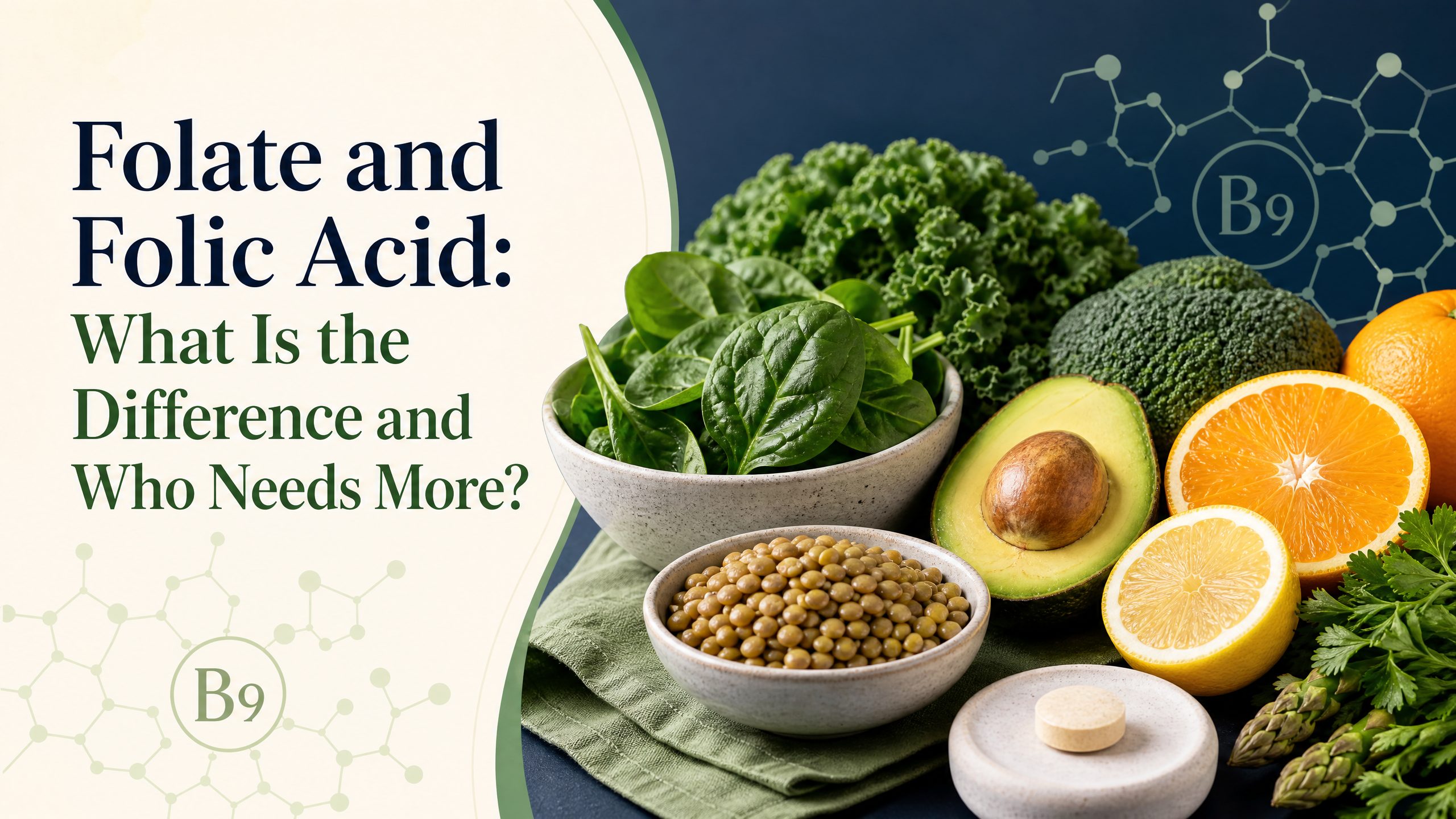
Folate and folic acid are related but not identical: folate is the family of B9 compounds that occur naturally in food, while folic acid is the stable synthetic form used in fortified foods and most supplements. This guide explains how they differ, who may need extra folate or folic acid, and how to compare product labels when you’re deciding whether to use a supplement.
What this guide covers
- The chemical and practical differences between food folate, folic acid, and methylfolate.
- Who needs more folate (including pregnancy guidance) and why.
- Food examples, intake targets (authoritative recommendations), and safety limits.
- A simple framework to compare supplements and when to consult a clinician.
Key points at a glance
- Folate = naturally occurring B9 in foods; folic acid = synthetic form used in fortified foods and many supplements [1].
- U.S. recommended amounts (RDA) differ by life stage: adults 19+ = 400 mcg dietary folate equivalents (DFE); pregnancy = 600 mcg DFE; breastfeeding = 500 mcg DFE [1].
- The CDC advises people who can become pregnant to take 400 mcg folic acid daily in addition to food sources to lower the risk of neural tube defects [2].
- Folic acid from fortified foods or supplements is more bioavailable than food folate; conversion uses Dietary Folate Equivalents (DFE) [1].
- Don’t exceed 1,000 mcg (1 mg) folic acid per day from fortified foods and supplements combined without clinician advice (upper limit to avoid masking B12 deficiency) [1].
What folate and folic acid are (and why it matters)
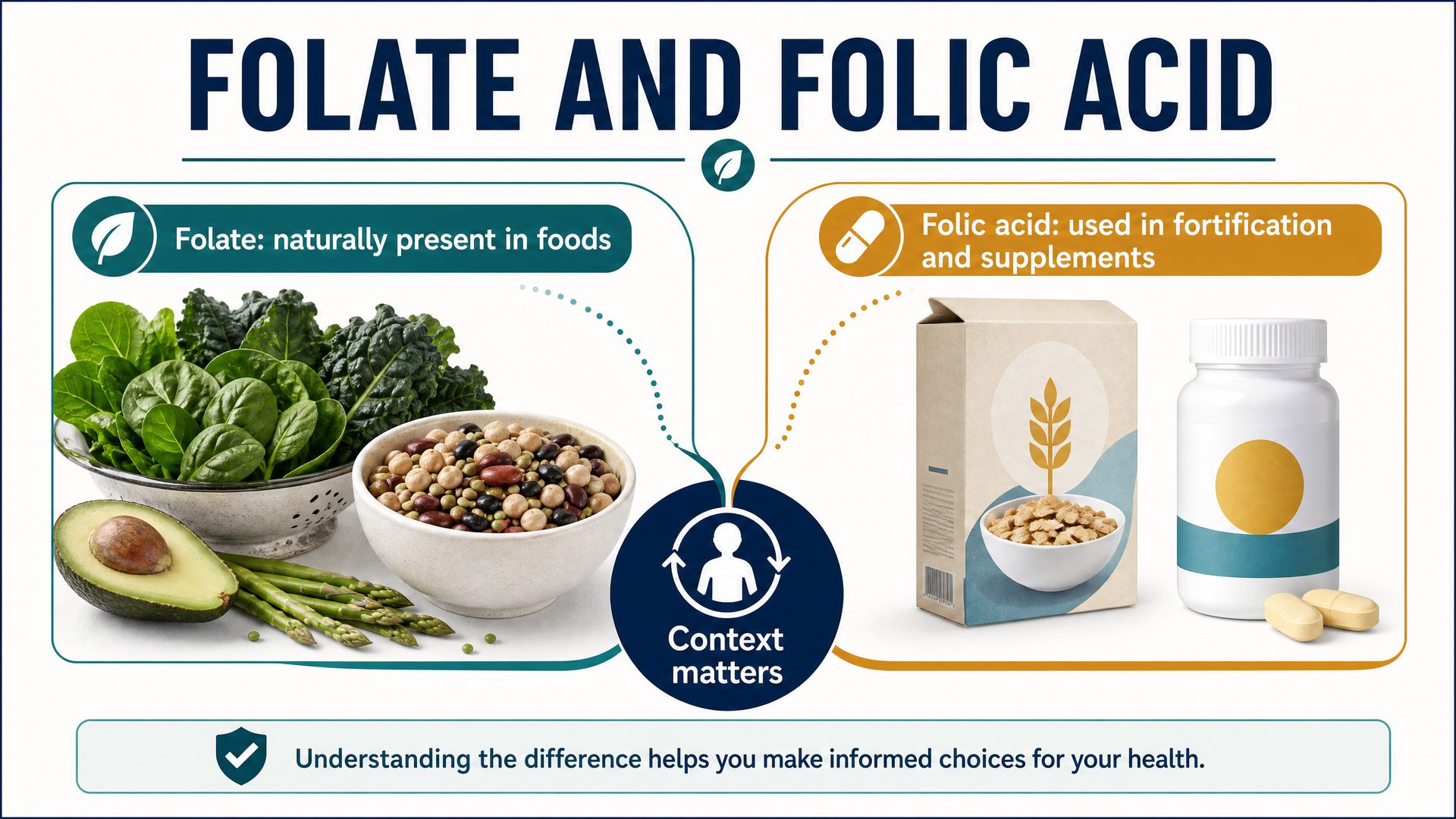
- Natural folates: A group of reduced, polyglutamated B9 compounds found in green leafy vegetables, legumes, citrus, and organ meats. These are relatively fragile and can be lost during cooking.
- Folic acid: A synthetic, oxidized form added to enriched grains and many supplements because it’s stable and absorbs efficiently.
- Active forms: Some supplements provide 5‑methyltetrahydrofolate (5‑MTHF or methylfolate), the biologically active form the body can use directly. Methylfolate is an alternative form found in some products, but routine switching is not necessary for most people; the appropriate form depends on the clinical context.
Why bioavailability and DFEs matter
– Because folic acid and food folate are absorbed differently, experts use Dietary Folate Equivalents (DFE) to compare intake. Per NIH: 1 mcg DFE = 1 mcg food folate = 0.6 mcg folic acid from fortified food or a supplement taken with food (0.5 mcg if taken on an empty stomach) [1]. Use DFE when comparing dietary intake to RDAs.
Who commonly needs more folate or folic acid
Life-stage questions
| Topic | Question to discuss |
|---|---|
| Diet pattern | Which foods regularly contribute folate? |
| Life stage | Does pregnancy planning or another stage change guidance? |
| Supplement choice | Which form and amount fit the person’s needs? |
People who can become pregnant or who are pregnant
– Recommendation: The CDC advises daily intake of 400 mcg folic acid for all people who can become pregnant, starting before conception and continuing through early pregnancy, to reduce risk of neural tube defects. The RDA during pregnancy is 600 mcg DFE [2][1]. Many prenatal vitamins provide 400–800 mcg folic acid; discuss an appropriate prenatal supplement with your clinician.
People with higher physiologic needs or absorption issues
– Higher needs or increased loss include people with certain malabsorptive conditions (e.g., celiac disease), those who’ve had bariatric surgery, chronic heavy alcohol use, or some kidney/liver disorders. Some anticonvulsant and other medications can reduce folate levels; check with a clinician or pharmacist [1].
H3: Older adults and people with certain medical conditions
– Folate deficiency causes megaloblastic anemia and can raise homocysteine; however, excessive folic acid intake can mask vitamin B12 deficiency. Older adults should have B12 status checked if there are anemia or neurologic concerns before taking high-dose folic acid [1].
Food sources and “folic acid foods”
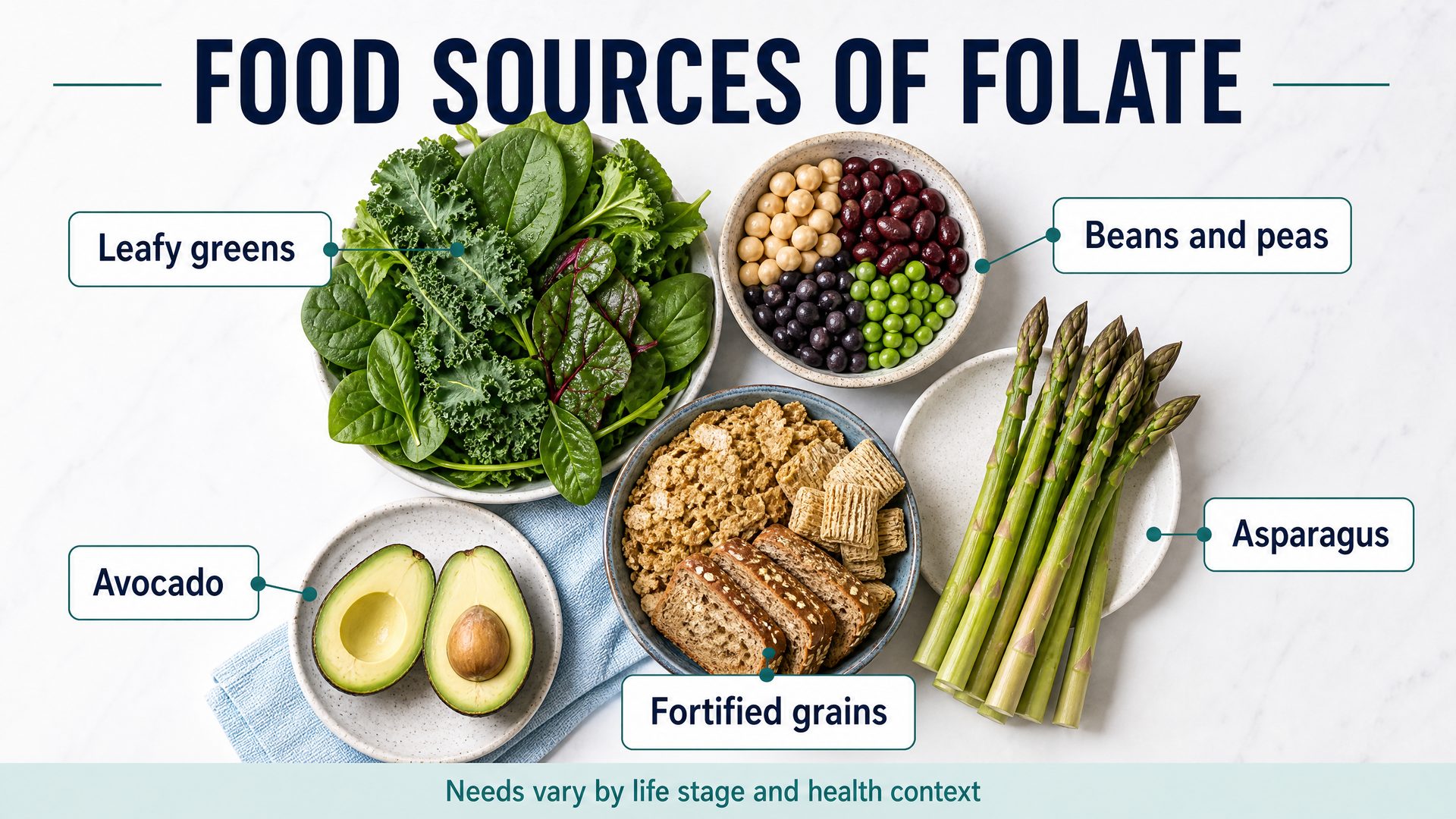
- Natural folate-rich foods (examples): cooked spinach, lentils and beans, asparagus, broccoli, oranges, and liver. Emphasize a variety of vegetables, legumes, and fortified grain products as part of a balanced diet per USDA MyPlate and Dietary Guidelines [4][5].
- Folic-acid–fortified foods (examples): enriched breakfast cereals, enriched bread, pasta, and rice. Fortification was implemented in the U.S. to reduce neural tube defects; these foods are significant contributors to total folic acid intake [1].
Practical example: If you eat a bowl of fortified cereal that lists 200 mcg folic acid per serving (as folic acid) and also have a serving of spinach providing 100 mcg food folate, your combined intake isn’t a simple additive—convert the folic acid to DFEs (200 mcg folic acid × 1.7 ≈ 340 mcg DFE) then add the 100 mcg food folate to estimate DFE intake.
Supplements: forms, dosing, and safety
Label-check sequence
- Read the form and amount.
- Check serving information.
- Look for overlapping products.
- Ask a clinician when individual guidance is needed.
H3: Common supplement forms
– Folic acid (most common): inexpensive and well absorbed.
– L‑methylfolate (5‑MTHF): active form used in some supplements and prescription products; may be chosen for specific clinical reasons.
– Multivitamins and prenatal formulas often list folic acid in micrograms (mcg) — compare against DFE and RDA.
H3: Dosage guidance and safety
– RDA (19+): 400 mcg DFE; pregnancy: 600 mcg DFE; breastfeeding: 500 mcg DFE [1].
– CDC recommendation: 400 mcg folic acid daily for people who can become pregnant, in addition to food sources [2].
– Upper limit: 1,000 mcg folic acid/day from fortified foods and supplements combined for adults; exceeding the UL risks masking B12 deficiency and other concerns [1]. Always check total intake across diet plus any supplements.
H3: When a clinician may recommend a higher dose
– Some clinicians prescribe higher folic acid doses for specific medical reasons (e.g., prior pregnancy with neural tube defect, certain antiepileptic therapy interactions). Do not self-prescribe high-dose folic acid—talk to your clinician.
How to compare products (practical comparison framework)
When you’re evaluating a folate or folic acid supplement, compare these label attributes:
– Active form listed (folic acid vs L‑methylfolate/5‑MTHF).
– Amount per serving (mcg) and whether the label shows DFEs. Convert folic acid to DFE using the 1.7 multiplier if needed [1].
– Whether the product is targeted for pregnancy (prenatal) and includes other key nutrients such as iron and vitamin B12.
– Serving size (some products list multiple tablets per dose).
– Third‑party testing or quality seals and an expiration date.
– Ingredient list for allergens or excipients if you have sensitivities.
– Total daily folic acid from all sources (fortified foods + supplements) to avoid exceeding the 1,000 mcg UL.
[Affiliate product comparison block—add verified iHerb links after approval]
Limitations and when to ask a clinician
- Ask a clinician before starting or changing folate/folic acid supplements if you are pregnant, planning pregnancy, breastfeeding, a child, have kidney or liver disease, have a history of B12 deficiency or neurologic symptoms, have malabsorption or an eating disorder, or take prescription medicines (especially antiepileptics, immunosuppressants, or methotrexate).
- Don’t use supplements to “treat” diagnosed deficiency without clinician supervision—blood tests (folate, RBC folate, B12, complete blood count) guide therapy and dosing.
- If you have genetic test results (e.g., MTHFR variants), discuss them with a clinician; routine testing and automatic switching to methylfolate isn’t universally recommended.
How to compare products later
When you revisit product options, look for:
– Form (folic acid vs 5‑MTHF) and exact mcg per serving.
– Whether the label lists DFEs or whether you need to convert.
– Total daily amount when combined with fortified foods.
– Presence of supporting nutrients (B12, iron) if relevant to your needs.
– Third‑party quality testing, expiration date, and clear dosing instructions.
– Price per serving and number of doses per bottle for cost comparison.
– Storage instructions and allergen statements.
[Affiliate product comparison block—add verified iHerb links after approval]
Bottom line
Folate (natural food forms) and folic acid (synthetic form) are both important sources of vitamin B9 but differ in stability and absorption. Most healthy adults can meet needs through a mix of folate-rich foods and fortified foods; people who can become pregnant should take 400 mcg folic acid daily in addition to dietary sources to reduce neural tube defect risk, and pregnant people need a higher total intake (600 mcg DFE). Choose supplements by checking the form, dose (mcg and DFEs), and total daily intake, and consult a clinician for pregnancy, medical conditions, or when higher doses may be needed.
Editorial note
VitaEvidence Editorial Team. Last reviewed: August 2026. For general education, not personal medical advice. Read our Editorial Policy.
References
[1] NIH Office of Dietary Supplements. Folate. https://ods.od.nih.gov/factsheets/Folate-Consumer/
[2] Centers for Disease Control and Prevention. Folic Acid. https://www.cdc.gov/ncbddd/folicacid/index.html
[3] U.S. Food and Drug Administration. Dietary Supplements. https://www.fda.gov/food/dietary-supplements
[4] USDA MyPlate. https://www.myplate.gov/
[5] U.S. Department of Health and Human Services and U.S. Department of Agriculture. Dietary Guidelines for Americans, 2020–2025. https://www.dietaryguidelines.gov/