
In this guide
- What this guide covers
- Key points at a glance
- Hydration Decision Map
- When water is usually enough
- When electrolytes and carbohydrate may help
- Sports drinks vs water: a simple comparison framework
- Electrolyte supplements: forms and when to consider them
- Practical how-to: a quick decision flow
- Limitations and when to ask a clinician
- How to compare products later
- Bottom line
- Editorial note
- References
- Related VitaEvidence reading
Staying hydrated supports performance, recovery, and safety during physical activity — but “hydration” doesn’t always mean the same thing for a 30-minute walk as it does for a 3-hour training run in hot weather. This guide explains when plain water usually suffices, when electrolyte-containing fluids or supplements can help, and how to choose and compare options safely.
What this guide covers
- Evidence-based situations where water alone is typically adequate.
- Scenarios when you may benefit from electrolyte-containing drinks or supplements.
- Practical examples, a product-comparison framework, and safety limits including when to ask a clinician.
Key points at a glance
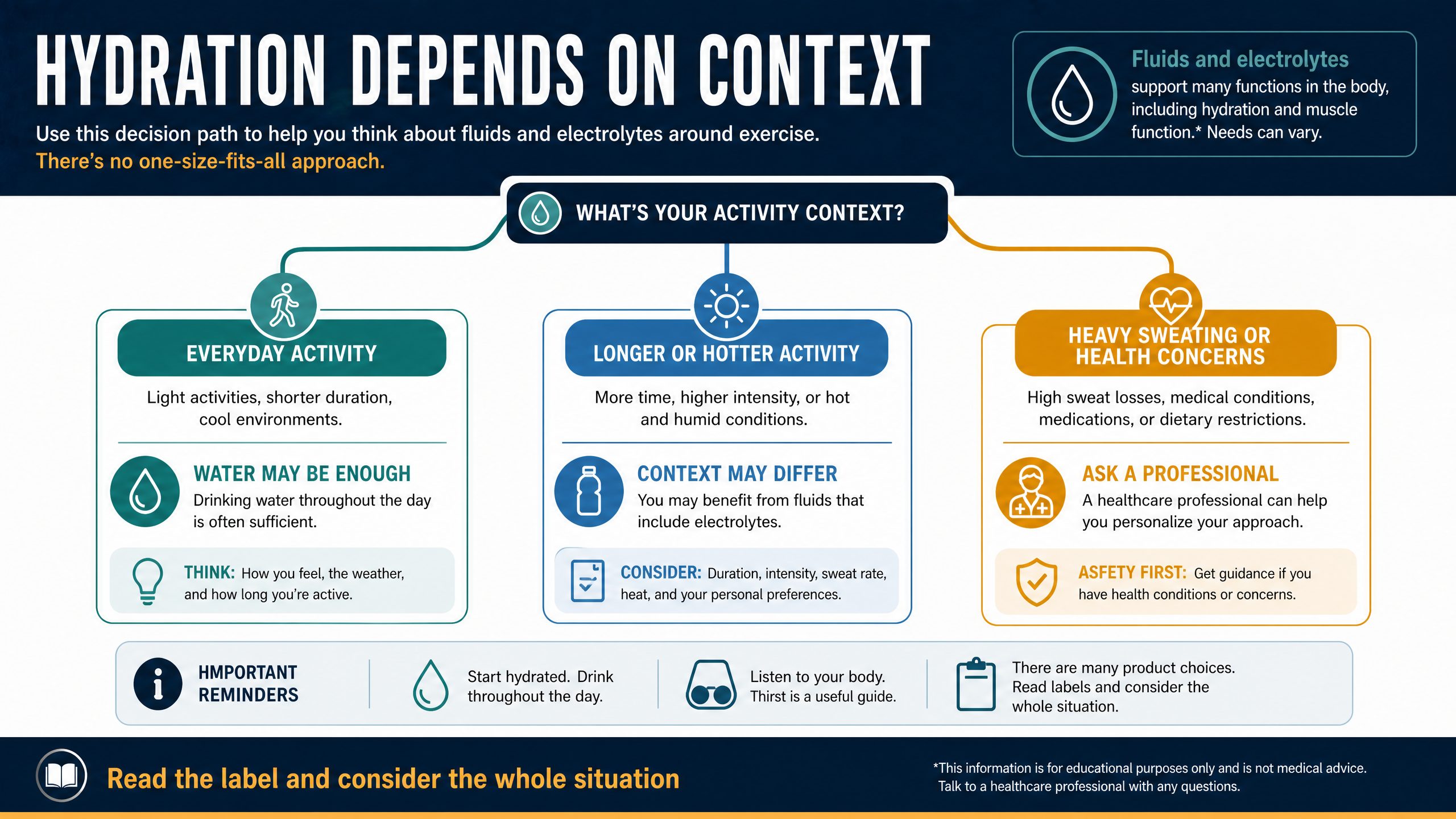
Hydration Decision Map
- For most healthy people doing moderate exercise under an hour, plain water generally meets hydration needs. [1]
- For prolonged, intense exercise (especially in heat) or repeated long sessions, fluids with electrolytes and carbohydrate can help performance and reduce recovery time. [1][5]
- “Sports drinks” provide fluid, sodium, and carbs but also add calories and sugar; choose based on goals and total daily intake. [1][4]
- People with medical conditions (kidney disease, heart disease), taking certain medications, pregnant or breastfeeding, or children require clinician guidance before using supplements. [2][3]
When water is usually enough
- Short-duration, moderate-intensity workouts (walking, light jogging, casual cycling) lasting less than ~60 minutes in temperate conditions typically require only water to replace fluid losses and maintain performance. Plain water replaces volume and is widely accessible. [1][4]
- If you consume a balanced diet (including sodium and potassium from food), routine training sessions often don’t create a net loss that requires targeted electrolyte replacement.
Practical example
– A 40-minute after-work bike ride at comfortable pace in spring: bring a bottle of water and drink by thirst or at short intervals. No sports drink needed.
When electrolytes and carbohydrate may help
Situations where electrolyte-containing fluids or products can be useful:
– Prolonged activity (>60–90 minutes) at moderate to high intensity — endurance runs, long-distance cycling, team sports tournaments with multiple matches. Electrolyte-containing drinks supply sodium to help maintain fluid balance and carbohydrates to sustain blood glucose. [1][5]
– Exercise in hot, humid environments that increase sweat losses, or events with limited access to food and fluids.
– Back-to-back training sessions on the same day where rapid recovery is a priority.
– Individuals with very high sweat rates or high-sodium sweat (some people lose more sodium in sweat than others) may need targeted sodium replacement to avoid hyponatremia or performance decline. [1]
Practical examples
– Marathon training in summer: use a sports drink during runs >90 minutes, and consider an electrolyte product for post-session recovery.
– Tournament soccer with matches every few hours: use fluids with sodium and small amounts of carbs between games.
Evidence and limits
– Sports drinks can improve performance by providing carbohydrate and sodium, but benefits depend on exercise duration and intensity. For many short events they offer little advantage over water. [1][5]
– Evidence linking electrolyte supplements to prevention of muscle cramps is mixed; cramps have multiple causes and electrolytes cannot be relied on as prevention. Be cautious of claims that electrolytes will reliably stop cramps. [5]
Sports drinks vs water: a simple comparison framework
- Hydration function: both supply fluid; sports drinks add sodium and potassium. [1]
- Energy: sports drinks provide carbohydrate (often 4–8% solution), useful for long-duration activities; water provides none. [1]
- Calories and sugar: sports drinks add calories and sugars—consider daily total intake and weight goals. Follow Dietary Guidelines to limit added sugars. [4]
- Practicality and cost: water is cheap and widely available; sports drinks are handy during events where food access is limited.
- Label differences: look at sodium (mg), potassium (mg), carbohydrate per serving (g), and serving size. See the “How to compare products later” section for label attributes to check. [2]
Electrolyte supplements: forms and when to consider them
Forms
– Effervescent tablets, powder sachets, gels, chews, or capsules deliver mostly sodium, sometimes potassium, magnesium, or calcium.
– Some combine sodium with carbohydrates and flavoring; others aim for minimal calories.
When they may be useful
– When you want compact, customizable sodium dosing during long training or travel.
– For athletes minimizing liquid volume (e.g., long runs where carrying multiple bottles is impractical).
– When you prefer to avoid the sugars in many commercial sports drinks.
Safety and uncertainties
– Electrolyte “overdose” is possible if used incorrectly — excess sodium or potassium can be harmful, especially with kidney disease or when combined with certain medications (ACE inhibitors, potassium-sparing diuretics). Always check with a clinician if you have chronic conditions or take regular medications. [2][3]
– Supplements are regulated as dietary supplements; the FDA does not approve them for safety or efficacy before marketing. Look for transparent labeling and third-party testing when possible. [2]
Practical how-to: a quick decision flow
- Estimate duration and intensity: <60 min moderate → water. >60–90 min intense or heat exposure → consider sports drink/electrolyte product. [1]
- Check context: hot/humid, repeated sessions, limited food access → favor electrolyte-containing fluids.
- Personal factors: high sweat volume, history of exercise-associated hyponatremia, or cramping that fluctuates with training — consider targeted sodium strategies and clinician input. [1][5]
- Review product labels (see next section) and choose lower-sugar options for frequent use if weight or blood sugar are concerns. [4][2]
Limitations and when to ask a clinician
- Children, pregnant or breastfeeding people, older adults, and people with kidney, liver, or heart disease need individualized guidance about fluids and electrolytes. Electrolyte supplements can be contraindicated or require dose adjustment. [2][3]
- If you have unexplained lightheadedness, fainting, persistent muscle cramps, swelling, dramatic weight change, or suspect hyponatremia or dehydration, seek medical care.
- If you take prescription medicines (diuretics, ACE inhibitors, ARBs, potassium-sparing drugs), ask a clinician before starting electrolyte supplements because of interactions and risk of abnormal blood levels. [2]
How to compare products later
When you compare sports drinks, electrolyte powders, or tablets, look at these label attributes:
– Electrolyte content per serving (mg sodium, mg potassium; magnesium or calcium if present). Evaluate based on your exercise needs and clinician advice. [1]
– Carbohydrate and sugar per serving (g) and the serving size — note concentrated products may require dilution. [4]
– Ingredients list for caffeine, artificial sweeteners, or additives you may want to avoid.
– Serving recommendations and how many servings per container.
– Third-party testing seals or Certificates of Analysis, manufacturing date/lot number, and clear contact information for the manufacturer. [2]
– Allergen statements and whether the product is appropriate for children or pregnancy (if relevant).
[Affiliate product comparison block—add verified iHerb links after approval]
Bottom line
For most healthy people doing routine, moderate exercise under an hour, plain water is sufficient. Electrolyte-containing drinks or supplements can help during prolonged, intense, or heat-exposed exercise and when rapid recovery between sessions matters, but they add calories and may be unnecessary for casual activity. People with medical conditions, on certain medications, or caring for children should consult a clinician before regular use of electrolyte supplements. When you choose a product, compare electrolyte and carbohydrate content, serving sizes, and third-party testing rather than marketing claims.
Editorial note
VitaEvidence Editorial Team. Last reviewed: August 2026. For general education, not personal medical advice. Read our Editorial Policy.
References
[1] NIH Office of Dietary Supplements. Exercise and Athletic Performance. https://ods.od.nih.gov/factsheets/ExerciseAndAthleticPerformance-HealthProfessional/
[2] U.S. Food & Drug Administration. Dietary Supplements. https://www.fda.gov/food/dietary-supplements
[3] Centers for Disease Control and Prevention. Physical Activity Basics. https://www.cdc.gov/physicalactivity/about/index.html
[4] U.S. Department of Agriculture & U.S. Department of Health and Human Services. Dietary Guidelines for Americans 2020–2025. https://www.dietaryguidelines.gov/
[5] Nutrients. Supplementation and sleep/nutrition reviews (2025). https://doi.org/10.3390/nu17111779
[6] Frontiers in Nutrition. Supplements and elite-athlete performance systematic review (2025). https://doi.org/10.3389/fnut.2025.1675654