
In this guide
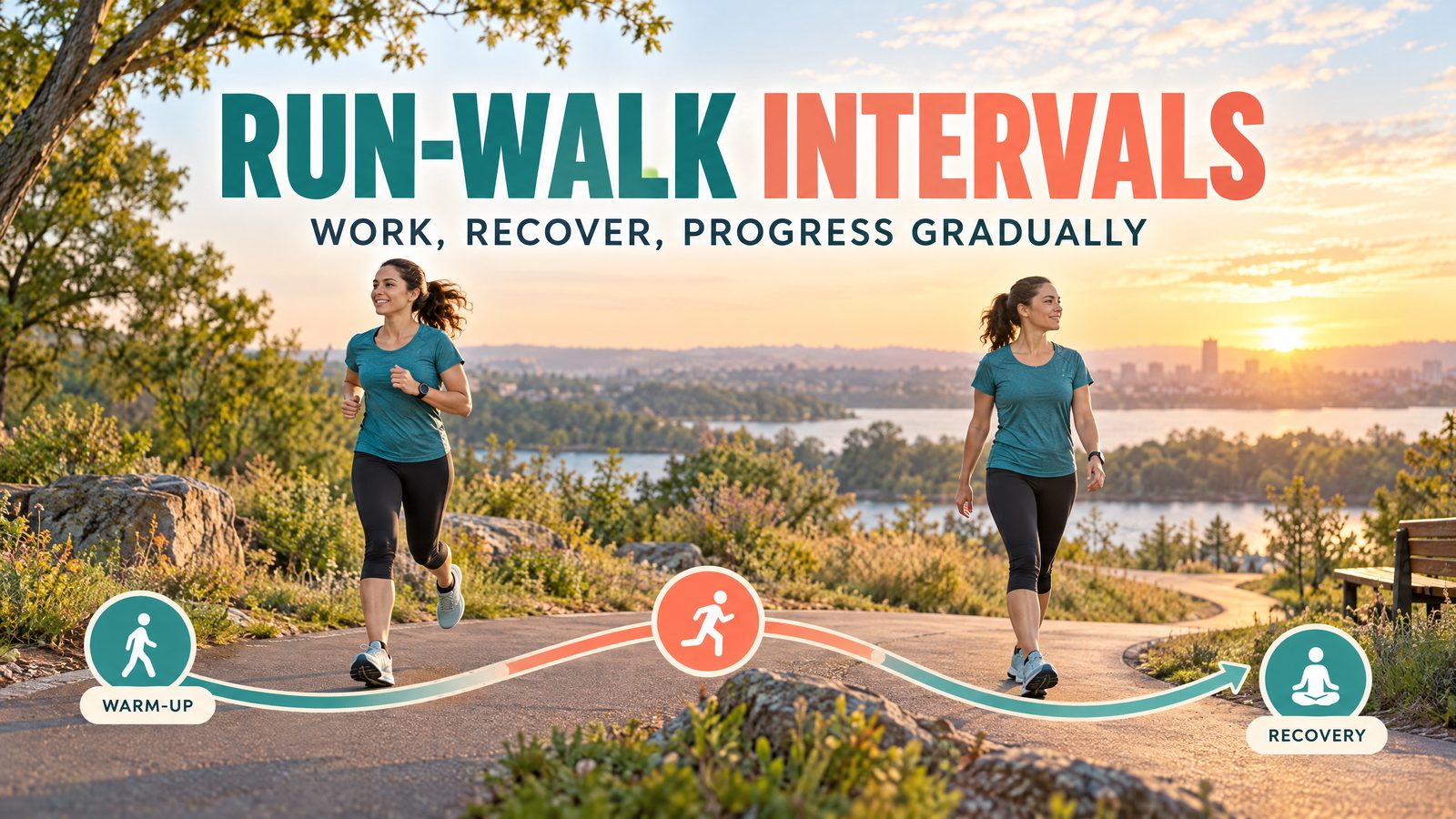
Starting to run does not require running continuously. Alternating short periods of easy running with planned walking can make the first weeks more manageable, help you control effort, and give your muscles and connective tissues time to adapt. A run-walk plan is a flexible way to build consistency—not a test of willpower and not a guarantee against injury.
The best structure is one you can repeat with good form and without escalating pain. Your running portions should usually feel controlled enough that you could complete another interval, while the walking portions should lower your breathing and effort before the next attempt.
Key Takeaways
- Run-walk intervals are a practical way to divide an aerobic session into work and recovery periods.
- Use effort, breathing, and symptoms—not a rigid pace—to choose the length of each interval.
- Start with more walking than running if needed, and progress one variable at a time.
- Research supports gradual, manageable activity, but it does not establish one perfect run-to-walk ratio for every new runner.
- Stop and seek help for chest pain, dizziness, extreme shortness of breath, or pain that changes how you move.
What a run-walk interval actually does
In this context, the “work” period is an easy jog or run, and the “recovery” period is purposeful walking. Recovery does not have to mean standing still. Walking keeps you moving while reducing the mechanical and breathing demand compared with running.
Running is commonly classified as vigorous activity, while brisk walking may be moderate activity, but intensity is relative to the person. The CDC’s talk test is useful: during moderate activity, you can talk but not sing; during vigorous activity, you can say only a few words before needing a breath. 1 For many beginners, an easy jog may already feel vigorous. That is a reason to slow down or walk, not a reason to force a preset speed.
How to structure the work and recovery periods
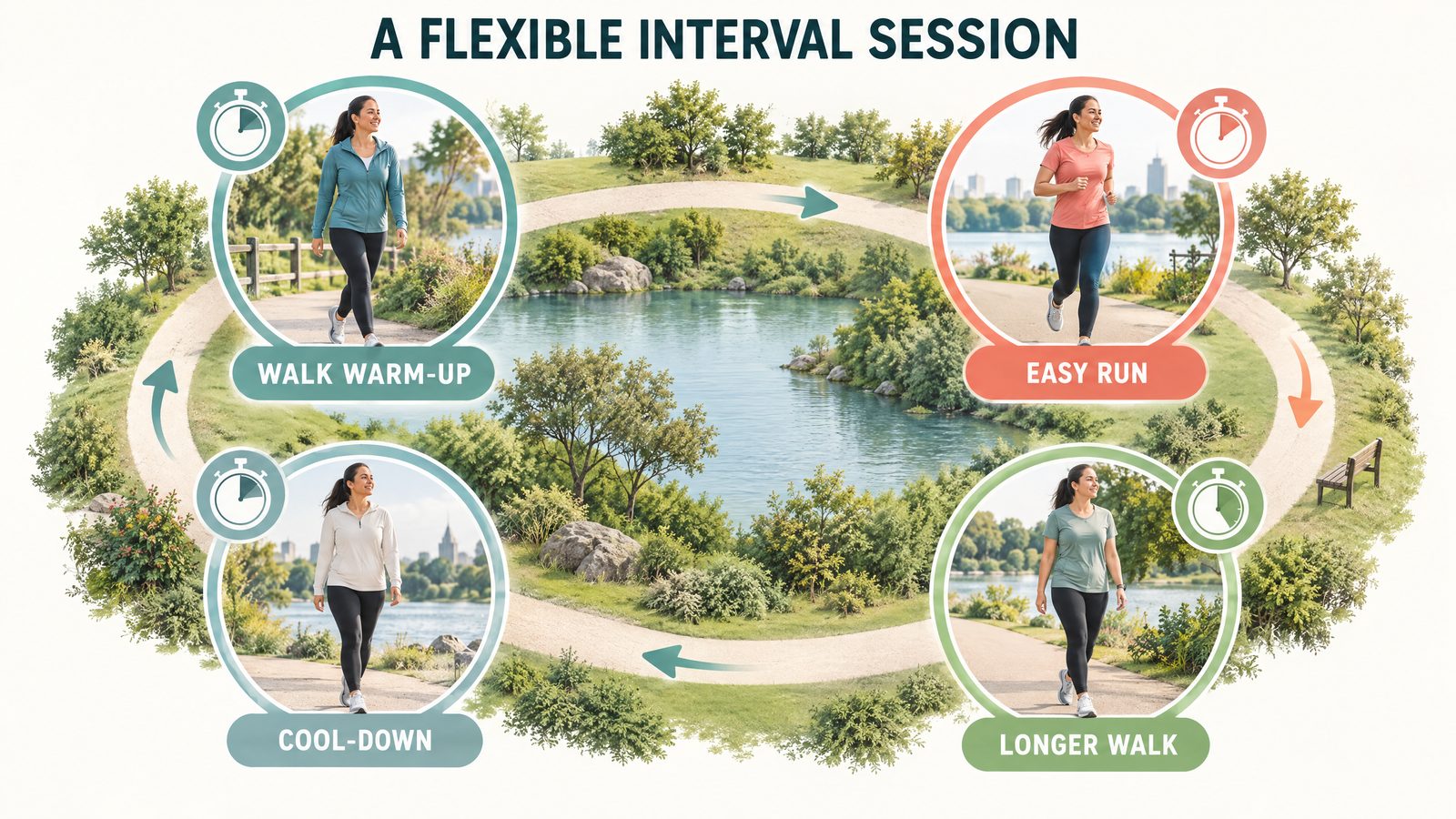
There is no single evidence-based ratio that fits all new runners. A useful starting structure is a brief warm-up, short easy running intervals, longer walking recoveries, and a gradual cool-down. For example, after several minutes of comfortable walking, a beginner might alternate 30 seconds of easy jogging with 90 seconds of walking for several rounds. Someone who is not yet comfortable jogging can begin with faster walking and add short jogs later.
Treat that example as a starting template, not a prescription. The running interval is appropriate when you can keep your steps light and your posture relaxed without sprinting. The walking interval is long enough when your breathing becomes more controlled and you feel ready to repeat the effort. If you are still gasping, the next running period is too soon or too fast.
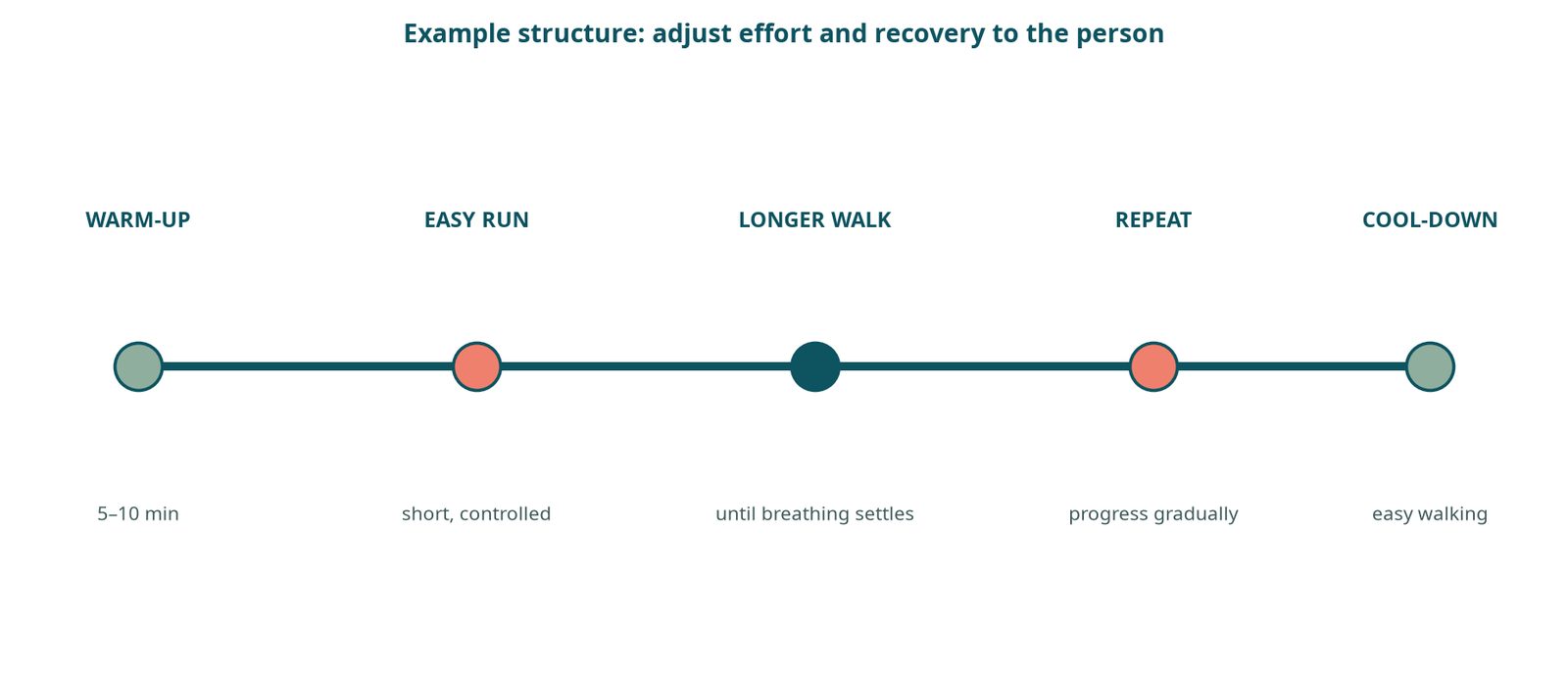
A simple session can look like this:
- Walk easily for about 5–10 minutes to warm up.
- Repeat a short, easy run followed by a longer walk. Keep the effort conversational or only mildly challenging at first.
- Finish with several minutes of easy walking.
- Note how your breathing, legs, and any symptoms felt later that day and the next morning.
How to progress without chasing a perfect plan
Progress should be gradual and should preserve recovery. First, repeat the same session enough times to learn how your body responds. If it feels comfortable, change just one factor: add a small amount of running time, shorten a walking break slightly, add another interval, or extend the total session. Do not increase all of them in the same week.
A practical rule is to progress only when the previous level feels repeatable and you are not developing worsening pain, unusual fatigue, or a change in your stride. A slower week, an extra rest day, or a walking-only session is a normal adjustment. Fitness gains do not require every workout to be harder.
The CDC notes that adults can break activity into smaller chunks and that some activity is better than none. Its general target is at least 150 minutes of moderate-intensity aerobic activity or 75 minutes of vigorous-intensity activity per week, plus muscle-strengthening activity on at least two days. 2 Those are population-level health guidelines, not a requirement to reach immediately as a new runner. Walking recovery counts as movement, but it should not be used to claim that every interval session is vigorous running.
What the evidence supports—and what remains uncertain
A systematic review and meta-analysis found a higher running-related injury incidence per 1,000 hours among novice runners than recreational runners. The authors also cautioned that studies used different definitions of injury and different runner categories, which limits direct comparison. 3 This supports taking adaptation seriously, but it does not prove that run-walk intervals prevent injury.
One randomized trial in obese novice runners compared starting with 3 kilometers per week with 6 kilometers per week over four weeks, with both programs increasing weekly distance. The intention-to-treat analysis did not show a statistically significant difference; a per-protocol analysis suggested fewer injuries and overuse symptoms in the lower-distance group. The study was small, short, and specific to its participants, so its results should not be turned into a universal distance rule. 4
Together, these findings support a cautious principle: starting with a manageable running load and allowing recovery may be sensible, especially when running is new. They do not identify a universally superior ratio such as 1:1 or 4:1. They also do not show that shoes, stretching, a particular surface, or a particular app can eliminate risk. A run-walk format is best viewed as a way to regulate exposure and effort.
Safety and when to seek care
Before starting, consider talking with a clinician if you have a known heart, lung, bone, joint, or metabolic condition; take medicines that affect exercise responses; are pregnant or recently postpartum; or have been inactive and have significant health concerns. This article cannot determine whether running is appropriate for your personal situation.
During a session, stop if you do not feel right, or if you develop chest pain or pressure, fainting, new dizziness, extreme shortness of breath, or palpitations with concerning symptoms. MedlinePlus advises stopping exercise and seeking help for pain, extreme shortness of breath, or dizziness. 5 Emergency symptoms such as severe or persistent chest discomfort, trouble breathing, or loss of consciousness warrant emergency care rather than a longer recovery interval.
For muscle and joint discomfort, distinguish ordinary effort from a problem that is worsening. Mild, short-lived soreness can occur after unfamiliar activity. Pain that is sharp, escalating, present at rest, associated with swelling, causes limping, or changes your running form is a reason to stop running and seek professional evaluation. Do not use a timer to push through symptoms.
Choose a well-lit, predictable route, wear comfortable footwear, and account for heat, cold, traffic, and low visibility. Hydrate according to conditions and your own thirst; do not chase a fixed fluid amount simply because a plan lists one.
| Session part | Purpose | Adjustment |
|---|---|---|
| Warm-up walk | Prepare gradually | Use about 5–10 minutes of easy walking. |
| Easy run | Controlled work | Slow down if talking becomes difficult or form changes. |
| Longer walk | Lower breathing and effort | Continue until you feel ready to repeat. |
| Cool-down | Finish comfortably | Use easy walking; stop for concerning symptoms. |
A practical way to use intervals this week
Pick two or three nonconsecutive days when you can recover between sessions. Begin each with easy walking. Use a run-walk pattern that leaves you in control, and finish before form breaks down. On other days, ordinary walking or rest can provide movement without adding another running load.
Record only useful training information: the interval pattern, overall effort, route conditions, and whether symptoms appeared during or after the session. Avoid treating one watch metric or one fast outing as a verdict on your fitness. If the pattern feels too hard, make the running periods shorter, make the walking periods longer, or walk for the whole session. If it feels easy for several sessions, progress one element modestly.
Bottom line
Run-walk intervals give new runners a clear way to practice running while preserving recovery. Start with easy effort and generous walking, use the talk test and symptoms to guide adjustments, and progress one variable at a time. The evidence supports gradual exposure and realistic recovery, but it does not support a magic ratio or a promise of injury prevention. Consistency, flexibility, and attention to warning signs matter more than completing a preset schedule.