In this guide
- Key Takeaways
- Why These Five Patterns Help
- The Five Patterns With Minimal Equipment
- 1. Push: Move an Object Away
- 2. Pull: Bring Resistance Toward You
- 3. Squat: Bend the Knees and Hips
- 4. Hinge: Load the Hips
- 5. Carry: Walk While Bracing
- How to Build a Balanced Session
- What the Evidence Supports—and What It Does Not
- Safety and When to Seek Care
- A Practical Bottom Line
- References
Meta title: Home Workouts With Limited Equipment: Five Essential Patterns
Meta description: Build a balanced home workout with body weight, bands, or a backpack by covering push, pull, squat, hinge, and carry—plus evidence-based safety tips.
Primary keyword: home workouts with limited equipment
Home Workouts With Limited Equipment: Covering Push, Pull, Squat, Hinge, and Carry
A useful home workout does not need a rack of weights. It does need a way to challenge the major movement patterns: pushing, pulling, squatting, hinging, and carrying. Together, these patterns can organize a simple full-body routine while leaving room to adjust for space, experience, and available equipment.
This approach is a programming framework, not a diagnosis or personal treatment plan. It can help an adult think through exercise choices, but pain, medical conditions, pregnancy, or a long break from activity may call for individualized guidance.
Key Takeaways
- A body-weight exercise, resistance band, backpack, or a few household items can provide useful resistance.
- The five patterns are a way to check balance; they are not a promise that every exercise will produce the same result as a barbell or gym machine.
- Progress can come from more controlled movement, a larger range of motion, a harder variation, added load, or more work—not only from heavier weights.
- U.S. guidance recommends muscle-strengthening activity on at least 2 days each week, working all major muscle groups. Shorter bouts still count toward an active week.1
- Stop for concerning symptoms rather than trying to “push through.” Seek urgent help for heart-attack warning signs such as chest discomfort, unusual shortness of breath, or lightheadedness.4
Why These Five Patterns Help
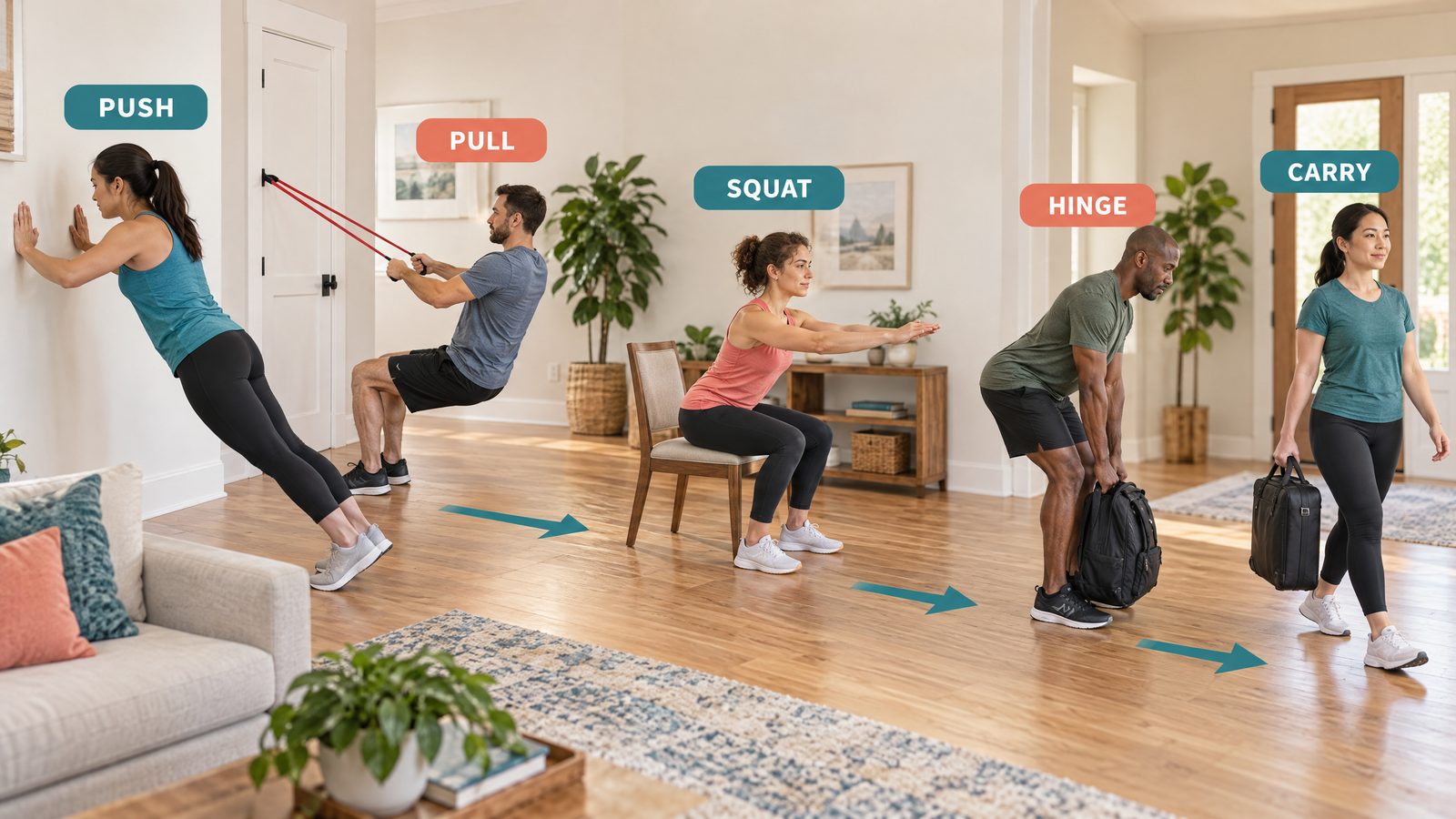
“Push” and “pull” describe how the upper body produces force. “Squat” emphasizes bending at the knees and hips with a relatively upright torso. “Hinge” emphasizes folding at the hips while keeping the spine controlled. A “carry” trains bracing and locomotion while holding resistance.
Resistance training is associated with better muscle strength and physical function in adults, and an overview of systematic reviews found that benefits appeared to outweigh harms. Evidence was less certain for some outcomes, including quality of life and cognitive function, and adverse events were not consistently reported.3 This supports regular resistance exercise, not one universally best routine.
The Five Patterns With Minimal Equipment
1. Push: Move an Object Away
Start with a wall push-up, then progress to an incline push-up using a stable surface, or a floor push-up if that position is comfortable. Keeping the ribs and pelvis controlled is more useful than chasing a particular number of repetitions. A backpack held at chest level can also provide a light pressing challenge, but it should not obstruct breathing or shift unexpectedly.
A push-up mainly trains horizontal pushing. An overhead press with light, securely held objects can add another angle, but overhead work is not automatically appropriate for a painful shoulder. A higher surface reduces the load; a lower surface increases it.
2. Pull: Bring Resistance Toward You
A resistance-band row, one-arm backpack row, or a row with a light household object can train horizontal pulling. The object must have a handle or shape that can be held securely. For a band, check the band and anchor point before each use. Never rely on a loose door, a lightweight table, or an improvised anchor that could move toward the body.
Vertical pulling is harder to reproduce safely without a pull-up bar. An incorrectly installed doorway bar can fall, so limited equipment should not mean accepting a fall risk.
3. Squat: Bend the Knees and Hips
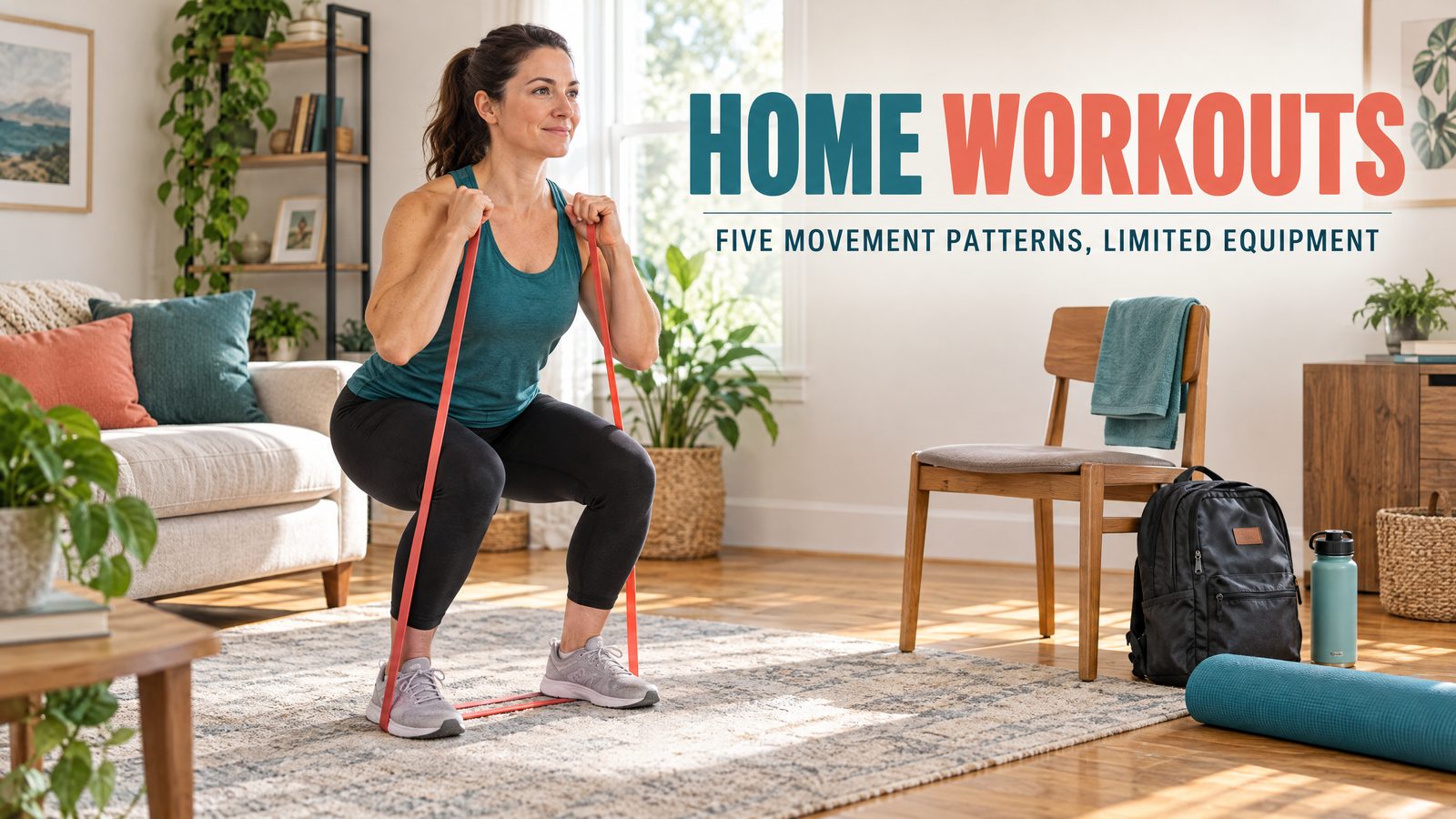
A sit-to-stand from a sturdy chair is an accessible starting point. Other options include a body-weight squat, split squat, or step-up on a securely fixed step. The goal is controlled lowering and standing, not forcing depth. A backpack worn close to the body can add resistance after the unweighted version is well controlled.
Use a chair only on a stable, non-slip surface. If balance is uncertain, keep a stable support nearby. Step-ups need secure footing and a stable step.
4. Hinge: Load the Hips
A hip hinge drill teaches the motion before adding load: soften the knees, send the hips back, and return to standing while keeping the trunk controlled. A backpack deadlift or Romanian-deadlift pattern can then add resistance. A glute bridge is another home-friendly hip-extension option, although it does not challenge standing control in the same way.
The hinge is not the same as rounding the back to reach the floor. A light object held close to the body is easier to control. Stop for sharp, radiating, or progressively worsening pain.
5. Carry: Walk While Bracing
A suitcase carry holds one load at one side. A front carry holds a backpack or object close to the chest. A farmer-style carry uses a load in each hand. These options train grip, trunk control, and the ability to move while resisting unwanted leaning.
Use a clear walking path and an object that will not spill, swing, or open. Start with a short walk and an even stride rather than carrying until posture changes.
How to Build a Balanced Session
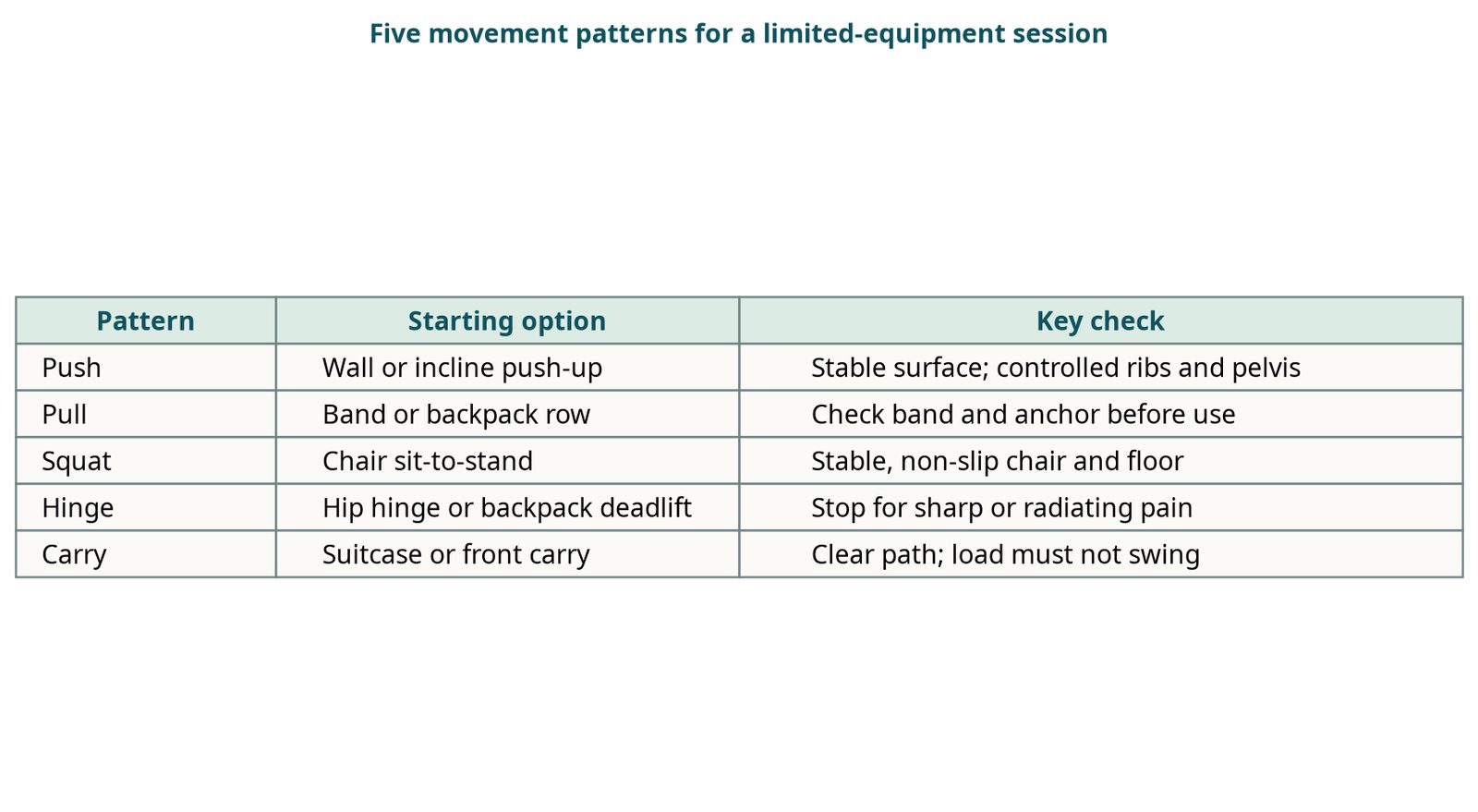
A general template can pair one exercise from each pattern in a circuit or divide the patterns across two full-body sessions. One session might include an incline push-up, band row, chair squat, hip hinge, and suitcase carry; another can use easier or harder variations.
Make the final repetitions challenging but controlled. Progress one variable at a time: use a harder variation, slower lowering, more range of motion, a small amount of load, or another controlled set. There is no need to test a one-repetition maximum at home.
CDC guidance separates aerobic activity from muscle-strengthening activity and recommends both for adults. The aerobic target is at least 150 minutes of moderate-intensity activity per week, or an equivalent vigorous amount, plus strengthening on at least 2 days.1 Those are population-level recommendations, not a required starting dose. WHO emphasizes that any amount of activity is better than none and that all movement counts, which can make a gradual start more realistic.2
What the Evidence Supports—and What It Does Not
Evidence supports resistance training as a way to improve strength and physical function, and home-based programs can help when access to a gym is limited. In a systematic review of home-based resistance training in older adults, most included studies reported improvement in functional ability, while strength gains were smaller and were more apparent in programs with more supervision.5 This suggests that consistency, progression, and feedback may matter as much as the setting.
The ideal home exercise, equipment, frequency, and progression remain uncertain for every adult because studies combine different ages, exercises, loads, and supervision levels. A home routine can build capacity, but it is not guaranteed to maximize muscle size, athletic performance, or disease prevention, and it cannot replace prescribed rehabilitation.
Safety and When to Seek Care
Clear floor space, non-slip footwear, stable chairs and steps, and a checked band or anchor reduce hazards. Warm up with easy movement and practice a new exercise unloaded. Normal exertion differs from sudden pain, faintness, or worsening symptoms.
Stop and seek medical advice for recurrent swelling, loss of strength, numbness, a new balance problem, or pain that does not settle. People with heart, lung, metabolic, bone, or neurologic conditions, or those who are pregnant or recently postpartum, should ask a clinician about appropriate modifications.
Call 911 for possible heart-attack warning signs, including chest discomfort, discomfort in the upper body, shortness of breath, cold sweat, nausea, rapid or irregular heartbeat, or unusual lightheadedness.4 Do not use a home workout to self-test a concerning symptom.
A Practical Bottom Line
Limited equipment is a constraint, not a reason to omit strength work. Choose a stable variation for each of the five patterns, practice control, and progress gradually. Use the checklist to notice what is missing, not to force an exercise that causes symptoms. A simple routine performed consistently can be more useful than an elaborate plan that is difficult to repeat—and the evidence supports the value of resistance training without claiming that one home setup is universally optimal.