In this guide
- What this guide covers
- Key points at a glance
- Why start (and what the evidence says)
- Getting ready: health checks, space, and basic gear
- Beginner program templates (practical examples)
- Safe workout progression (how to increase load without rushing)
- Technique, mobility, and injury prevention
- Nutrition, sleep, and recovery basics
- How to compare programs, trainers, or equipment (a simple framework)
- How to compare products later
- When to ask a clinician (limitations and red flags)
- Bottom line
- Editorial note
- References
- Related VitaEvidence reading
Strength training (lifting weights or using resistance) improves strength, function, and long-term health, but starting the right way reduces injury risk and builds steady progress. This guide gives practical, evidence-informed steps and two simple starter programs you can adapt for home or gym use.
What this guide covers
- Why strength training matters and basic safety principles.
- How to prepare (medical checks, equipment, warm-up).
- Two beginner program templates with clear examples.
- Practical progression strategies, recovery tips, and when to ask a clinician.
- A comparison framework to evaluate gyms, equipment, programs, and supplements later.
Key points at a glance
- Aim to include muscle‑strengthening activities at least 2 days per week as part of overall physical activity goals [1].
- Begin with controlled movements and focus on technique before adding heavy loads; supervised instruction speeds safer skill development [2].
- Use gradual, consistent progression (small increases in weight, reps, or sets) and plan regular rest and deloading to avoid overuse.
- Match program choice to your goals, access, and need for feedback—programs that allow progressive overload and technique coaching are safer for beginners.
- Ask a clinician before starting if you have uncontrolled medical conditions, recent cardiac events, pregnancy concerns, severe osteoporosis, or other major health issues (see “When to ask a clinician”).
Why start (and what the evidence says)
Strength (resistance) training helps maintain muscle mass, bone health, metabolic function, and daily function as you age. Public health guidance recommends including muscle‑strengthening activities on 2 or more days per week as part of regular physical activity [1]. Good nutrition, sleep, and recovery support adaptation to training; evidence on supplements for performance is mixed and should be considered carefully [2][5][6].
Getting ready: health checks, space, and basic gear
Quick medical screen
– If you have chronic conditions (heart disease, uncontrolled blood pressure, diabetes with complications), recent surgery, pregnancy, or major joint problems, check with a clinician first. See the “When to ask a clinician” section for specifics.
– Otherwise, a gradual start is safe for most adults when you listen to your body.
Choose a safe practice environment
– Space: clear area free of trip hazards.
– Surface: flat, non-slip floor.
– Lighting: good visibility.
– Spotting/help: for heavy lifts (e.g., barbell squat), have a trained spotter or use safety racks/boxes.
Basic gear (budget to moderate)
– Bodyweight and household items are fine to begin.
– Helpful inexpensive items: mat, adjustable dumbbells or kettlebell, resistance bands, stable bench or chair.
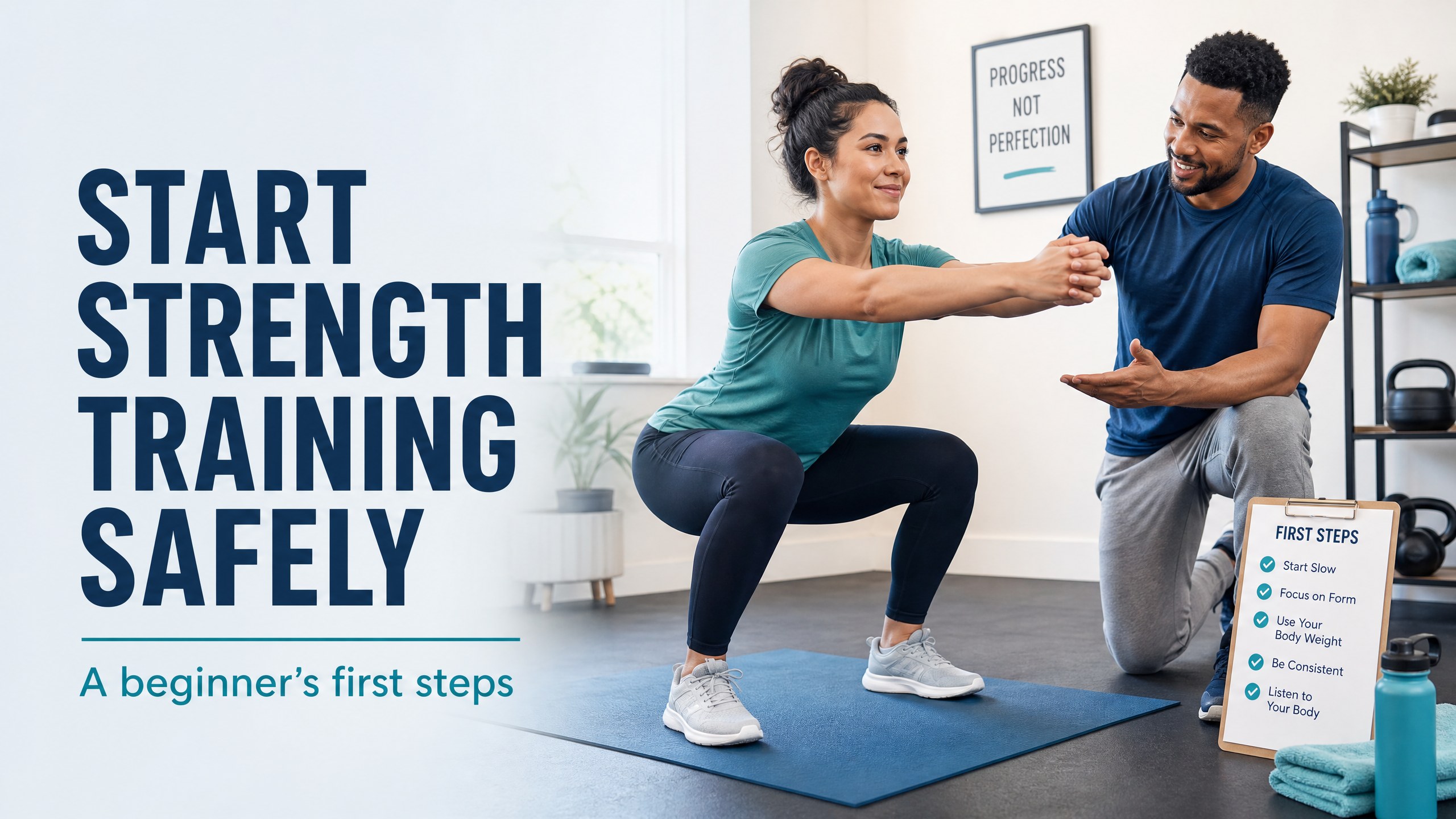
– If training in a gym, consider an initial session with a certified coach for technique feedback.
Beginner program templates (practical examples)
Note: these are sample starting plans. Choose the one that fits your schedule and access. Rest 48+ hours between full‑body sessions for beginners.
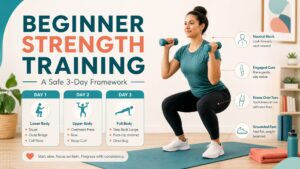
Option A — Full‑body, 3 days/week (Mon/Wed/Fri)
– Warm-up: 5–10 min light cardio + dynamic mobility (hip circles, arm swings).
– Squat pattern: Bodyweight or goblet squat — 2–4 sets of 8–12 reps.
– Push pattern: Push‑ups (knees or incline as needed) or dumbbell bench press — 2–4 sets of 6–12 reps.
– Pull pattern: Bent‑over dumbbell row or band row — 2–4 sets of 8–12 reps.
– Hinge: Romanian deadlift with light dumbbells or kettlebell — 2–3 sets of 8–12 reps.
– Core: Plank 2 × 20–45 seconds or dead‑bug 2 × 8–12 per side.
– Cooldown: light stretching.
Option B — Upper/Lower split, 4 days/week (Mon/Tue/Thu/Fri)
– Day 1 (Upper): Push, pull, shoulder, core — 3 sets each, 6–12 reps.
– Day 2 (Lower): Squat, hinge, lunges, calves — 3 sets each, 8–12 reps.
– Day 3 (Upper): Variation with different angles and lighter load — 2–3 sets.
– Day 4 (Lower): Focus on single‑leg work and mobility — 2–3 sets.
How to choose between these
– Full‑body 3×/week: simple, time-efficient, good for complete beginners or limited days.
– Upper/lower 4×/week: more volume per muscle group and recovery flexibility; suitable once you’re comfortable with basic movements.
Safe workout progression (how to increase load without rushing)
General principles
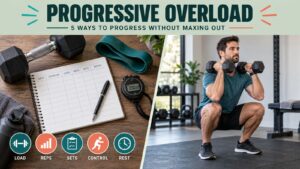
– Prioritize consistent increases over large jumps. Small, repeatable improvements produce lasting gains and lower injury risk.
– Progression methods: add small weight increments, add 1–2 reps per set, add an extra set, shorten rest slightly, or improve exercise difficulty (e.g., incline push‑up → floor push‑up). Use one change at a time.
Practical rule-of-thumb approach
– If you can complete your target reps for all sets with good form and feel you could do 2 extra reps on the final set, consider a small increase in load or a more challenging variation the next session. (This is a widely used practical method; adapt to your recovery and fatigue.)
– Schedule a lighter week (deload) every 4–8 weeks if training consistently, or sooner if you feel persistent soreness, performance decline, or poor sleep.
Monitoring intensity and recovery
– Use Rate of Perceived Exertion (RPE) or a simple “hardness” scale: aim for challenging but not maximal on most sets for beginners.
– Track workouts (loads, reps, how you felt) so small progressions are clear.
Technique, mobility, and injury prevention
Learn safe mechanics first
– Master movement patterns with light loads or bodyweight before heavy loading. Slow, controlled reps and attention to spinal neutrality reduce risk.
– Breathing: exhale during exertion phase (e.g., upward phase of a squat). Avoid breath‑holding unless coached.
Warm-up and mobility
– A general warm-up increases blood flow. Add joint‑specific mobility or movement practice for planned lifts (e.g., hip mobility before squats).
– Address movement limitations (tight hips, limited shoulder overhead reach) with corrective drills before loading.
Red flags during training
– Dizziness, chest pain, sudden sharp joint pain, or new numbness/weakness warrant immediate stop and medical evaluation.
Nutrition, sleep, and recovery basics
- Meet overall energy and protein needs to support adaptation; refer to Dietary Guidelines and MyPlate for healthy eating patterns [3].
- Sleep is essential for recovery; prioritize regular sleep consistent with public health guidance [5].
- Supplements: evidence for many supplements to boost beginner gains is limited; if you consider them, review FDA guidance on dietary supplements and consult a clinician [4][2][6].
How to compare programs, trainers, or equipment (a simple framework)
- Goal alignment: Does the program build progressive overload toward your goals (strength, function, aesthetics)?
- Technical feedback: Does the option provide coaching/feedback (in-person trainer, video analysis, or clear cueing)? Beginners benefit from feedback.
- Progression structure: Is there a clear plan for gradual increases in load/volume?
- Safety features: For equipment, check safety stops, stable construction, and incremental weight sizes. For trainers, verify credentials and liability insurance.
- Cost and accessibility: Include travel time, schedule fit, and long‑term affordability.
- Evidence transparency: Programs that explain why they prescribe certain progressions and show basic safety practices are preferable.
How to compare products later
When you evaluate equipment or training programs, compare: build quality, weight increments, warranty, return policy, coach credentials, session format (live vs recorded), and user reviews that include safety and longevity. For supplements, compare ingredient lists, serving sizes, third‑party testing, and FDA warnings.
[Affiliate product comparison block—add verified iHerb links after approval]
When to ask a clinician (limitations and red flags)
Ask a clinician before starting or modifying strength training if you have:
– Known heart disease, recent myocardial infarction, angina, or uncontrolled blood pressure.
– Pregnancy or postpartum recovery concerns (exercise advice should be individualized).
– Severe osteoporosis, recent fractures, joint replacements, or major orthopedic surgeries.
– Chronic conditions with complex management (advanced diabetes, kidney or liver disease) or if taking medications that affect heart rate, blood pressure, or bleeding risk.
– Active or recent eating disorder—training plans should be coordinated with medical and mental‑health care.
If you experience chest pain, severe shortness of breath, fainting, or neurological symptoms during or after exercise, seek emergency care.
Bottom line
Beginner strength training is safe and highly beneficial when you prioritize technique, consistent small progressions, and adequate recovery. Start with simple, full‑body movements (or a conservative split), focus on learning mechanics, and increase load gradually. If you have health concerns or complex medical conditions, consult a clinician before beginning a program. Use the comparison framework here to choose equipment, trainers, or programs that support progressive, supervised, and safe training.
Editorial note
VitaEvidence Editorial Team. Last reviewed: August 2026. For general education, not personal medical advice. Read our Editorial Policy.
References
[1] CDC — About Physical Activity. https://www.cdc.gov/physical-activity/about/index.html
[2] NIH Office of Dietary Supplements — Exercise and Athletic Performance (Health Professional). https://ods.od.nih.gov/factsheets/ExerciseAndAthleticPerformance-HealthProfessional/
[3] Dietary Guidelines for Americans 2020–2025. https://www.dietaryguidelines.gov/
[4] U.S. Food & Drug Administration — Dietary Supplements. https://www.fda.gov/food/dietary-supplements
[5] Nutrients 2025 — Mini‑review on sleep, nutrition and supplementation. https://doi.org/10.3390/nu17111779
[6] Frontiers in Nutrition 2025 — Systematic review of supplements and elite‑athlete performance. https://doi.org/10.3389/fnut.2025.1675654