
In this guide
- Key Takeaways
- What Data Might a Period-Tracking App Collect?
- Questions to Ask Before You Share Health Data
- 1. What does the company collect, and why?
- 2. Who receives the information?
- 3. Is the data stored on my phone, on a server, or both?
- 4. Can I use it without an account or precise location?
- 5. What control do I have later?
- 6. What does the app actually claim to predict?
- What the Evidence Supports—and What Remains Uncertain
- Practical Ways to Reduce Exposure
- Safety and When to Seek Care
- A Practical Bottom Line
- References
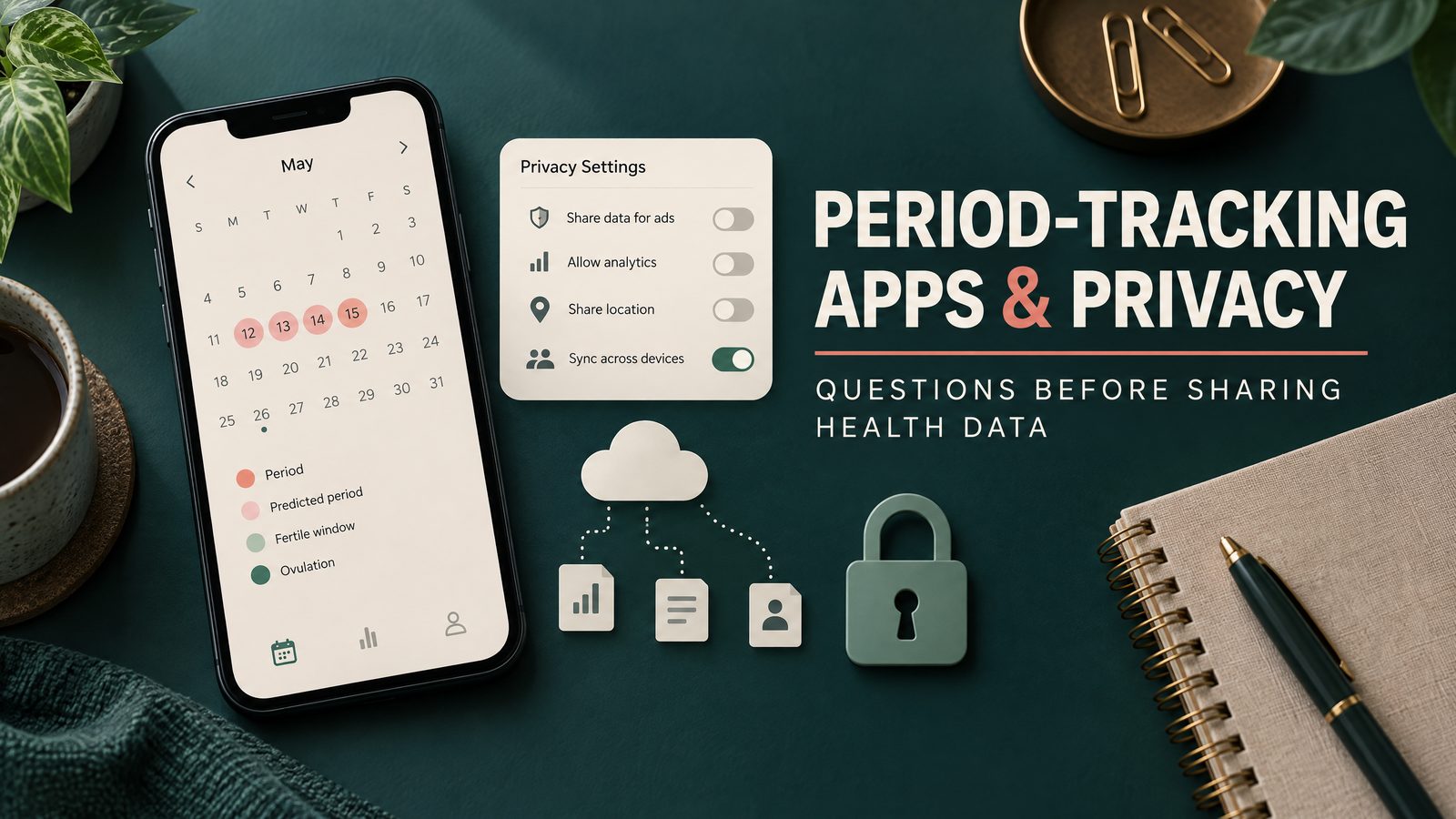
A period-tracking app can make it easier to record bleeding, cramps, mood, or other symptoms. It may also create a detailed record of reproductive health on a phone, in a cloud account, or with companies that provide analytics and advertising services. Before entering health information, it is reasonable to ask not only whether an app is useful, but also what happens to the information after you tap “save.”
This is an educational guide, not a diagnosis or substitute for medical care. Check current policies and features before signing up.
Key Takeaways
- A period-tracking app may collect more than period dates, including symptoms, fertility-related information, device identifiers, IP address, location, and usage data.
- A privacy label or promise that data are “secure” does not mean information is never shared. Look for purposes, recipients, retention, and your choices.
- HIPAA does not automatically cover a consumer app that you download and use on your own. The FTC, state laws, and the company’s own promises may be relevant instead. 1
- Calendar predictions can help with planning, but they are not the same as a confirmed ovulation measurement or a reliable diagnosis. Research has found wide variation in ovulation predictions among calendar-based apps. 2
- You can reduce exposure by sharing less, turning off unnecessary permissions, using a strong device lock, and choosing an app that explains deletion and third-party sharing clearly.
What Data Might a Period-Tracking App Collect?
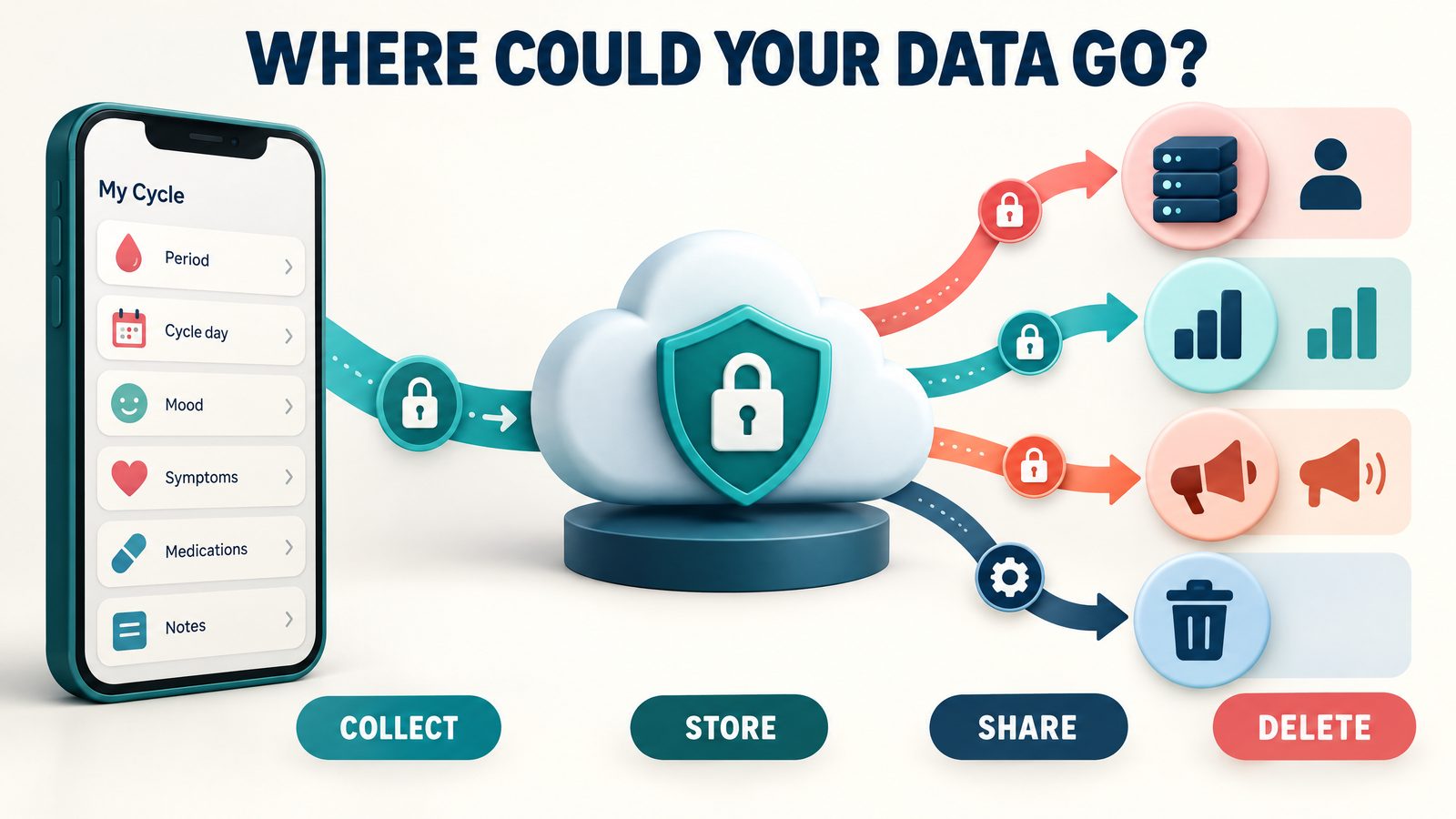
The obvious data are the first day of bleeding, cycle length, flow, pain, and symptoms. Many apps also invite entries about sex, contraception, pregnancy intentions, cervical mucus, basal body temperature, medications, mood, or a pregnancy outcome. Some collect account information, device identifiers, IP address, approximate location, advertising identifiers, and information about how you use the app.
That combination matters. Repeated entries can reveal possible pregnancy, fertility goals, health concerns, or clinic visits. Location and device information can add context even without your name. A 2025 evaluation of four reproductive-health apps identified concerns involving IP-address tracking, third-party advertising, and unclear descriptions of data practices. Policies can change over time. 3
Before creating an account, ask: What is required, what is optional, and what happens if I decline? An app that needs an email address, precise location, contacts, or access to unrelated phone functions to record a period deserves extra scrutiny.
Questions to Ask Before You Share Health Data
1. What does the company collect, and why?
Read the privacy policy and app-store information. Look for explanations of health data, identifiers, location, analytics, advertising, and information obtained elsewhere. Ask whether data are used only to provide the feature or also for advertising, research, or analysis, and whether they are identifiable, deidentified, or combined with other information.
2. Who receives the information?
Look for references to service providers, analytics companies, advertising partners, data brokers, social-media tools, and business transfers such as a merger or sale. Ask whether the company sells data, shares it for targeted advertising, or allows third parties to use it for their own purposes.
This is not hypothetical. In 2021, the FTC finalized an order involving Flo Health after alleging that the app shared sensitive health information with Facebook, Google, and other firms despite privacy promises. The order required consent for certain future sharing, user notification, and an independent privacy review. 1 In 2023, the FTC also announced action involving Premom over alleged disclosure of sensitive health data. 4
3. Is the data stored on my phone, on a server, or both?
An app that works mostly offline may expose less information to a company than one requiring a cloud account, although local data can still be seen through your phone or backup. Ask whether entries are encrypted in transit and at rest, whether end-to-end encryption is used, and who can access the account.
4. Can I use it without an account or precise location?
If an account is optional, consider whether the app still works without one. A period tracker generally does not need precise location to display a calendar. HHS advises people to avoid unnecessary apps and to deny location access when it is not needed for the app’s function. It also notes that HIPAA generally does not protect health information stored on a personal phone or tablet in the same way it protects information held by covered health-care organizations. 5
On iPhone or Android, review permissions after installation, not just during setup. Turn off location, contacts, microphone, photos, or Bluetooth access if the feature is unnecessary. Disabling a permission may limit a feature, so confirm what you are giving up.
5. What control do I have later?
Find out whether you can export, correct, or delete entries and the whole account. Ask how long backups, deidentified information, logs, and service-provider records remain. “Delete your account” may not mean every copy disappears immediately. Look for a clear deletion process and a way to withdraw optional consent; policies and settings can change.
6. What does the app actually claim to predict?
Tracking can help you notice a pattern or prepare questions for a clinician. It does not guarantee the next period date, and a calendar estimate does not confirm ovulation. A systematic review found that calendar-based apps evaluated in the literature had ovulation-day prediction accuracy below 90%, varying widely by app and method. 2
If avoiding pregnancy is important, do not assume a generic period calendar is contraception. ACOG explains that fertility-awareness methods require learning specific signs and using them consistently; basal body temperature mainly shows that ovulation has occurred, not that it is about to occur. 6 An app can support recordkeeping, but its prediction should not replace appropriate counseling.
| Question | Where to look | Reason for caution |
|---|---|---|
| What data is collected? | Privacy policy and app-store disclosures | Optional fields or unrelated permissions may reveal more than needed. |
| Who receives it? | Sharing, analytics, advertising, and service-provider sections | Third-party use may differ from the app’s core function. |
| Where is it stored? | Security and account sections | Cloud backups and access controls affect exposure. |
| Can I delete it? | Account, export, correction, and deletion instructions | Deleting the app may not delete server-held copies. |
What the Evidence Supports—and What Remains Uncertain
The evidence supports using tracking as a record of self-reported observations. It may help you describe timing, symptoms, or changes at a medical visit. However, the app does not verify every entry, and predictions depend on data quality and the company’s model.
Privacy research also has limits. A policy review captures practices at one point in time and cannot predict later changes or data combinations. “Deidentified” does not mean zero risk. The conclusion is not that every app is harmful; it is that informed consent requires checking the important parts of the policy.
Practical Ways to Reduce Exposure
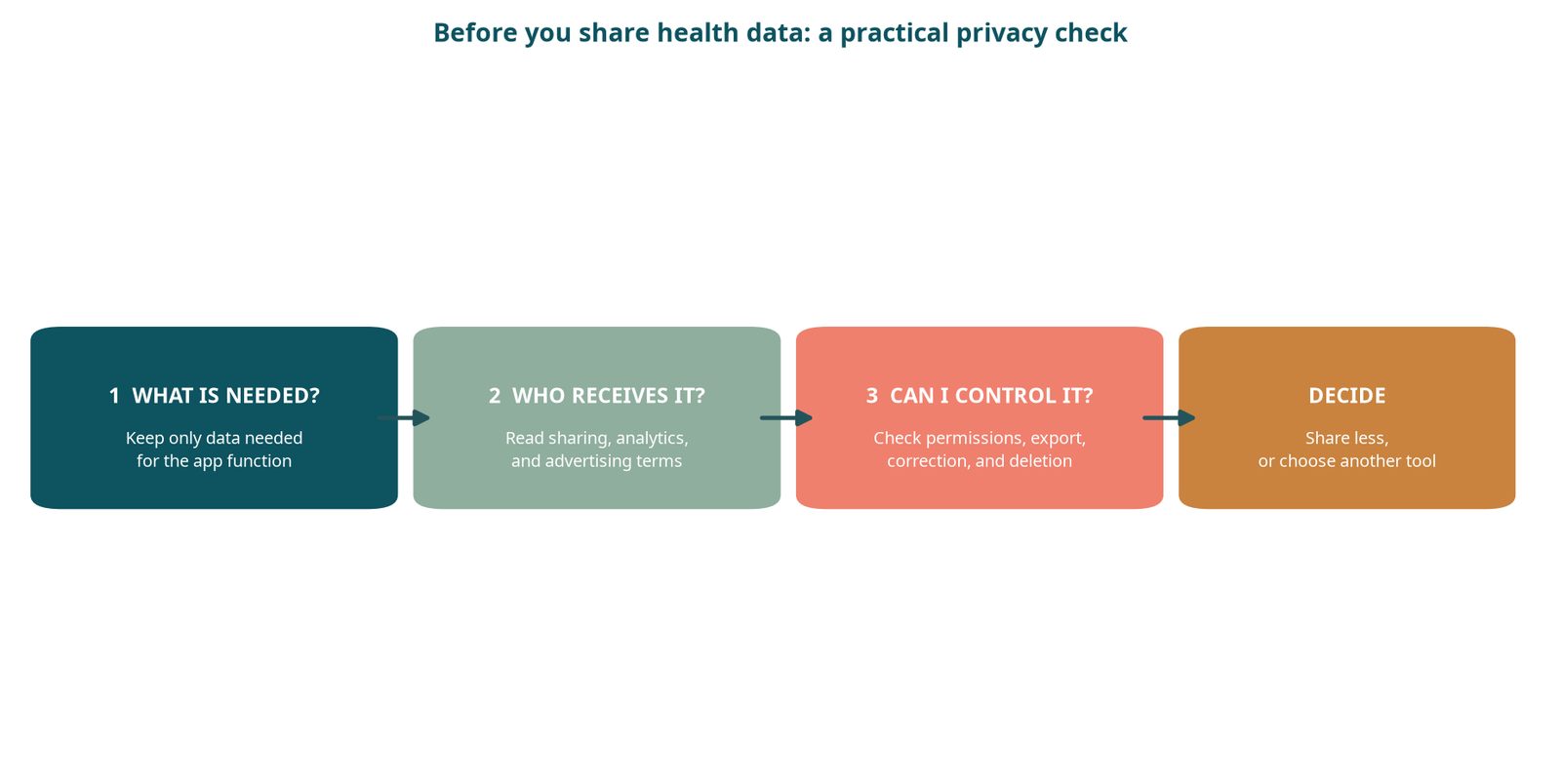
Start with data minimization. Enter only what you need, skip optional pregnancy or sexual-health fields, and avoid linking other health services unless the benefit is clear. Use a strong device passcode, enable updates, and review permissions and advertising settings periodically.
If notifications could reveal private information, turn off lock-screen previews or use neutral notifications. Do not rely on deleting the app alone; check whether account and server-held data require a separate request. HHS notes that reducing a phone’s digital footprint cannot eliminate it. 5
Safety and When to Seek Care
Privacy choices should not stop you from seeking care. Severe or worsening pelvic pain, very heavy bleeding, fainting, chest pain, trouble breathing, or a positive pregnancy test with pain or bleeding warrant prompt medical or emergency help. An app cannot determine the cause or urgency.
A Practical Bottom Line
Choose a period-tracking app based on both usefulness and data practices. Before sharing health data, identify what is collected, why it is collected, who receives it, where it is stored, how long it remains, and how you can delete it. Avoid permissions that do not fit the app’s purpose, treat predictions as estimates, and keep a private alternative available. The best choice is the one that gives you enough information to meet your goal without asking you to surrender more personal health data than you are comfortable sharing.