

In this guide
- Key Takeaways
- What “brain fog” can mean
- What the evidence supports—and what remains uncertain
- How to describe symptoms at a visit
- Check other contributors before blaming hormones
- Sleep and vasomotor symptoms
- Mood, stress, and mental load
- Medicines, supplements, alcohol, and substances
- Medical and nutritional contributors
- Safety/When to Seek Care
- A practical next step
- References
Meta title: Menopause Brain Fog: Describe Symptoms and Check Causes
Meta description: Learn how to describe menopause-related brain fog, track patterns, and discuss sleep, mood, medications, thyroid, B12, and other contributors with a clinician.
Primary keyword: menopause brain fog
Menopause Brain Fog: How to Describe Symptoms and Check Other Contributors
Forgetting a word, losing your train of thought, or walking into a room and forgetting why can feel unsettling during perimenopause or menopause. “Brain fog” is a useful everyday phrase, but it is not a diagnosis. It can describe changes in attention, processing speed, working memory, or word retrieval. It can also reflect poor sleep, stress, depression, medication effects, or another health issue.
The goal is not to decide on your own whether hormones are responsible. A clearer description of what is happening—and a check for other contributors—can help a health professional decide what evaluation is appropriate.
Key Takeaways
- Forgetfulness and trouble concentrating are reported during the menopausal transition, but the experience varies widely.
- Research supports an association between menopause-related cognitive complaints and changes in attention or memory in some studies. It does not show that every lapse is caused by estrogen changes or that brain fog means dementia.
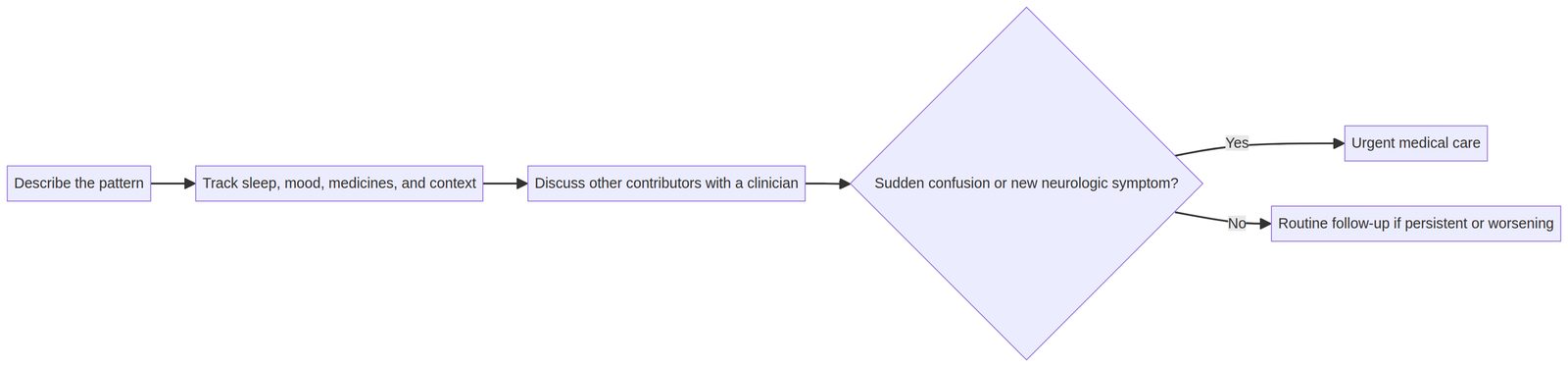
- Track the symptom in plain language: what happened, how often, how severe it was, and whether sleep, hot flashes, mood, alcohol, illness, or a new medication changed at the same time.
- A clinician may consider sleep, mood, medications and supplements, thyroid or other medical conditions, alcohol or drug use, and nutrient concerns such as vitamin B12 when the history suggests them.
- Seek urgent help for sudden confusion or a new neurological symptom. Arrange a routine visit when problems persist, worsen, or interfere with safety or daily tasks.
What “brain fog” can mean
People use the term to describe different experiences. Examples include needing longer to find a familiar word, rereading the same paragraph, forgetting an appointment despite normally keeping a calendar, losing track during a conversation, or struggling to hold several instructions in mind. Some people notice that the problem is worse when they are tired or having a hot flash. Others notice a steady change that does not follow an obvious pattern.
This is different from simply feeling worried about an occasional lapse. The most useful description identifies the function that changed. “I forget names” is more informative than “my memory is bad.” “I can remember the meeting later, but I cannot follow the discussion when I have slept four hours” gives important context.
Perimenopause is the transition before menopause, when menstrual cycles and ovarian hormone production can fluctuate. Menopause itself is defined retrospectively after 12 months without a menstrual period. The National Institute on Aging lists forgetfulness and difficulty concentrating among possible symptoms, while also noting that some midlife changes may relate to aging or other causes. 1
What the evidence supports—and what remains uncertain
Research reviews report that subjective cognitive complaints become more common across the menopause transition. Some studies also find links with attention, verbal memory, working memory, sleep disruption, mood symptoms, and other menopause-related experiences. 2 These findings validate that the symptom can be real and disruptive.
They do not establish a single explanation for every person. Studies use different definitions of “brain fog,” cognitive tests, and comparison groups. A brief self-check cannot rule out a medical or neurological problem.
Hormone changes may be one part of the picture, but the evidence does not support treating menopause brain fog as proof of brain damage or as a reliable sign of future dementia. A review of subjective cognitive complaints specifically calls for more research on how menopause and ovarian hormone loss relate to these symptoms. 2 In practical terms, the symptom deserves attention without assuming the cause.
Menopausal hormone therapy is prescribed for selected menopause symptoms after an individualized discussion of benefits and risks. It should not be started, stopped, or changed solely to test whether brain fog improves. Current public guidance emphasizes discussing symptoms, medical history, and preferences with a clinician rather than using a one-size-fits-all plan. 1

How to describe symptoms at a visit
A short symptom record for one to two weeks can be more useful than trying to remember several difficult moments in the exam room. You do not need to share private health information with anyone except the health professional you choose. Record only what you are comfortable bringing to the visit.
Include:
- The exact problem: word-finding, losing focus, forgetting steps, misplacing items, or difficulty learning new information.
- Timing: when it began, whether it is getting better or worse, and how often it occurs.
- Impact: whether it affects work, driving, finances, cooking, medication organization, or relationships.
- Context: hours and quality of sleep, night sweats, hot flashes, pain, illness, stress, alcohol, and major changes in routine.
- Menstrual and menopause context: cycle changes, the date of the last period if known, and other symptoms that started around the same time.
- Products and medicines: prescription medicines, over-the-counter products, cannabis or other substances, and supplements—especially anything started or stopped recently.
Use a simple severity scale if helpful, such as “mild,” “moderate,” or “severe,” and write one concrete example. A pattern such as “three episodes after nights with repeated waking” can point the conversation toward sleep as well as menopause.
| Track | Example note | Why it helps |
|---|---|---|
| Exact function | Word-finding, focus, following steps | Describes the change more clearly than “bad memory.” |
| Timing and frequency | Three episodes in one week | Shows whether the pattern is persistent or changing. |
| Context | Four hours of sleep, hot flash, stress, new medicine | Identifies contributors to discuss with a clinician. |
| Safety and impact | Driving, work, medication organization | Helps determine how promptly to seek evaluation. |
Check other contributors before blaming hormones
Sleep and vasomotor symptoms
Night sweats, hot flashes, urinary symptoms, pain, and insomnia can fragment sleep. Poor or shortened sleep can make attention and recall feel worse the next day. Ask whether the cognitive symptom follows nights of waking, snoring, gasping, restless legs, or an irregular schedule. A sleep problem may deserve its own evaluation rather than being labeled a menopause symptom.
Mood, stress, and mental load
Anxiety, depression, grief, caregiving demands, and chronic stress can affect concentration and memory. NIA lists depression, anxiety, stressful life events, and sleep problems among factors that may affect memory. 4 Mention persistent sadness, loss of interest, excessive worry, panic, irritability, or feeling unable to manage usual responsibilities. These are health concerns, not evidence that the symptom is imaginary.
Medicines, supplements, alcohol, and substances
A new medicine, a dose change, a sedating over-the-counter product, or a combination of products may affect alertness. Alcohol and other substances can also affect sleep and memory. Bring an up-to-date list or the product containers. Do not stop a prescribed medicine abruptly; ask the prescriber or pharmacist about possible cognitive or sleep-related effects.
Medical and nutritional contributors
Memory problems can occur with thyroid, kidney, or liver disease, after a head injury, with certain infections or neurological conditions, or when nutrition is inadequate. NIA also lists low vitamin B12 as a possible contributor. 4 Testing is not a checklist that everyone needs. A clinician chooses an examination or laboratory work based on the history, symptoms, medicines, and risk factors.
Avoid using a “brain” supplement as a diagnostic test. Products marketed to sharpen memory may be ineffective, unsafe, or interact with treatment. NIA advises caution with unproven memory products and supplements. 4
Safety/When to Seek Care
Seek emergency care now for sudden confusion, trouble speaking or understanding, facial drooping, weakness or numbness on one side, a sudden severe headache, new vision loss, fainting, a seizure, or a serious head injury. These symptoms can signal an emergency and should not be attributed to menopause.
Arrange a prompt routine appointment if memory or concentration changes are persistent, progressive, or interfering with work, driving, finances, cooking, medication safety, or getting lost in familiar places. Repeatedly asking the same questions, being unable to follow familiar directions, or major changes in judgment also warrant evaluation. 4
Tell the clinician if symptoms began after a new medicine, illness, fall, or significant mood change. A medical history, medication review, physical examination, and—in some cases—cognitive screening or targeted tests can help distinguish common forgetfulness from a problem needing further assessment. This article cannot diagnose the cause or recommend a personal treatment.
A practical next step
For the next week, choose one neutral tracking method: a paper note, a private calendar, or a phone note that stays on your device. Record one example, sleep quality, major menopause symptoms, mood, and any medication or supplement change. At the visit, ask: “What else could cause this pattern?” and “What would make you want to test or follow up?”
Menopause brain fog is worth describing precisely, not dismissing and not catastrophizing. Connecting the cognitive complaint with sleep, mood, medicines, health conditions, and the timing of menopause gives you and your clinician a safer starting point than assuming one cause.