In this guide
- Key Takeaways
- Why Alcohol May Feel Different During the Menopause Transition
- What to Track When Symptoms Change
- 1. The drink itself
- 2. Symptoms and timing
- 3. Sleep quality—not only bedtime
- 4. Context and possible confounders
- What the Evidence Supports
- What Is Still Uncertain
- Safety and When to Seek Care
- A Practical Way to Use Your Log
- Bottom Line
- Sources
Meta title: Menopause and Alcohol: What to Track When Symptoms Change
Meta description: Learn what evidence says about alcohol, hot flashes, sleep, mood, and midlife health—and what to track before discussing changes with a clinician.
Primary keyword: menopause and alcohol
Menopause and Alcohol: What to Track When Symptoms Change
A glass of wine may seem unrelated to a night of sweating, a 3 a.m. awakening, or a next-day mood dip. During perimenopause and menopause, however, symptoms can vary for many reasons at once: changing hormones, stress, sleep loss, medications, health conditions, and alcohol exposure. That makes it easy to assume alcohol is the cause—or to dismiss a useful pattern as coincidence.
This article offers an evidence-based way to observe changes, not a diagnosis or personal treatment plan. A consistent log can support a clinician conversation without relying on memory.
Key Takeaways
- Alcohol may trigger or intensify hot flashes and night sweats for some people, but studies do not show a simple, universal cause-and-effect rule.
- Alcohol can make sleep feel easier at first while worsening sleep quality later; menopause symptoms themselves can also disrupt sleep.
- Count standard drinks, not just glasses or containers. In U.S. guidance, one standard drink contains about 0.6 fluid ounces (14 grams) of pure alcohol.
- U.S. public-health guidance says women who choose to drink should have no more than one drink in a day, while also emphasizing that less alcohol—or none—lowers health risks. This is not a target to reach.
- Track timing, amount, symptoms, sleep, medications, and other triggers for a few weeks. Seek care for concerning symptoms, postmenopausal bleeding, or difficulty controlling alcohol use.
Why Alcohol May Feel Different During the Menopause Transition
Menopause is defined as 12 consecutive months without a menstrual period. The transition before it, called perimenopause, can bring irregular bleeding, hot flashes, night sweats, sleep problems, mood changes, vaginal symptoms, and concentration difficulties. Symptoms often fluctuate rather than follow a predictable schedule.
Alcohol can affect blood-vessel dilation, temperature perception, alertness, and sleep. It may feel relaxing or sedating at first but fragment sleep later. If a night sweat wakes you, alcohol, a hot bedroom, a hot flash, snoring, stress, or several factors may be involved.
Alcohol also matters beyond symptoms. The Centers for Disease Control and Prevention (CDC) says alcohol use is linked with several cancers, including breast cancer, and that even moderate drinking can carry health risks compared with not drinking. Those risks are separate from whether a particular drink triggered a hot flash.
What to Track When Symptoms Change
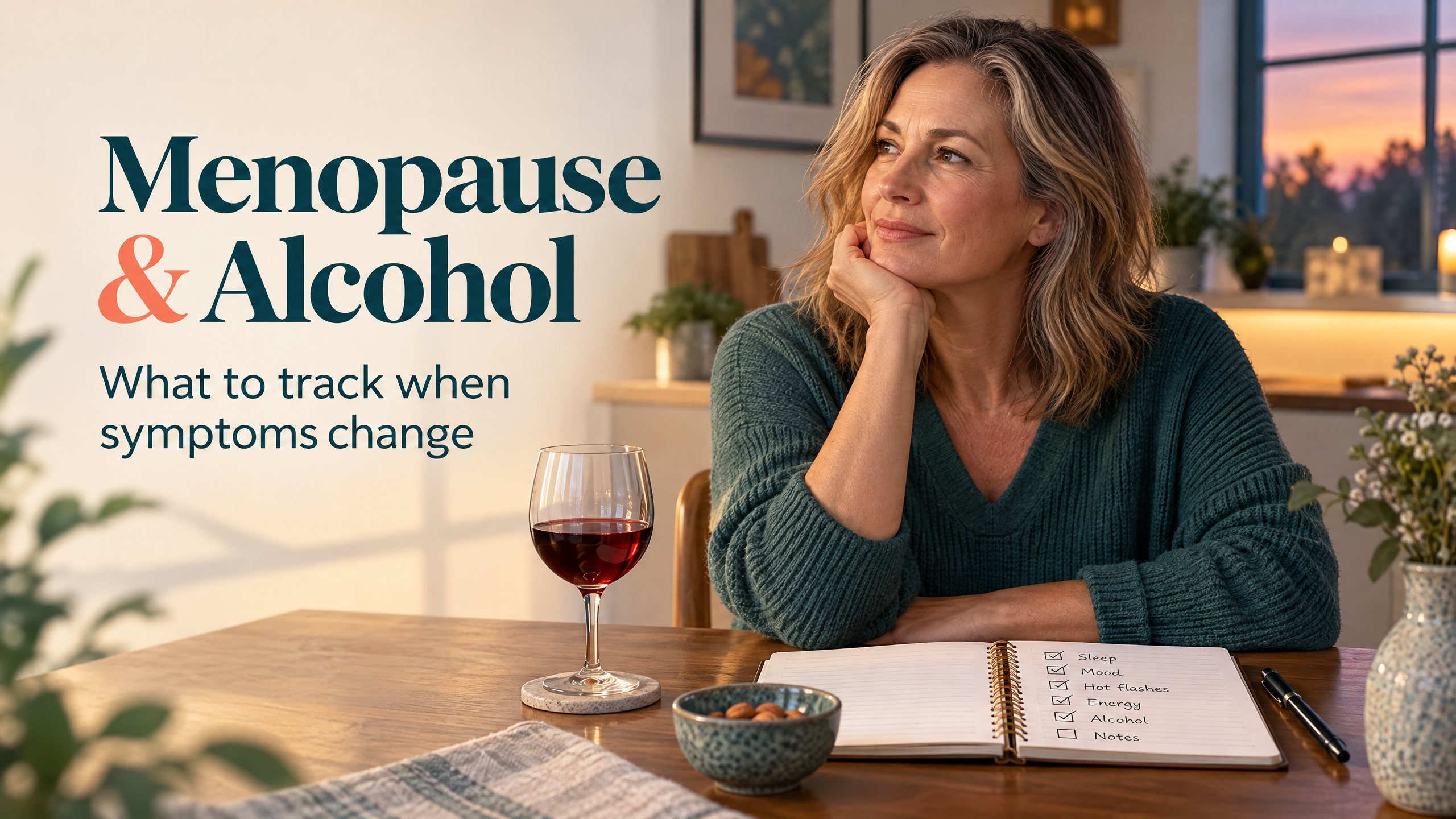
A tracking log can be simple. Use a notes app, calendar, or paper chart for two to four weeks.
1. The drink itself
Write down the type, approximate amount, start and finish time, and whether you drank with food. A large pour, strong cocktail, or craft beer may exceed one standard drink. In the United States, one is roughly 12 ounces of regular beer, 5 ounces of wine, or 1.5 ounces of 80-proof spirits, but serving size and strength vary.
Also note alcohol-free days. The goal is observation, not “testing” yourself with more alcohol. If you are pregnant or might be pregnant, take medicines that interact with alcohol, have certain liver conditions, are recovering from alcohol use disorder, or cannot control how much you drink, CDC guidance says not to drink.
2. Symptoms and timing
For each hot flash or night sweat, record the time, duration if known, intensity, sweating or chills, and what you were doing. Note whether it occurred during drinking, within hours afterward, or the following night. Also track headache, palpitations, reflux, anxiety, low mood, vaginal discomfort, or urinary symptoms.
The timing matters. A symptom several days after a drink is less suggestive of an immediate trigger than a repeated pattern occurring soon after similar exposures. Even then, the log cannot prove causation.
3. Sleep quality—not only bedtime
Record bedtime, estimated time to fall asleep, awakenings, night sweats, final wake time, and how rested you feel. Note alcohol near bedtime, caffeine, screens, pain, snoring, or a warm room. A drink may shorten sleep onset yet bring more awakenings. Poor sleep on alcohol-free nights suggests other contributors may matter.
4. Context and possible confounders
Menopause symptoms can change alongside stress, illness, travel, exercise, spicy foods, caffeine, room temperature, and changes in a menstrual cycle. Record these briefly. Include new prescriptions, over-the-counter products, cannabis or other substances, and the timing of any menopause treatment. Do not stop prescribed medicines based on a log; bring questions to the prescriber.
What the Evidence Supports
The Office on Women’s Health lists alcohol as a possible hot-flash trigger and encourages tracking. It advises women who drink to limit alcohol to one drink a day and no more than seven per week. This is population guidance, not a guarantee of safety for an individual.
A 2024 narrative review in Maturitas describes a complex relationship involving vasomotor symptoms, sleep, mood, sexual health, and bone health, while emphasizing mixed findings and the need for more research. Alcohol is a plausible contributor for some people, but symptoms should not automatically be attributed to it.
Alcohol-related risk also depends on the pattern. The National Institute on Alcohol Abuse and Alcoholism defines binge drinking for women as four or more drinks in about two hours and heavy drinking as four or more on any day or eight or more per week. These thresholds describe higher-risk patterns; they are not symptom-management targets or a safe-use guarantee.
What Is Still Uncertain
Research on alcohol and hot flashes is difficult to interpret. Studies are often observational, define “moderate” differently, and cannot fully separate alcohol from smoking, body weight, stress, sleep, or medication use. A 2024 review notes mixed results across menopausal stages.
There is no reliable rule that wine is better than beer or spirits for menopause symptoms. Ethanol amount, serving size, drinking pattern, and individual response matter more than a wellness label. A symptom-free evening does not erase long-term risk, while one bad night does not prove causation.
Do not use alcohol as a treatment for hot flashes, anxiety, or insomnia. Short-term relief can reinforce a cycle in which sleep and mood become more dependent on drinking, while health risks accumulate.
Safety and When to Seek Care
Talk with a health professional if symptoms bother you, change abruptly, or interfere with daily life. Menopause symptoms can overlap with thyroid disease, anemia, sleep disorders, medication effects, depression, anxiety, and other conditions.
Seek medical evaluation for bleeding or spotting after 12 months without a period, very heavy bleeding, bleeding between periods or after sex, or periods lasting more than a week. These changes should not be assumed to be caused by alcohol or menopause.
Get urgent help for chest pain, fainting, severe shortness of breath, new one-sided weakness, severe confusion, or thoughts of self-harm. Inability to wake, repeated vomiting, seizures, or slow or irregular breathing after drinking may signal alcohol poisoning.
If you drink heavily most days, do not abruptly stop without medical advice. Alcohol withdrawal can be dangerous. Contact a clinician or an alcohol-support service for a safer plan. Difficulty cutting down, drinking more than intended, hiding alcohol use, or continuing despite health or relationship problems are reasons to ask for confidential help—not reasons for shame.
A Practical Way to Use Your Log
After two to four weeks, look for repeated patterns rather than one-off events. Ask whether symptoms occur more often after alcohol, whether bedtime drinking corresponds with awakenings, whether symptoms also occur with stress or caffeine alone, and whether drinking has increased.
Bring the log, medication list, and questions to a primary care clinician, ob-gyn, or menopause-focused professional. Discuss symptom evaluation, sleep, mood, breast-cancer risk factors, liver health, falls, medication interactions, and evidence-based treatment options. You do not need to prove causation before asking for help.
Bottom Line
Menopause and alcohol can intersect through hot flashes, night sweats, sleep, mood, and longer-term health risks, but individual responses vary and the evidence is not a simple yes-or-no answer. Track what you drink, when you drink, what symptoms follow, how you sleep, and what else changed. Use the information to support a clinical conversation—not to self-diagnose or chase a perfect number. For health risk, less alcohol is generally better than more, and not drinking is a valid choice.
Sources
- Centers for Disease Control and Prevention (CDC): About Moderate Alcohol Use. Updated January 14, 2025.
- CDC: Alcohol Use and Your Health. Updated January 14, 2025.
- National Institute on Alcohol Abuse and Alcoholism (NIAAA): Understanding Alcohol Drinking Patterns. Updated January 2026.
- Office on Women’s Health: Menopause Symptoms and Relief. Updated May 30, 2025.
- Shihab S, Islam N, Kanani D, Marks L, Vegunta S. Alcohol use at midlife and in menopause: a narrative review. Maturitas. 2024;189:108092. doi:10.1016/j.maturitas.2024.108092.
- National Institute on Aging (NIH): What Is Menopause?. Updated October 16, 2024.