In this guide
- What this guide covers
- Key points at a glance
- Calcium: Food and Supplement Context
- How calcium in food and supplements differs
- Calcium from food: advantages and practical examples
- Calcium supplements: uses and common forms
- Absorption: what affects how much calcium your body gets
- Safety considerations and interactions
- Known safety limits
- Drug interactions and medical conditions
- A practical comparison framework: deciding food first vs. supplement
- When to ask a clinician
- How to compare products later
- Bottom line
- Editorial note
- References
- Related VitaEvidence reading
Calcium is essential for building and maintaining bone, and many people wonder whether they should rely on food alone or add a supplement. This article explains the benefits and limits of dietary calcium versus supplements, how absorption and safety differ, and practical ways to decide what might fit your needs.
What this guide covers
- How calcium from food compares with supplemental calcium for bone health.
- Factors that affect calcium absorption and safety.
- Practical food examples, a product-comparison framework, and clear signs for when to consult a clinician.
Key points at a glance
Calcium: Food and Supplement Context
| Question | Why it matters |
|---|---|
| Can food meet the need? | Food sources can contribute calcium along with other nutrients. |
| Is a supplement being considered? | The product, amount, and other ingredients should be reviewed. |
| Are medications involved? | Timing and interactions may need a pharmacist’s review. |
| Is a high intake being planned? | More is not automatically better; personal context matters. |
- When practical, aim to meet calcium needs through a varied diet; foods also contribute other nutrients, but the best plan depends on dietary pattern and medical needs [1][4].
- Supplements can help people who can’t meet needs with food, but they have different absorption patterns and safety considerations than dietary calcium [1][3].
- Take supplemental calcium in divided doses (generally ≤500 mg at a time) for better absorption; avoid assuming that extra vitamin D or calcium is needed; discuss testing or supplementation when clinically appropriate [1][2].
- Discuss supplements with a clinician if you are pregnant, breastfeeding, have kidney disease, take multiple medications, or have a history of kidney stones or a history of kidney stones, kidney disease, or questions about cardiovascular risk [3][1].
How calcium in food and supplements differs
Calcium from food: advantages and practical examples
- Whole foods can provide calcium along with other nutrients and may fit a balanced eating pattern; they are not a guarantee against bone loss [4].
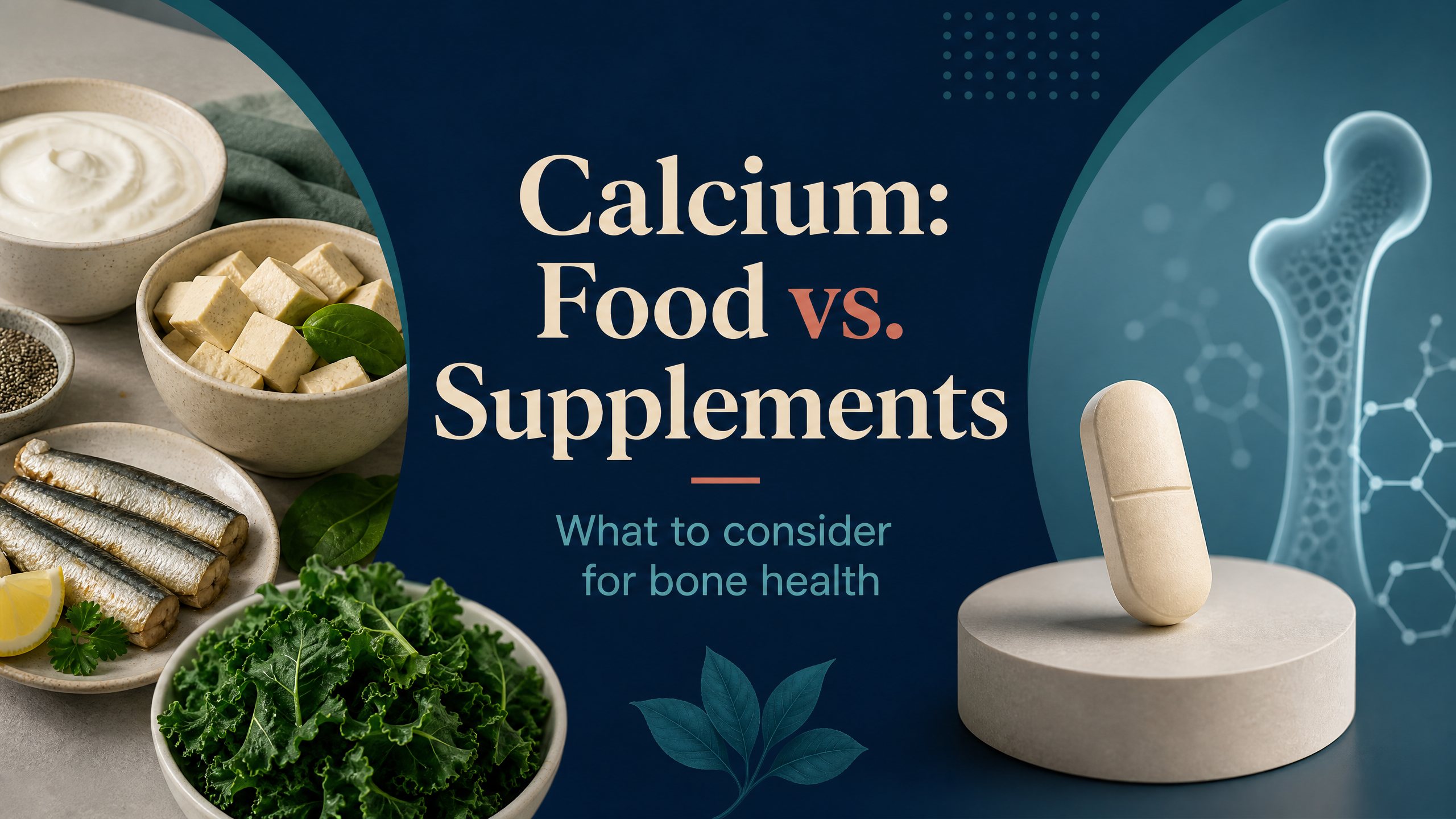
- High-quality calcium sources: dairy (milk, yogurt, cheese), canned salmon or sardines with bones, calcium-set tofu, fortified plant milks and juices, and low-oxalate leafy greens (kale, bok choy) [1][4].
- Practical meal examples:
- Breakfast: 1 cup yogurt + ½ cup fortified cereal + fruit.
- Lunch: Salad with canned salmon (soft bones) and a calcium-fortified plant milk on the side.
- Snack: 1 ounce almonds and a small cheese portion.
Note: Some vegetables (spinach, Swiss chard) contain oxalates that bind calcium and reduce absorption, so their calcium contributes less than equal amounts from dairy or fortified foods [1].
Calcium supplements: uses and common forms
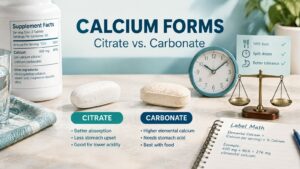
- Common forms: calcium carbonate (higher elemental calcium per pill; best taken with food because stomach acid helps absorption) and calcium citrate (better absorbed if stomach acid is low; can be taken with or without food) [1].
- Typical reasons to use supplements: inadequate dietary intake despite food choices, lactose intolerance or strict vegan diets without fortified foods, certain medical conditions that increase needs or reduce absorption.
- Dosing tips: single large doses are less well absorbed—splitting total supplemental calcium into smaller doses (about ≤500 mg at a time) improves absorption [1].
Absorption: what affects how much calcium your body gets
- Vitamin D status affects calcium absorption, but taking more vitamin D or calcium is not a substitute for assessing the underlying problem [2].
- Age: intestinal absorption decreases with age; older adults may absorb less and may need higher intake or attention to vitamin D [1].
- Meal context and other nutrients: large amounts of dietary fiber, phytates (in some grains/legumes), and oxalates (in some greens) can lower absorption; consuming calcium with food often improves uptake compared with taking supplements on an empty stomach [1][4].
Safety considerations and interactions
Known safety limits
- Recommended intake targets differ by age and sex; authoritative targets are available from NIH Office of Dietary Supplements (ODS) [1]. For adults, common reference targets are 1,000 mg/day for most adults 19–50 years, and 1,200 mg/day for women 51+ and men 71+; tolerable upper intake levels (ULs) set by expert panels should be checked before taking large supplemental doses [1].
- Very high calcium intake (usually from supplements) may increase risk for adverse effects, including constipation and, in some people, a greater risk of kidney stones; evidence about cardiovascular effects from supplemental calcium is mixed and being studied [1][3].
Drug interactions and medical conditions
- Calcium can interfere with absorption or effectiveness of several medications (e.g., certain antibiotics like tetracyclines and fluoroquinolones, bisphosphonates, levothyroxine, some iron formulations). Space doses as your clinician or the medication label directs [3].
- People with kidney disease, hyperparathyroidism, or a prior history of kidney stones need medical evaluation before starting supplements—excess calcium can be harmful when kidneys can’t excrete it well [1][3].
A practical comparison framework: deciding food first vs. supplement
Ask these questions and weigh each item:
- Intake gap: Do you meet recommended calcium intake from diet (estimate using MyPlate/Dietary Guidelines guidance)? If yes, prefer food; if not, consider targeted supplement use [4][5].
- Absorption context: Do your main dietary calcium sources have high bioavailability (dairy, fortified foods, low-oxalate greens, calcium-set tofu)? If not, a supplement may be reasonable [1][4].
- Vitamin D status: Are you vitamin D sufficient? If not, addressing vitamin D often improves calcium absorption; some supplements combine calcium + vitamin D but check doses [2][1].
- Safety/health conditions: Do you have kidney disease, history of stones, or take medications that interact with calcium? If yes, consult a clinician before supplementing [3][1].
- Convenience and tolerance: If you have GI sensitivity or dislike dairy, choose a form (carbonate vs citrate) and a divided dosing schedule that you can tolerate [1].
Example decision paths:
– Patient A (50‑year‑old woman, dairy‑free but drinks fortified plant milk and eats tofu): likely can meet needs with food + fortified choices; monitor intake and vitamin D before adding supplements.
– Patient B (65‑year‑old man, limited diet after bariatric surgery, low vitamin D): likely needs supplements and vitamin D, but must consult clinician for individualized dosing and monitoring.
When to ask a clinician
Seek medical advice before starting calcium supplements if any of the following apply:
– Pregnant or breastfeeding, or giving supplements to infants/children (dosing differs by age) [1].
– Known kidney disease, hyperparathyroidism, or history of kidney stones or hypercalcemia [1].
– Taking medications that may interact with calcium (thyroid hormone, some antibiotics, bisphosphonates, certain blood pressure medicines) [3].
– You have malabsorption (e.g., celiac disease, inflammatory bowel disease, prior bariatric surgery) or long‑term corticosteroid use.
– You’re unsure about total daily calcium from food plus any supplements—clinician or dietitian can review your diet and labs (serum calcium, vitamin D) and recommend appropriate dosing and monitoring.
How to compare products later
When you evaluate a calcium supplement label, compare these attributes:
– Elemental calcium per serving (not just “calcium carbonate 1,250 mg” — check the elemental calcium amount).
– Form of calcium (carbonate vs citrate) and whether it matches your stomach acidity and tolerance.
– Dose per pill and whether the product’s suggested dosing keeps doses ≤500 mg elemental calcium at a time.
– Presence and amount of added vitamin D (useful if you’re low; check total daily vitamin D from all sources).
– Third‑party testing or certification statements and a clear expiration date.
– Complete ingredient list for allergens and unwanted additives; avoid “proprietary blends” that hide amounts.
– Safety information, interactions, and manufacturer contact information.
[Affiliate product comparison block—add verified iHerb links after approval]
Bottom line
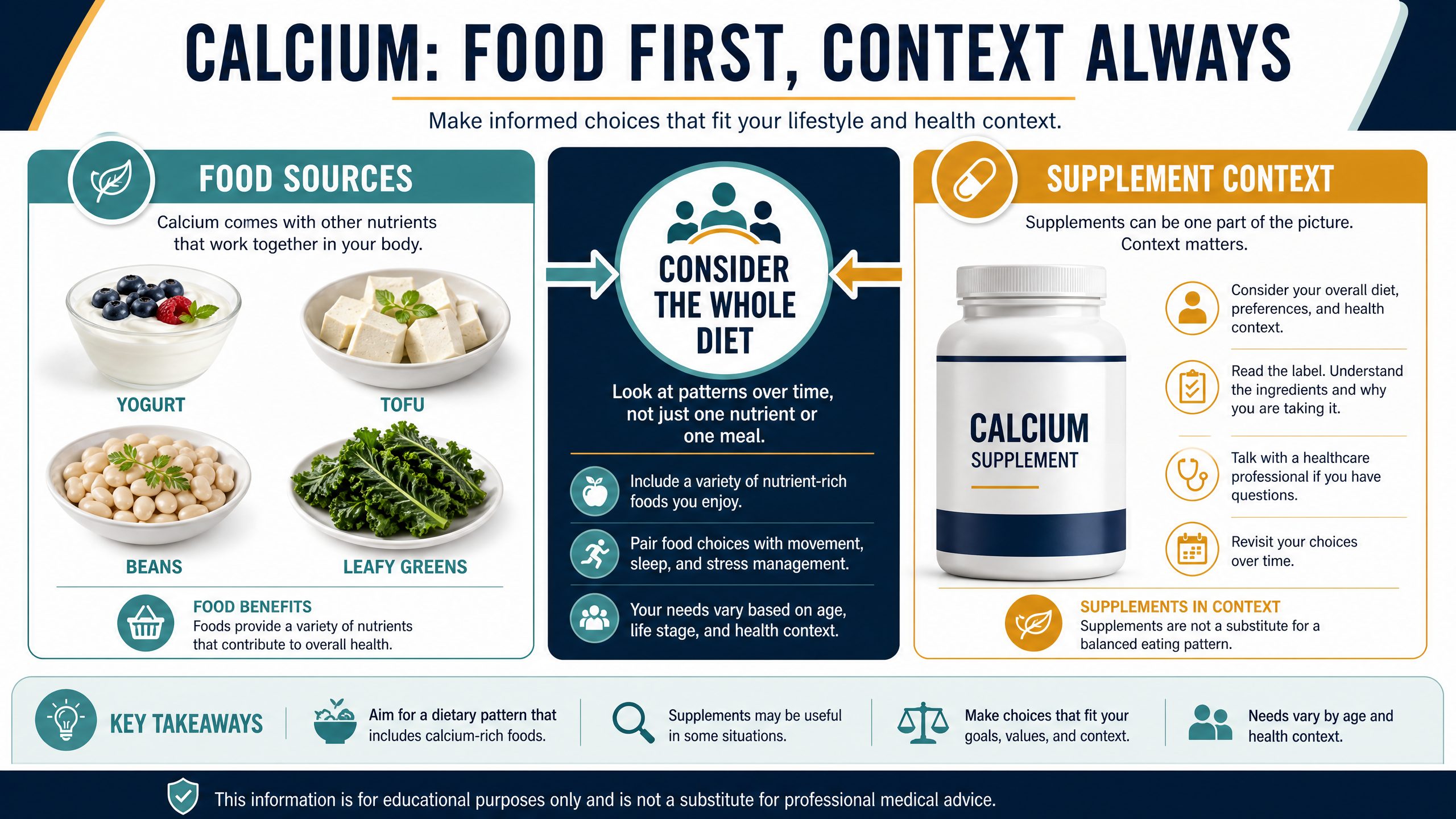
Food-first strategies are generally preferred for meeting calcium needs because foods provide calcium plus other nutrients that support bone health. Supplements are a practical option when dietary intake, absorption, or medical circumstances make it difficult to meet requirements, but they require attention to dose, timing, vitamin D status, and potential interactions. Talk with your clinician or registered dietitian for personalized dosing, especially if you are older, pregnant, have kidney disease, take interacting medications, or are unsure of your total intake.
Editorial note
VitaEvidence Editorial Team. Last reviewed: August 2026. For general education, not personal medical advice. Read our Editorial Policy.
References
[1] NIH Office of Dietary Supplements — Calcium Fact Sheet for Consumers. https://ods.od.nih.gov/factsheets/Calcium-Consumer/
[2] NIH Office of Dietary Supplements — Vitamin D Fact Sheet for Consumers. https://ods.od.nih.gov/factsheets/VitaminD-Consumer/
[3] U.S. Food & Drug Administration — Dietary Supplements. https://www.fda.gov/food/dietary-supplements
[4] USDA MyPlate — Foods and Nutrients. https://www.myplate.gov/
[5] U.S. Department of Health and Human Services & U.S. Department of Agriculture — Dietary Guidelines for Americans 2020–2025. https://www.dietaryguidelines.gov/