In this guide
- What this guide covers
- Key points at a glance
- How “expiration” and shelf-life work
- Which ingredients are most affected by heat, light, and moisture
- Practical storage: examples and common mistakes
- How to tell a supplement may be past its prime
- Comparison framework: how to choose packaging and storage features
- Limitations and when to ask a clinician
- How to compare products later
- Bottom line
- Editorial note
- References
- Related VitaEvidence reading
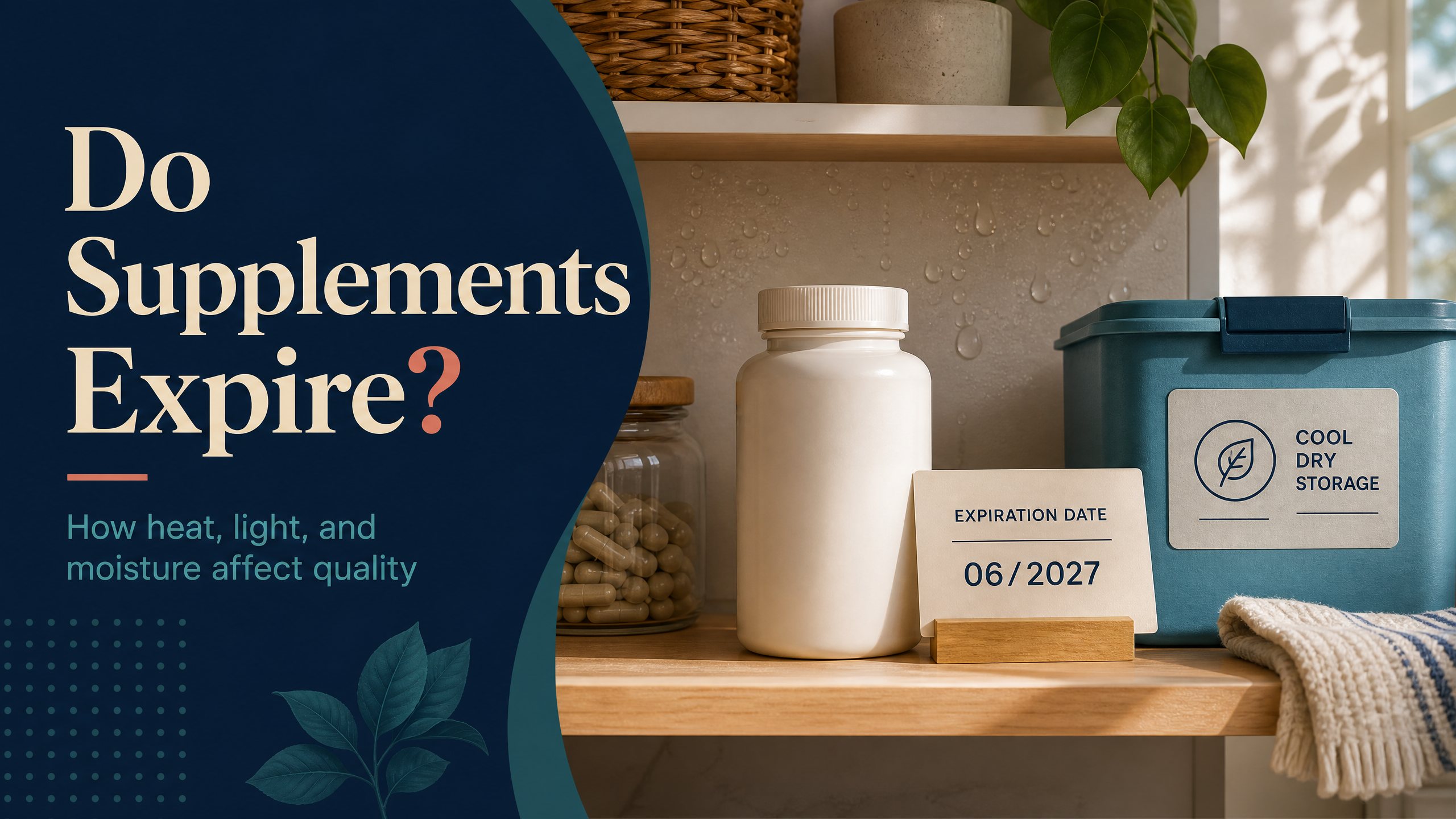
Most dietary supplements are manufactured with a stability period, and many carry an expiration or “best by” date — but potency and safety can change before or after that date depending on storage. This guide explains what manufacturers test, how heat, light, and humidity speed up loss of potency or quality, and practical steps to keep supplements effective longer.
What this guide covers
- How supplement “expiration” and shelf-life are set and what the labels mean.
- Which ingredients are most vulnerable to heat, light, and moisture (vitamins, oils, probiotics, herbal extracts).
- Practical storage do’s and don’ts and how to spot when a product has deteriorated.
- A short framework for comparing product packaging and labeling later, plus when to ask a clinician.
Key points at a glance
- Manufacturers decide shelf life based on stability testing; the FDA requires that label claims be accurate but does not prescribe a single required expiration format for supplements [2].
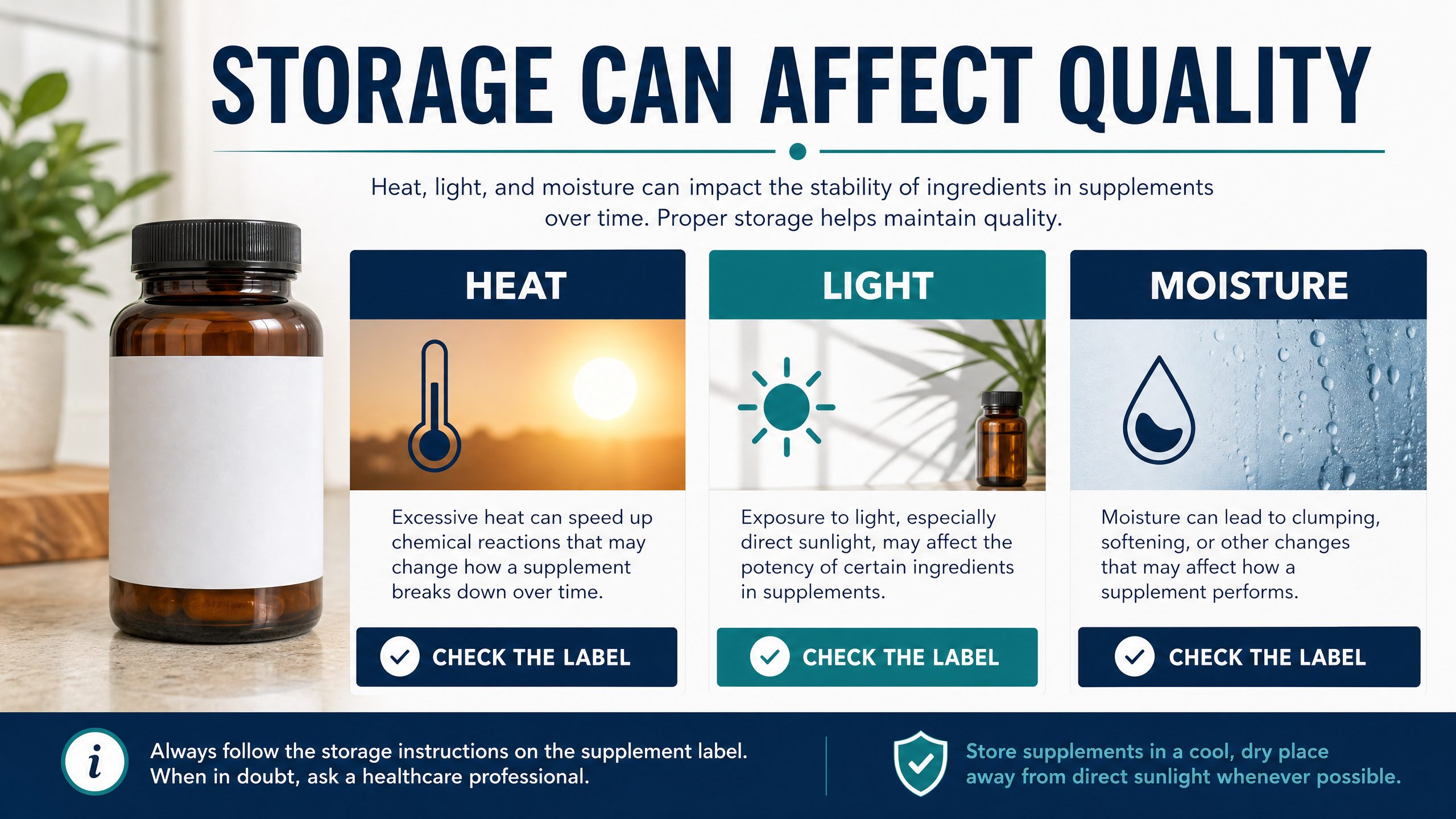
- Heat, light, and moisture accelerate chemical breakdown (loss of potency), oxidation (rancid oils), and loss of viability (probiotics); minerals tend to be most chemically stable [1][3][4].
- Keep supplements in a cool, dry, dark place; some products (certain probiotics, fish oils) may benefit from refrigeration—follow the label [1][3].
- Visual changes (off smell, color change, clumping, oil separation) are useful cues to stop using a product, but absence of changes does not confirm unchanged potency.
How “expiration” and shelf-life work
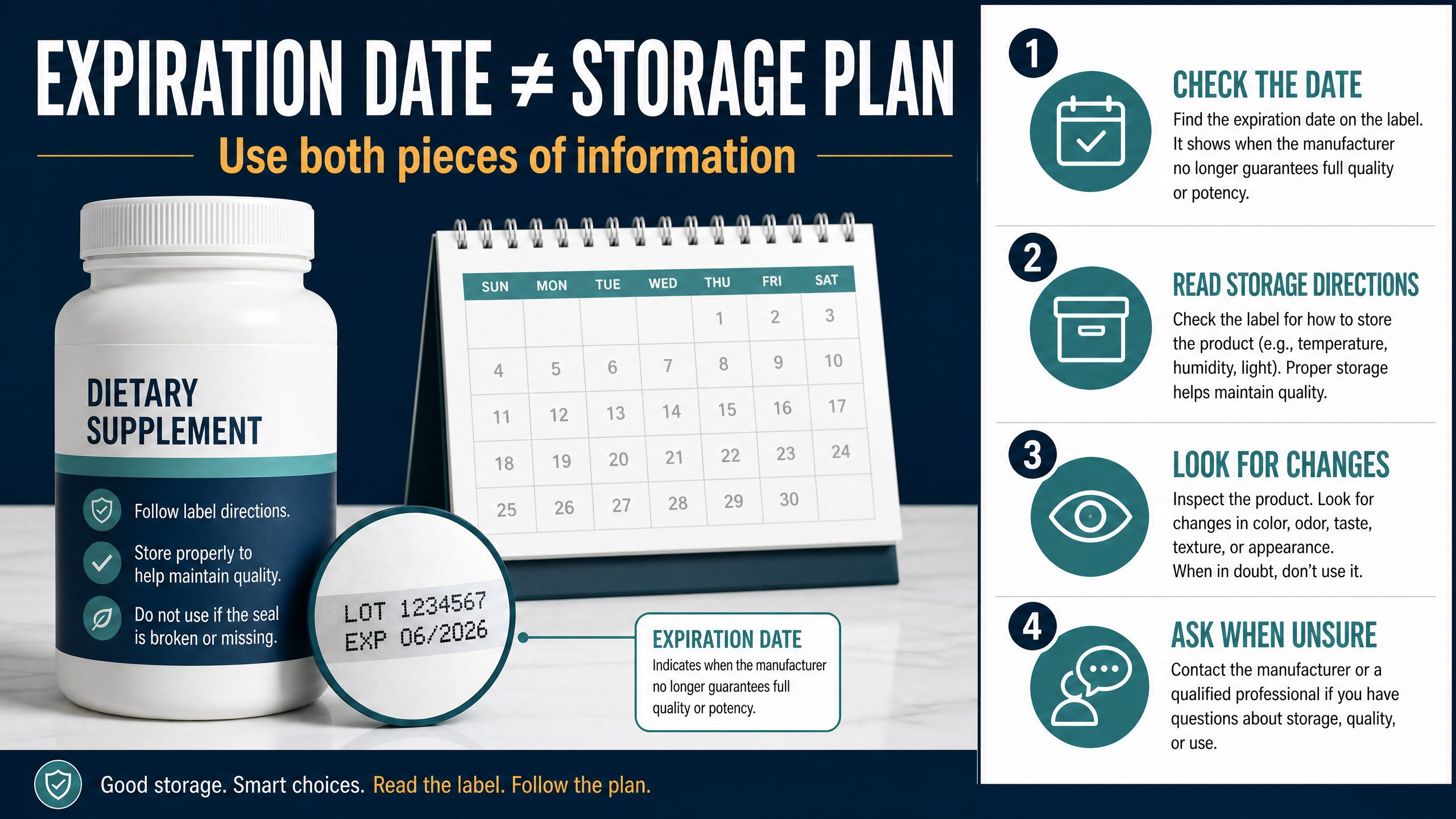
- Manufacturer testing and labeling: Companies that place an expiration or “best by” date should have stability data to support it; the FDA expects labels and claims to be truthful and not misleading [2]. If no date appears, potency may still decline over time.
- What “expires” means: Expiration usually refers to when the manufacturer can support the stated potency and safety under specified storage conditions. It does not always mean an immediate safety hazard after that date — but efficacy may be reduced.
Which ingredients are most affected by heat, light, and moisture
Vitamins and amino acids
– Water-soluble vitamins (vitamin C and many B vitamins) are prone to oxidation and loss of potency from air, heat, and light exposure [4].
– Fat-soluble vitamins (A, D, E, K) are chemically different but can still degrade if exposed to light or stored at high temperatures.
Oils and fatty-acid supplements
– Fish oil and other omega‑3 oils are sensitive to oxidation and can become rancid if exposed to heat, light, or prolonged air contact. Proper packaging (dark glass, airtight seals) and cooler storage slow oxidation [1]. Rancid oils may smell or taste off.
Probiotics and live cultures
– Probiotic labels list colony-forming units (CFUs) at manufacture or “at the time of expiration.” Viability declines with heat and moisture — some strains are shelf-stable, others require refrigeration. Follow label storage instructions and accept that CFU counts drop over time even under ideal storage [3].
Minerals and simple salts
– Most single minerals (e.g., calcium, iron, magnesium) are relatively stable to heat and light; their chemical forms do not degrade the way vitamins or live cultures do. However, formulations with binders, flavors, or added vitamins may still be vulnerable.
H3: Herbal extracts, tinctures, and powders
– Herbal compounds vary. Many botanical extracts are more sensitive to light and oxygen; powders may clump with moisture and lose aroma or potency. Alcohol‑based tinctures are generally more shelf-stable than aqueous extracts.
Practical storage: examples and common mistakes
H3: Best-practice storage
– Keep containers tightly closed, in a cool (not hot), dry, dark place — a kitchen pantry away from the stove or a bedroom cupboard is usually better than a bathroom medicine cabinet.
– For products that say “refrigerate after opening” or “store below X°C/F,” follow the label; refrigeration can extend life for oils and some probiotics [1][3].
H3: Common mistakes that shorten shelf life
– Leaving bottles in a hot car or on a sunny windowsill: heat and sunlight speed chemical reactions and oxidation.
– Storing in the bathroom: repeated humidity cycles from showers introduce moisture that causes tablets to soften, powders to clump, and capsules to degrade.
– Leaving lids off or routinely opening containers: increased air exposure accelerates oxidation.
H3: Special handling examples
– Protein powders and powdered supplements: keep sealed and free from moisture; use scoop to avoid introducing water. If clumping or sour smell develops, discard.
– Liquid herbal extracts or tinctures: watch for cloudiness or off odors; some may darken but still be usable — check label guidance.
– Single-dose blister packs or stick packs: offer improved protection from air and moisture compared with bulk jars.
How to tell a supplement may be past its prime
- Smell: fish oil or herbal oils that smell strongly “off” or rancid should be discarded.
- Appearance: clumping, discoloration, visible mold, or capsule deformity are signs of moisture damage.
- Texture/taste: tablets that crumble, turn soft, or have a stale, sour taste are suspect.
- When in doubt: if the product lacks an expiration date or the lot number is missing and you suspect storage damage, discard it.
Note: absence of obvious signs does not confirm unchanged potency; a tablet that looks normal may have reduced active ingredient levels after prolonged exposure to heat or past the labeled date.
Comparison framework: how to choose packaging and storage features
When evaluating products in the future, compare these label and packaging attributes:
– Expiration or “best by” date and any stated storage conditions (e.g., “store in a cool, dry place” or “refrigerate after opening”).
– Packaging type: individual blister packs or single-serve stick packs vs. bulk bottles; amber glass or opaque containers vs. clear plastic.
– Presence of desiccant packets or oxygen-impermeable seals.
– Whether the label lists CFUs “at time of manufacture” or “at time of expiration” for probiotics (the latter is preferable) [3].
– Third‑party testing seals or Certificates of Analysis (COA) availability for potency and purity.
[Affiliate product comparison block—add verified iHerb links after approval]
Limitations and when to ask a clinician
- Evidence limits: published research covers some products’ stability (for example, probiotics and oils), but stability can vary by formulation, strain, and manufacturer; generalizations have exceptions. The manufacturers’ testing, storage claims, and third‑party certificates are important but not uniformly required [2][3].
- Ask a clinician or pharmacist if you are: pregnant or breastfeeding; giving supplements to children; taking prescription medicines; managing kidney, liver, or immune disease; or preparing to compete as an athlete (some supplements carry risks for doping or contain undeclared ingredients). Professional guidance is especially important for therapeutic‑dose regimens or when switching to refrigerated formulations. The NIH Office of Dietary Supplements and FDA provide general consumer guidance, but individualized recommendations require clinical review [2][3][5–7].
How to compare products later
When you revisit options, compare: expiration/date and storage instructions; packaging (blister/amber glass/airtight); desiccant or sealed batches; CFU statements for probiotics; and presence of third‑party testing/COAs. Prioritize products with clear storage guidance and a stated potency at expiration for probiotics.
[Affiliate product comparison block—add verified iHerb links after approval]
Bottom line
Supplements can and do lose potency and quality over time; heat, light, and moisture accelerate chemical breakdown, oil rancidity, and loss of live cultures. Follow label storage instructions, keep bottles tightly closed in a cool, dry, dark place, and watch for obvious sensory changes (smell, color, clumping). When in doubt — for sensitive groups or therapeutic use — consult a clinician or pharmacist before continuing use.
Editorial note
VitaEvidence Editorial Team. Last reviewed: August 2026. For general education, not personal medical advice. Read our Editorial Policy.
References
[1] Omega‑3 Fatty Acids (Fish Oil): NIH Office of Dietary Supplements. https://ods.od.nih.gov/factsheets/Omega3FattyAcids-Consumer/
[2] Dietary Supplements: FDA. https://www.fda.gov/food/dietary-supplements
[3] Probiotics: NIH Office of Dietary Supplements. https://ods.od.nih.gov/factsheets/Probiotics-Consumer/
[4] Vitamin C: NIH Office of Dietary Supplements. https://ods.od.nih.gov/factsheets/VitaminC-Consumer/
[5] Nutrients (2025) Mini‑review: Sleep, nutrition and supplementation. https://doi.org/10.3390/nu17111779
[6] Nutrients (2025) Systematic review: Dietary supplement interventions and sleep quality. https://doi.org/10.3390/nu17243952
[7] Frontiers in Nutrition (2025) Systematic review: Supplements and elite‑athlete performance. https://doi.org/10.3389/fnut.2025.1675654