In this guide
- Key Takeaways
- Surface: a moving belt versus a changing route
- Grade: why an incline is more than a number
- Pace: the console number is only one signal
- For an easy aerobic run
- For intervals
- For hills
- What the evidence supports—and what remains uncertain
- Safety and When to Seek Care
- A practical way to choose
- References
A treadmill and an outdoor route can show the same speed while creating different running experiences. The belt moves beneath you, the surface is uniform, and the incline can be constant. Outdoors, you respond to wind, turns, slope changes, surface texture, and the need to propel your body. Those differences change what the session trains and how you interpret the numbers.
For most healthy adults, the main health question is whether you accumulate regular moderate or vigorous activity—not whether every mile is indoors or outside. The CDC recommends at least 150 minutes of moderate-intensity aerobic activity or 75 minutes of vigorous activity per week, plus muscle-strengthening activity on two days. Running is one way to reach that target, but a sustainable choice fits your environment, access, and goals.
Key Takeaways
- A treadmill is not a perfect outdoor replica. A systematic review found that most measured biomechanical outcomes are broadly comparable, but some foot-strike, knee-motion, contact-time, and pelvis-motion measures differ.
- The same pace is not necessarily the same workload. Grade, wind, turns, heat, surface changes, and how familiar you are with the treadmill can alter effort.
- A 1% treadmill incline is not a universal conversion rule. Research has used 1% in some protocols, but studies do not establish one incline that accurately simulates every outdoor run.
- Grade changes the session. Uphill running generally raises cardiorespiratory demand; downhill running adds braking and control demands that a flat treadmill cannot reproduce in the same way.
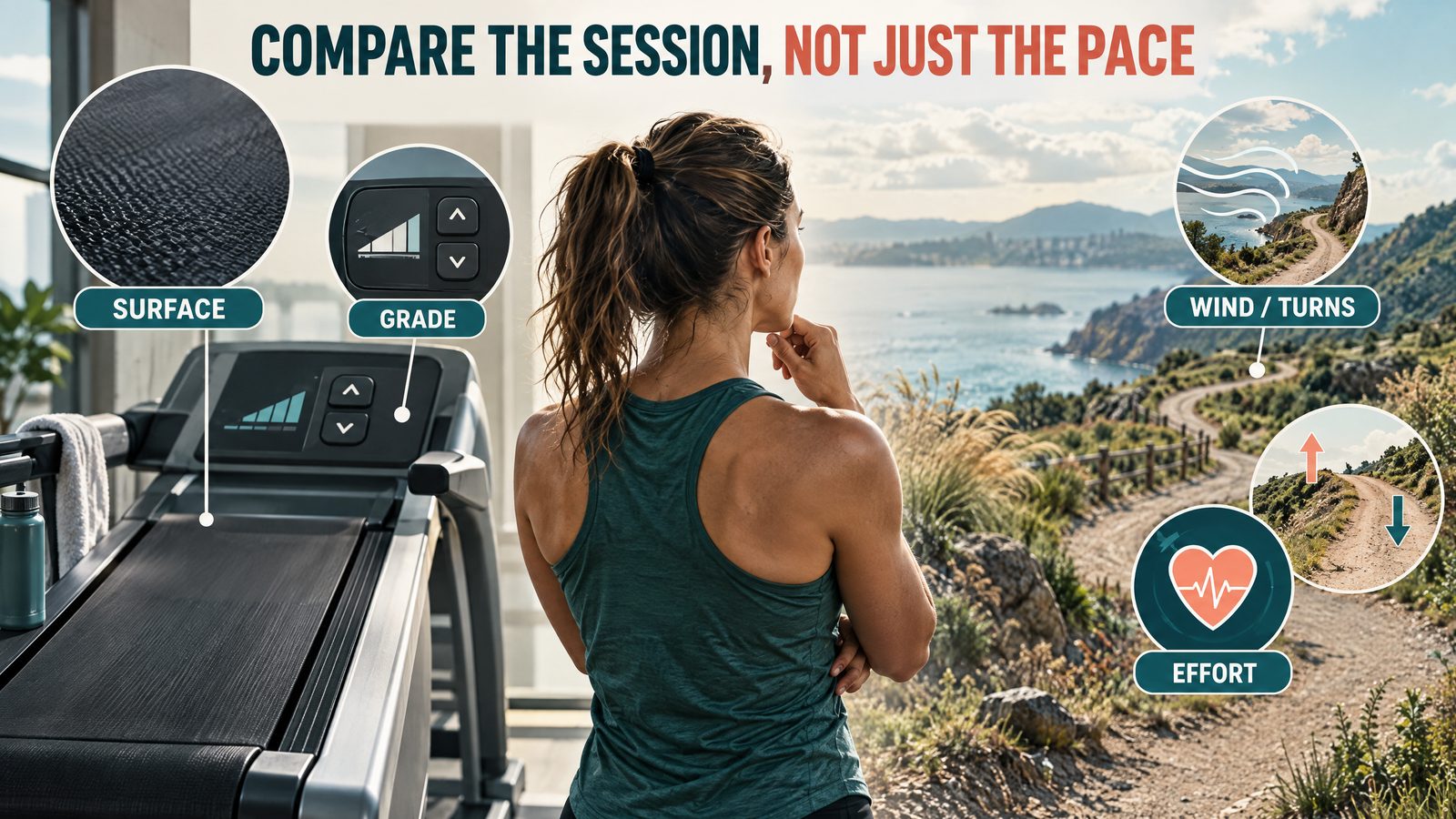
- Compare like with like. Use effort, duration, grade, and conditions—not pace alone—to decide whether two runs were similar.
Surface: a moving belt versus a changing route
A motorized treadmill provides a steady belt speed and predictable surface. That consistency can help with intervals, controlled testing, or running when darkness, traffic, smoke, extreme weather, or an unsafe route is a concern. It also reduces the need to avoid cracks, gravel, or pedestrians.
Outdoor running requires more adjustments. Asphalt, concrete, tracks, packed dirt, and trails differ in traction, unevenness, and turning demands. Wind creates air resistance, and hills may arrive gradually rather than as a single console setting. Pace can fluctuate even when effort is steady.
The best treadmill-versus-overground evidence does not support a simple claim that one surface causes fewer injuries for everyone. In a 2019 systematic review and meta-analysis of 33 crossover studies, most biomechanical outcomes were comparable. However, the authors reported low- or very-low-certainty differences in foot-ground angle at foot strike, knee motion, contact time, and vertical pelvis displacement. Treadmill experience, surface stiffness, belt dimensions, speed perception, and air resistance may contribute.
In practical terms, a treadmill may make pace control easier while offering less variety than an outdoor route. A runner training for uneven or hilly terrain should include gradual outdoor exposure, while a treadmill can make a controlled session more practical.
Grade: why an incline is more than a number
Changing grade changes the muscular and cardiovascular task even if belt speed stays fixed. Uphill running raises the body’s center of mass and usually increases the contribution of muscles involved in propulsion. Outdoors, runners often slow on a climb; on a treadmill, the same speed can be held while incline—and workload—increases.
Downhill running emphasizes braking and control. It may feel easier from a breathing standpoint than climbing while still challenging the muscles. A standard treadmill can simulate uphill grade, but not the repeated downhill changes, turns, and impact-control decisions of an outdoor course.
The frequently repeated “1% incline equals outdoors” idea needs context. A systematic review included studies using 0%, 1%, and, less often, higher grades; it did not establish one incline for every runner, treadmill, weather condition, or pace. Wind, temperature, belt mechanics, and individual running economy matter. A flat setting can be reasonable for an easy indoor run, while a modest incline can add uphill demand.
Pace: the console number is only one signal
Treadmill pace is a controlled external target: the belt moves at the selected speed unless you change it. Outdoors, pace is an outcome of effort plus terrain and conditions. A headwind, hill, loose surface, or sharp turn can slow the watch pace while the runner works harder. Conversely, a sheltered downhill section can produce a faster pace without the same aerobic demand.
Research supports caution when translating numbers. A 2019 meta-analysis found broadly similar oxygen uptake and heart-rate responses at maximal running, but some physiological and perceived-effort measures differed at submaximal speeds. Endurance performance tended to be poorer on motorized treadmills, while sprint findings varied. A treadmill time trial, outdoor race pace, and easy-run pace are not automatically interchangeable measurements.
A practical approach is to match the purpose of the workout first:
For an easy aerobic run
Choose a pace at which breathing is controlled and conversation is possible in short sentences. Keep the grade comfortable and judge the session by effort and duration. If the treadmill feels unusually hot or enclosed, ventilation may affect perceived effort even when the speed is unchanged.
For intervals
A treadmill can make work and recovery durations repeatable. Use a gradual speed change and leave room to step off safely rather than trying to jump onto moving side rails. If the goal is an outdoor race, include some outdoor sessions so the body practices turns, wind, variable pace, and the course’s actual grade pattern.
For hills
Use grade and effort together. A slower uphill pace can be a hard interval; a fast downhill pace may stress the legs without producing the same heart-rate response. Comparing only minutes per mile can mislabel the session.
| Condition | What changes | How to compare |
|---|---|---|
| Surface | Belt consistency versus texture, turns, and uneven ground | Record route and surface, not pace alone. |
| Grade | Uphill propulsion and outdoor downhill braking | Record grade and effort together. |
| Wind and weather | Outdoor air resistance, heat, and cold | Note conditions when interpreting pace. |
| Purpose | Intervals, easy aerobic work, or race-specific skills | Choose the setting that trains the intended demand. |
What the evidence supports—and what remains uncertain
Evidence supports the idea that treadmill and outdoor running are related but not identical tasks. Systematic reviews show substantial overlap, with differences that can depend on speed, grade, equipment, and familiarity. A treadmill is therefore a legitimate way to train and measure some aspects of running.
Evidence is weaker for claims such as “treadmills prevent injury,” “outdoor running is always more functional,” or “a 1% incline is mandatory.” Studies are often small, short, and conducted in healthy adults who are not representative of every runner. Treadmills also vary in belt stiffness, length, cushioning, and calibration. There is no universal pace or incline conversion for every route.
Safety and When to Seek Care
Use the handrails only when mounting, dismounting, or regaining balance; holding them while running changes posture and can make the displayed workload misleading. Wear shoes that fit comfortably, keep the area around the treadmill clear, and learn how to use the emergency stop before increasing speed. Outdoors, choose visible routes, account for traffic and weather, and use appropriate lighting after dark.
Stop the session and seek urgent medical care for chest pressure or pain, fainting, severe or rapidly worsening shortness of breath, new confusion, or symptoms that feel life-threatening. For persistent or recurrent pain, swelling, limping, dizziness, or a marked change in exercise tolerance, pause the provoking activity and arrange an evaluation with a qualified health professional. This article is general education, not a diagnosis or individualized treatment plan.

A practical way to choose
Choose the treadmill when control, convenience, climate, safety, or repeatable intervals matter most. Choose outdoors to practice real-route skills, variable terrain, wind management, or race-specific pacing. Many runners benefit from combining both.
When comparing runs, record duration, effort, grade, surface, weather, and pace changes. Then ask whether the session met its purpose. A slower outdoor run into a headwind may be harder than a faster treadmill run. The useful question is: “Which conditions did this session prepare me to handle?”
References
- CDC: Adult Activity—An Overview
- Van Hooren et al., Is Motorized Treadmill Running Biomechanically Comparable to Overground Running? Systematic Review and Meta-Analysis
- Miller et al., Systematic Review and Meta-Analysis Comparing Physiological, Perceptual and Performance Measures Between Treadmill and Overground Running
- Zimmermann et al., The Energetic Costs of Uphill Locomotion in Trail Running
- U.S. Physical Activity Guidelines for Americans, 2nd Edition