In this guide
- What this guide covers
- Key points at a glance
- How timing affects absorption and side effects
- Morning or night vitamins: practical approaches
- Timing for performance and exercise supplements
- Building a personal supplement timing plan — a simple framework
- Limitations and when to ask a clinician
- How to compare products later
- Bottom line
- Editorial note
- References
- Timing questions to ask
- Related VitaEvidence reading
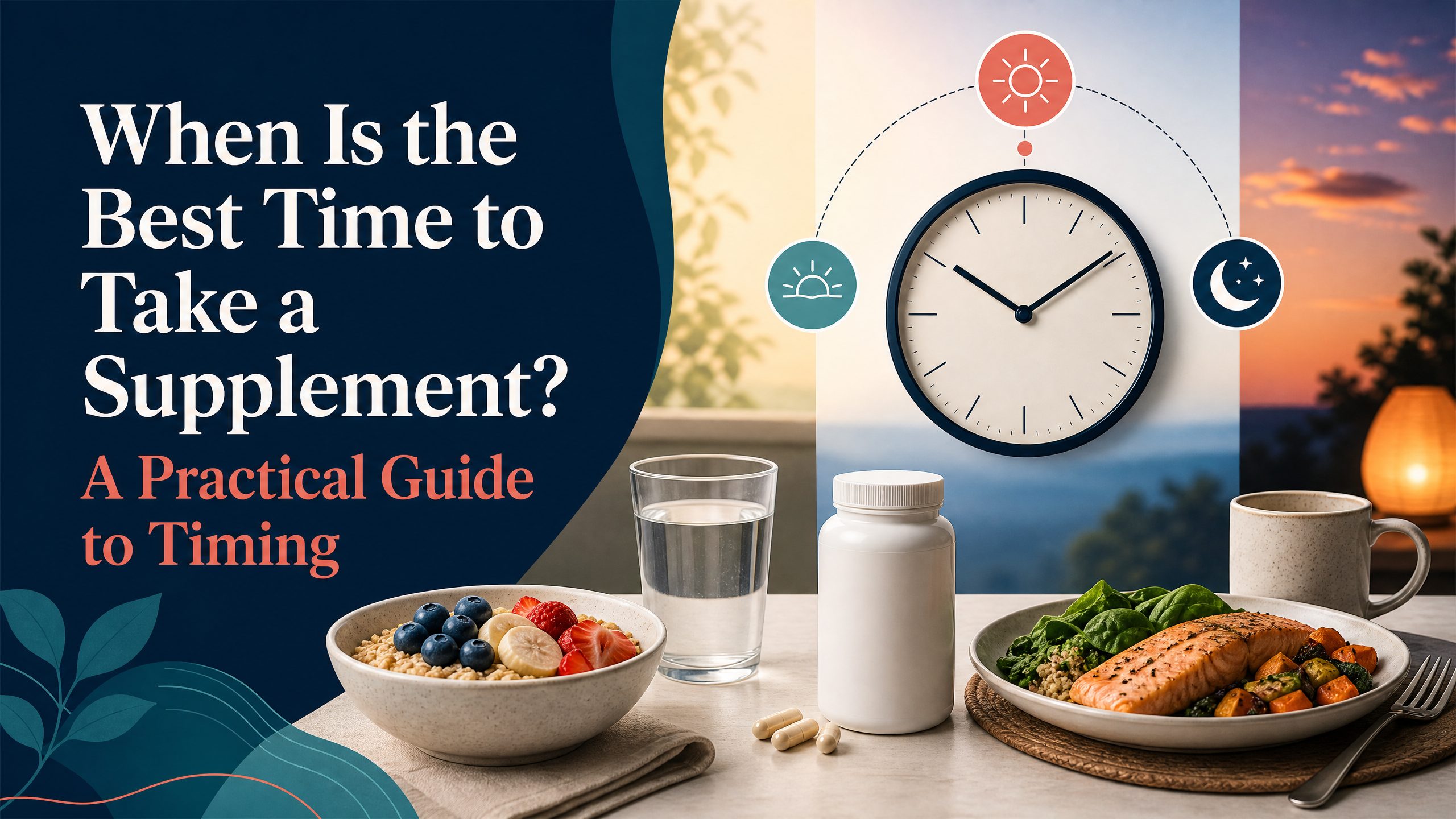
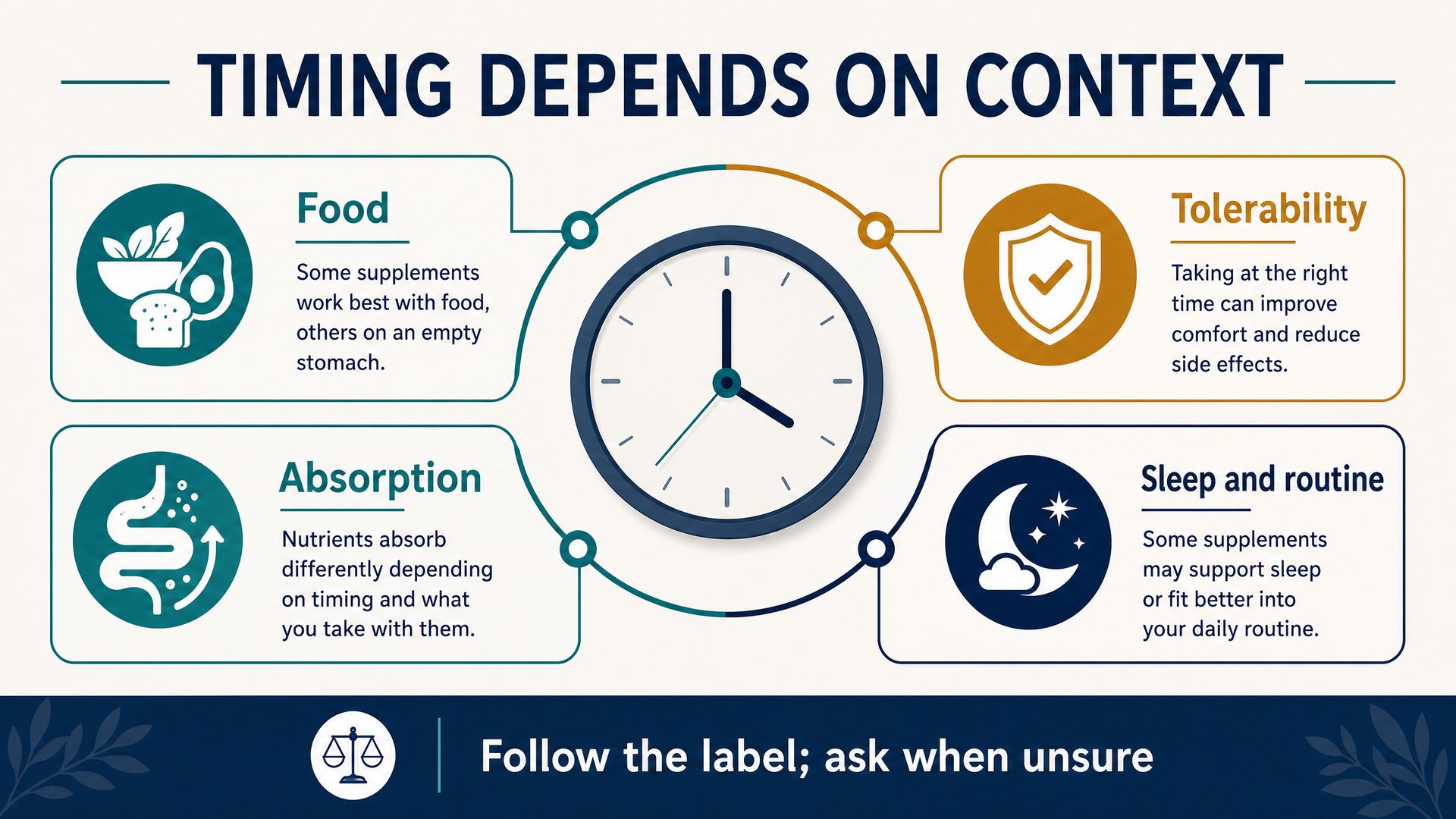
Timing can affect convenience, tolerability, or absorption for some products, but there is no universal best time and timing cannot compensate for an unsuitable supplement. This guide gives evidence-calibrated, practical rules for common supplements and a simple framework to build your own timing plan.
What this guide covers
- When to take common supplement types (fat‑ vs water‑soluble vitamins, minerals, probiotics, melatonin, omega‑3s, multivitamins).
- Rules for whether to take vitamins with food or on an empty stomach.
- Practical morning-or-night strategies and examples you can adopt today.
- A comparison checklist to help you evaluate products later and when to ask a clinician.
Key points at a glance
- Fat‑soluble vitamins (A, D, E, K) are usually better absorbed with a meal that contains some fat. [evidence: NIH ODS Vitamin D]
- Iron is absorbed best on an empty stomach but causing stomach upset is common; take with food if needed and keep it separate from calcium and some teas. [evidence: NIH ODS Iron]
- Many water‑soluble vitamins (B vitamins, vitamin C) can be taken any time; B12 in the morning may help with energy in some people.
- Time sleep‑related supplements (melatonin, valerian) near bedtime; evidence for many over‑the‑counter sleep aids is mixed. [evidence: systematic reviews]
- Consult a clinician before starting or changing supplements if you are pregnant, breastfeeding, a child, have kidney/liver disease, or take prescription medicines.
How timing affects absorption and side effects
H3: Fat‑soluble versus water‑soluble
– Fat‑soluble vitamins (A, D, E, K): dissolve in fat and are better absorbed when taken with a meal that contains some fat (for example, yogurt, avocado, olive oil). This is well established for vitamin D absorption. [1]
– Water‑soluble vitamins (B complex, vitamin C): dissolve in water and do not require fat; they are absorbed from the intestine and excess is excreted in urine. Consistency matters more than exact clock time.
H3: Minerals and interactions
– Iron: non‑heme iron (from supplements or plants) is absorbed better on an empty stomach but is often taken with food to reduce nausea. Calcium, antacids, and high‑fiber foods can reduce iron absorption; separate doses by 2–4 hours when possible. [2]
– Calcium and magnesium may compete with other minerals; spacing them out can improve absorption and reduce gastrointestinal side effects.
H3: Probiotics and stomach acidity
– Some probiotic strains are more likely to survive when taken with food because stomach acid is lower during and after a meal. Check manufacturer guidance or third‑party testing for strain stability.
Morning or night vitamins: practical approaches
H3: Morning-friendly
– B vitamins and B12: often taken in the morning because they can increase alertness for some people. If you notice jitteriness or disrupted sleep, move them earlier or split doses.
– Multivitamins: many people prefer morning with breakfast to form a habit and avoid stomach upset.
H3: Night-friendly
– Magnesium: some people find a calming effect and take magnesium in the evening to support relaxation. If magnesium causes loose stools, split the dose or reduce amount.
– Melatonin and sleep aids: take 30–60 minutes before planned bedtime. Evidence for over‑the‑counter herbal sleep aids varies; systematic reviews show mixed results and more research is needed. [3]
H3: Examples
– Example A — simple routine: Multivitamin with breakfast (contains some fat), omega‑3 with lunch, magnesium 1 hour before bed.
– Example B — digestive sensitivity: Iron at mid‑afternoon on an empty stomach with a vitamin C‑rich snack to boost absorption, or iron with a small amount of food if stomach upset occurs.
Timing for performance and exercise supplements
- Protein: post‑exercise protein supports recovery; total daily protein is more important than precise minute‑by‑minute timing for most recreational exercisers. For athletes, a protein intake spread across the day is recommended. [4]
- Creatine: can be taken any time; consistency and adequate daily dose are key (see product label and professional guidance). For performance-focused timing, taking creatine near training sessions is common but not required. [4]
(See Frontiers review for elite‑athlete considerations.) [4]
Building a personal supplement timing plan — a simple framework
H3: Step 1 — List what you take and why
– Record each supplement, the active ingredient(s), and the purpose (e.g., vitamin D for low levels, iron for deficiency, omega‑3 for heart health).
H3: Step 2 — Assign timing rules
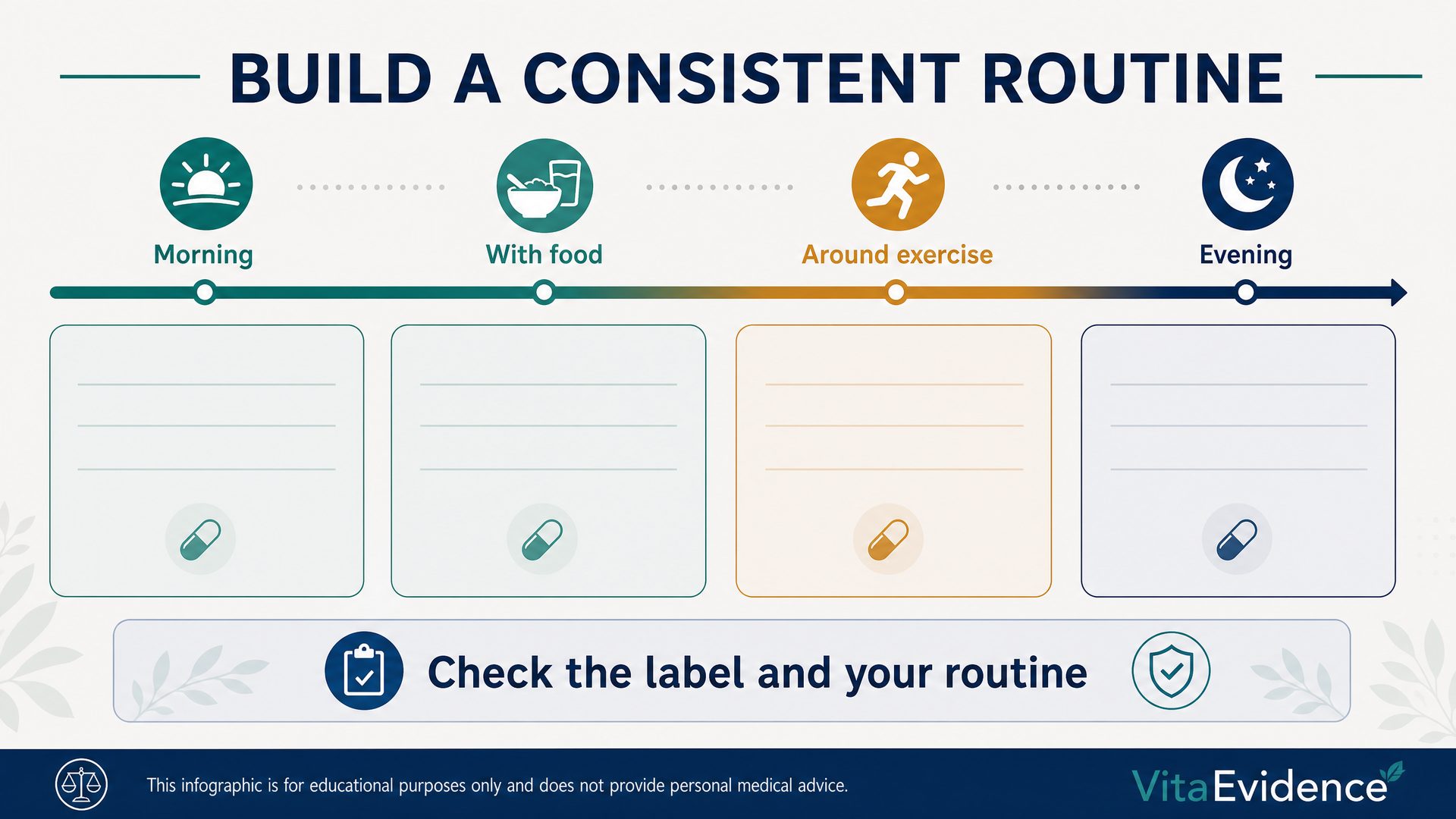
– Use three categories: With a meal (fat‑soluble vitamins, some multivitamins), Empty stomach (iron for absorption if tolerated), Before bed (melatonin, some magnesium). Note interactions (iron separate from calcium).
H3: Step 3 — Match to your daily routine
– Anchor doses to consistent daily events (breakfast, lunch, bedtime) to improve adherence. Example schedule: breakfast = multivitamin + vitamin D; lunch = omega‑3; bedtime = magnesium.
H3: Step 4 — Monitor effects and adjust
– Track side effects (nausea, heartburn, sleep changes) and effectiveness (lab results, symptom changes). If you suspect interactions with medications or health conditions, stop and consult a clinician.
Limitations and when to ask a clinician
- Evidence gaps: For many herbal supplements and combination formulas, high‑quality evidence on optimal timing is limited or inconsistent. Systematic reviews indicate mixed results for sleep supplements and varied effects in athlete studies. [3][4]
- Populations requiring review: pregnancy or breastfeeding, children, people with kidney or liver disease, those taking prescription medicines (anticoagulants, anticonvulsants, thyroid hormones, etc.), allergies, and people with eating disorders. These groups need individualized advice because of safety, altered absorption, or dose adjustments. [5]
- Medication interactions: Supplements can change drug levels (for example, calcium and thyroid hormone absorption, or vitamin K affecting warfarin). Always tell your clinician and pharmacist about all supplements you take. [5]
How to compare products later
When you shop, compare these label attributes and quality markers:
– Active ingredient (form and dose per serving) and percent Daily Value (if listed).
– Supplement Facts serving size and amount per serving.
– Ingredient form (e.g., methylcobalamin vs cyanocobalamin for B12; EPA/DHA amounts on omega‑3s).
– Allergen statements and fillers.
– Third‑party testing seals or a link to a Certificate of Analysis (COA).
– Manufacturer contact info, batch/lot number, and expiration date.
– Warning, contraindication, and medication interaction statements.
[Affiliate product comparison block—add verified iHerb links after approval]
Bottom line
The best time to take supplements depends on the nutrient, how it’s absorbed, potential side effects, and your daily routine. Taking fat‑soluble vitamins with a meal that contains fat and separating iron from calcium are reliable rules; many other supplements can be timed around meals or bedtime to reduce side effects and fit your schedule. Because evidence for some herbal and specialty formulas is limited and interactions can be important, check with a clinician for pregnancy, serious illness, or if you take prescription medicines.
Editorial note
VitaEvidence Editorial Team. Last reviewed: August 2026. For general education, not personal medical advice. Read our Editorial Policy.
References
[1] Vitamin D — Fact Sheet for Consumers. National Institutes of Health, Office of Dietary Supplements. https://ods.od.nih.gov/factsheets/VitaminD-Consumer/
[2] Iron — Fact Sheet for Consumers. National Institutes of Health, Office of Dietary Supplements. https://ods.od.nih.gov/factsheets/Iron-Consumer/
[3] Figueiro, M. G., et al. (2025). Dietary supplement interventions and sleep quality: systematic review and meta‑analysis. Nutrients. https://doi.org/10.3390/nu17243952
[4] Sousa, C., et al. (2025). Supplements and elite‑athlete performance: systematic review. Frontiers in Nutrition. https://doi.org/10.3389/fnut.2025.1675654
[5] Dietary Supplements. U.S. Food & Drug Administration. https://www.fda.gov/food/dietary-supplements
[6] How sleep works and why it matters. Centers for Disease Control and Prevention. https://www.cdc.gov/sleep/about_index.html