In this guide
- What this guide covers
- Key points at a glance
- Match the form to your needs
- Swallowing, age, and adherence
- Dosing precision and titration
- Absorption and bioavailability
- Tolerability and gastrointestinal side effects
- Convenience, portability, and cost
- Common supplement forms: pros and cons
- Capsules and tablets
- Powders
- Liquids and tinctures
- Gummies and chewables
- Softgels and RTDs
- Practical examples and decision flow
- Limitations and when to ask a clinician
- How to compare products later
- Bottom line
- Editorial note
- References
- Related VitaEvidence reading
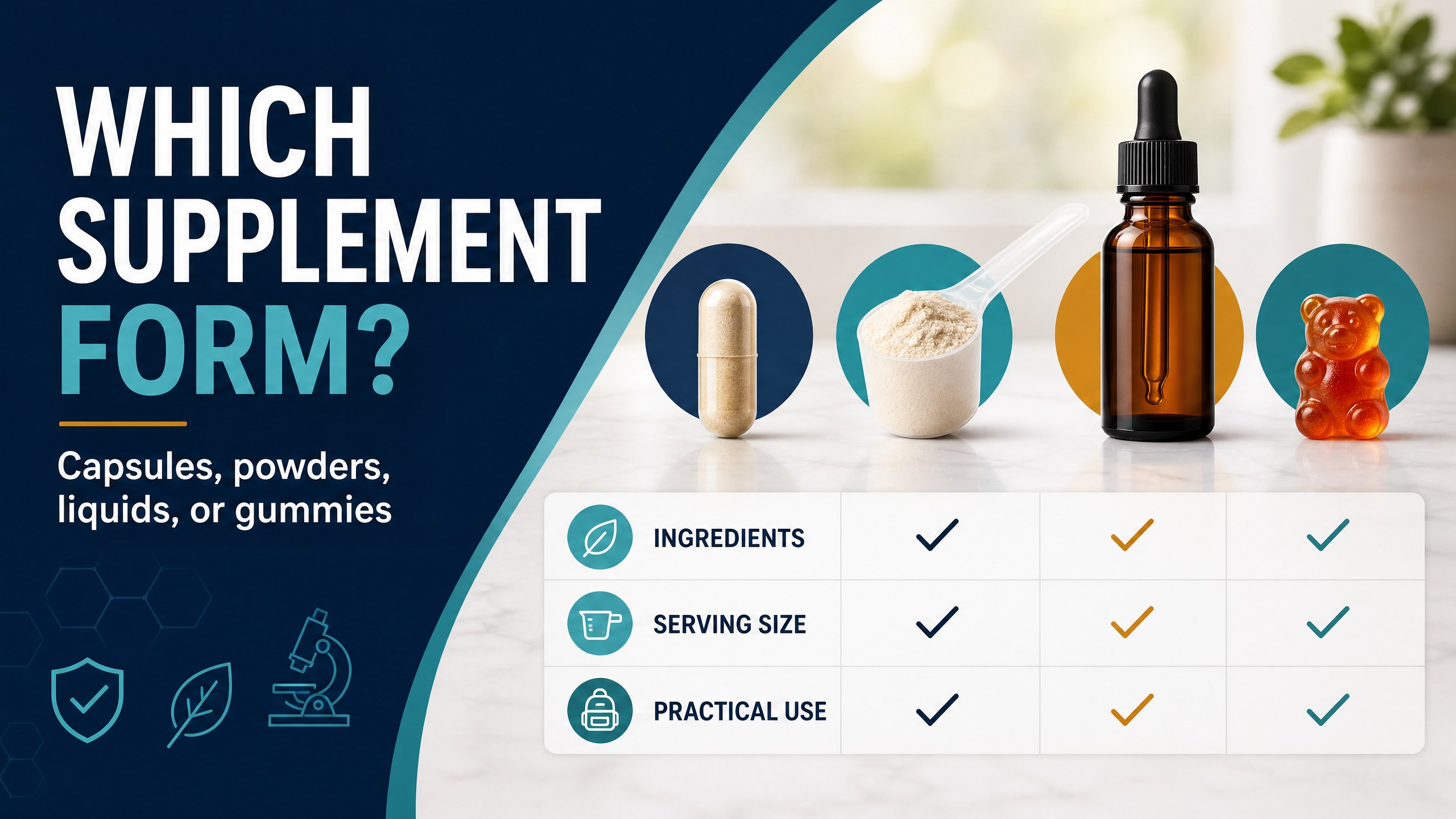
The right supplement form depends on the ingredient, dose, product quality, and the person using it; no form is universally best. This guide helps you match capsule, powder, liquid, gummy, and other formats to your needs—so you get the right dose, absorption, and adherence while avoiding common pitfalls.
What this guide covers
- How physical form affects dose accuracy, absorption, tolerability, and convenience
- Practical examples to match form to common goals (age, swallowing, athletic use, picky eaters)
- A simple comparison framework and future product–label checklist
- Limits of the evidence and when to talk with a clinician
Key points at a glance
- Pick a form that fits your ability to take it (swallowing, taste, dose frequency) and the nutrient’s stability or absorption needs.
- Powders and liquids may offer flexible dosing, but faster absorption is not guaranteed but can be less stable or taste strong; capsules and gummies are convenient but may limit dose precision.
- Consider safety signals: sugar or additives in gummies, alcohol or preservatives in liquids, and third‑party testing for quality. Consult a clinician for pregnancy, children, chronic disease, or drug interactions.
Match the form to your needs
Swallowing, age, and adherence
- Capsules/tablets: Good for adults who can swallow pills and want minimal taste. Enteric-coated or delayed-release tablets can reduce stomach irritation for some minerals or herbs.
- Gummies and chewables: Often improve adherence for children and adults who dislike pills, but may contain added sugar or lower active doses. Gummies are not ideal when precise dosing or large nutrient amounts are required.
- Powders and liquids: Useful for people who have trouble swallowing, need large or adjustable doses (protein, creatine, electrolytes), or prefer mixing into food/drinks.
Practical example: An older adult with mild dysphagia may prefer powders mixed into yogurt or a liquid under clinician supervision rather than large tablets.
Dosing precision and titration
- Capsules/tablets: Typically fixed doses—easy to track but less flexible for small adjustments.
- Powders and liquids: Allow fractional dosing (half‑serving) and gradual titration, helpful when starting new nutrients that may cause sensitivity (e.g., magnesium for sleep or fiber supplements).
- Gummies: Often deliver smaller, fixed doses intended for regular daily use—less suitable when clinical lab monitoring guides dose changes.
Absorption and bioavailability
- Some nutrients are formulated specifically to improve absorption (e.g., lipophilic vitamins in oil-based softgels, emulsified omega‑3s). For fat‑soluble vitamins, taking a capsule or softgel with a meal containing fat improves absorption.
- Liquids and powders do not automatically produce faster or better absorption; absorption also depends on the chemical form of the nutrient (e.g., different mineral salts) and the presence of food. Check the ingredient list for the nutrient form.
Evidence note: Research into whether a particular physical form meaningfully changes clinical outcomes is mixed and nutrient-specific; product formulation and dose matter as much as form [Nutrients reviews, 2025] [1][2].
Tolerability and gastrointestinal side effects
- Minerals such as iron commonly cause GI upset with tablets; gentle forms or liquid formulations may reduce irritation but can taste unpleasant and stain.
- Powders with fiber or certain amino acids may cause bloating or gas on initiation—start at lower doses and increase gradually.
- Gummies and chewables can cause dental sugar exposure; look for low‑sugar or sugar‑free options if dental health is a concern.
Convenience, portability, and cost
- Capsules/tablets: Typically the most compact and often least expensive per dose.
- Powders: Bulk powders are often cost‑effective for high‑dose nutrients (protein, creatine) but require measuring and mixing.
- Liquids and RTDs (ready‑to‑drink): Convenient but usually costlier and have shorter shelf life once opened.
- Gummies: Easy to take without water; may increase overall cost and provide lower doses per unit.
Common supplement forms: pros and cons
Capsules and tablets
Pros: Accurate dose, easy storage, low taste.
Cons: Harder to split doses; swallowing difficulty; some tablets contain binders or coatings.
When to choose: Standard daily vitamins or minerals when dose is fixed and swallowing is not an issue.
Powders
Pros: Flexible dosing, cost‑effective for high doses, mixable with food/drinks.
Cons: Taste, texture, mixability, variable solubility, potential contamination risk if scoops are reused.
When to choose: Protein, creatine, electrolyte mixes, or when you need to adjust dose precisely.
Liquids and tinctures
Pros: Fast absorption, useful for infants or people who can’t swallow pills, flexible dosing.
Cons: Often contain preservatives or alcohol, shorter shelf life, taste challenges.
When to choose: Infant vitamin D drops (per pediatric guidance consult), people with swallowing difficulties (check for sugar or excipient content).
Gummies and chewables
Pros: High adherence, palatable for children and adults who dislike pills.
Cons: Lower active amounts per unit, added sugars or colors, sticky (dental risk).
When to choose: Multivitamins for picky children (after clinician discussion), or adults needing a palatable adherence aid—not for high‑dose therapeutic needs.
Softgels and RTDs
Pros: Good for oil‑based nutrients (vitamin D, omega‑3), convenient for on‑the‑go.
Cons: Cost, sometimes larger capsules, limited dose flexibility.
When to choose: When formulation requires oil base for stability or absorption.
Practical examples and decision flow
- If you need a large nutrient load (protein, creatine): Powder is generally most practical and cost‑efficient. Check a product for purity and third‑party testing.
- If you have swallowing problems or care for an infant: Liquid drops or powders mixed into food are reasonable but ask a clinician about dose and excipients, especially for infants or during pregnancy.
- If you want daily multivitamin adherence: A gummy may improve consistency, but check for sugar content and that the active nutrient amounts meet your needs. Gummies often provide lower levels of minerals like iron or zinc.
- If you’re managing an interaction risk (prescription meds, kidney disease): Capsules/tablets with known ingredient forms may be easier for clinicians to review; always consult before starting.
Limitations and when to ask a clinician
- Supplements are not regulated like drugs; the FDA does not approve dietary supplements for safety or effectiveness before they are marketed [FDA]. Product quality, dose accuracy, and contaminants can vary.
- Talk with a clinician before starting or switching forms if you are pregnant, breastfeeding, a child, have kidney or liver disease, are on prescription medicines, have allergies, an eating disorder, or plan to use high therapeutic doses. Laboratory monitoring may be needed for certain nutrients (iron, vitamin D, potassium, etc.).
- For athletes or performance goals, consult a sports‑medicine clinician or dietitian: certain formats (RTDs, powders) are common in sports, but evidence for performance outcomes varies by supplement and population [Frontiers in Nutrition review, 2025] [3].
How to compare products later
When you shop, compare these label attributes:
– Serving size and amount per serving (mg, IU, g) and % Daily Value (if provided)
– The chemical form of the nutrient (e.g., magnesium citrate vs magnesium oxide) and whether an oil base is used for fat‑soluble vitamins
– Number of servings per container and cost per daily dose
– Inactive ingredients: sugars, alcohol, artificial colors, allergens (gluten, soy, dairy)
– Storage requirements and expiration date; opened shelf life for liquids/RTDs
– Evidence of third‑party testing or certificate of analysis, and a visible manufacturer contact/batch number
– Any dosing instructions (with food, avoid certain medicines) and warnings
[Affiliate product comparison block—add verified iHerb links after approval]
Bottom line
No single “best supplement form” fits everyone. Choose a form by balancing dose accuracy, absorption needs, tolerability, and how likely you are to take it consistently. Powders and liquids offer flexibility and are favored for high or adjustable doses; capsules/tablets are compact and precise; gummies improve adherence but may sacrifice dose and add sugars. For pregnancy, children, chronic conditions, or potential drug interactions, consult a clinician before changing or starting supplements.
Editorial note
VitaEvidence Editorial Team. Last reviewed: August 2026. For general education, not personal medical advice. Read our Editorial Policy.
References
[1] Nutrients 2025 mini‑review: Nutrition, supplements, and sleep. https://doi.org/10.3390/nu17111779
[2] Nutrients 2025 systematic review: Dietary supplement interventions and sleep quality. https://doi.org/10.3390/nu17243952
[3] Frontiers in Nutrition 2025 systematic review: Supplements and elite‑athlete performance. https://doi.org/10.3389/fnut.2025.1675654
[4] NIH Office of Dietary Supplements — Fact Sheets. https://ods.od.nih.gov/factsheets/list-all/
[5] U.S. Food and Drug Administration — Dietary Supplements. https://www.fda.gov/food/dietary-supplements
[6] USDA MyPlate. https://www.myplate.gov/
[7] Centers for Disease Control and Prevention — Sleep Basics. https://www.cdc.gov/sleep/about/index.html