
In this guide
- Key Takeaways
- What “Limited Human Evidence” Actually Means
- A Practical Evidence Ladder
- 1. Start with the study type
- 2. Identify the population and the product
- 3. Separate outcomes from surrogate markers
- How to Recognize a Real Research Gap
- What the Evidence Can Support—and What It Cannot
- Evidence may support
- Evidence cannot automatically support
- Safety: When to Slow Down or Seek Care
- A Practical Way to Read the Gap
- Bottom Line
- Sources
Meta title: Supplement Ingredients With Limited Human Evidence: How to Read the Research Gap
Meta description: Learn how to judge limited human evidence for supplement ingredients, separate promising signals from proof, and ask practical safety questions before buying.
Primary keyword: supplement ingredients with limited human evidence
Supplement Ingredients With Limited Human Evidence: How to Read the Research Gap
A supplement ingredient can sound compelling long before researchers know whether it helps people. Laboratory and animal findings, or a small human trial showing a blood-marker change, do not by themselves establish that a retail supplement improves a meaningful health outcome.
The gap between a plausible idea and dependable human evidence is common. NCCIH notes that evidence varies widely across products and that store-bought products may differ from those used in studies. Read the gap by asking what was studied, in whom, with which product, for how long, and with what outcome.
Key Takeaways
- “Limited evidence” usually means uncertainty, not proof that an ingredient works or does not work.
- Human randomized trials generally provide more useful evidence about effects than laboratory, animal, or purely observational research, but a small or poorly designed trial can still be unreliable.
- A change in a biomarker, such as a hormone or antioxidant measure, is not automatically a change in symptoms, function, disease risk, or longevity.
- A study of one standardized extract, dose, or formulation may not apply to a different product on a store shelf.
- Safety evidence can be limited even when a product appears promising; interactions, contamination, pregnancy, surgery, and underlying conditions matter.
What “Limited Human Evidence” Actually Means
The phrase can mean no human studies, only laboratory or animal research, one small trial, or observational research unable to separate an ingredient’s effect from other behaviors. Trials may also use different formulations, doses, populations, or outcomes, making them difficult to combine.
Ask whether studies answer the consumer’s question. A healthy-adult trial may not apply to a diagnosed condition; a short study may not address prevention; and an extract may not represent a tea or blend.
NCCIH cautions that labels may not always reflect product contents, so evidence for a named ingredient does not guarantee the same identity, purity, strength, or composition on a store shelf.
A Practical Evidence Ladder
1. Start with the study type
Laboratory and animal findings can guide what to test next, but are not direct evidence of benefit in people. Observational studies identify associations, yet supplement users may differ from nonusers in many ways. Well-conducted randomized controlled trials (RCTs) reduce some of these differences by assigning participants to an intervention or comparison group.
“Randomized” is not a magic word. Look for a credible comparison, enough participants for useful precision, adequate follow-up, and meaningful outcomes. Substantial dropout, unclear allocation, no meaningful control, or selective reporting lowers confidence.
2. Identify the population and the product
Ask whether participants resemble the claimed users. Check age, sex, health status, medications, baseline nutrient status, and reason for use, along with botanical species, plant part, extraction method, chemical form, combination ingredients, and serving size.
“Studies on ingredient X” can hide major differences. One study may test a purified compound while another tests a whole-plant extract. A product may advertise the ingredient’s name but provide an amount or form that was never evaluated in humans. Evidence is strongest when the tested intervention and the product being considered are sufficiently similar—and when that similarity is documented rather than assumed.
3. Separate outcomes from surrogate markers
A surrogate marker—such as a blood value, inflammatory marker, or imaging result—may be useful, but is not the same as fewer symptoms, better function, fewer hospitalizations, or longer life. A marker can change without meaningful benefit, or while harm occurs.
Locate the primary outcome and ask whether it was defined before the trial. Treat many positive secondary findings cautiously, because some may appear favorable by chance. A statistically noticeable result may be too small to matter.
How to Recognize a Real Research Gap
A research gap is more than “scientists need more studies.” It can be described specifically:
- Population gap: Evidence comes from a narrow group, such as young healthy volunteers, not older adults or people taking common medications.
- Product gap: The studies use a different extract, formulation, or quality-controlled product than the one being sold.
- Outcome gap: Research measures a short-term laboratory change rather than symptoms, function, or a patient-important outcome.
- Duration gap: Trials are too brief to address long-term effectiveness or harms.
- Comparison gap: Studies lack a placebo, usual-care group, or comparison with an established approach.
- Safety gap: Adverse effects, drug interactions, pregnancy, lactation, kidney or liver disease, and surgery have not been adequately studied.
These gaps support a careful conclusion: the ingredient may be plausible and early findings interesting, but effectiveness and safety remain uncertain. That is neither proof nor proof of worthlessness.
What the Evidence Can Support—and What It Cannot
Evidence may support
Early human studies may justify further research or suggest a hypothesis for a specific population and outcome. Consistent results across well-designed trials can increase confidence when estimates are precise, outcomes meaningful, and products comparable. Evidence may support a narrower statement than a label—for example, a short-term measured change rather than a promise to “boost immunity” or “detox” the body.
The CDC’s GRADE framework judges risk of bias, inconsistency, indirectness, imprecision, and publication bias across a body of evidence. High, moderate, low, and very low certainty describe confidence in an estimate—not a guarantee for an individual.
Evidence cannot automatically support
A mechanism, testimonial, animal study, or single small trial cannot establish disease prevention, treatment, or long-term safety. A meta-analysis cannot rescue fundamentally mismatched or weak studies; combining them may create a precise-looking but unreliable number.
Publication and reporting bias create another problem. Cochrane notes that unfavorable findings may be less likely to become available, while positive findings may be reported more prominently. A search that finds only published results may therefore overstate benefits. A confident headline can hide small, inconsistent, or incomplete evidence.
Safety: When to Slow Down or Seek Care
Limited effectiveness evidence also means less is known about harms. FDA does not approve dietary supplements for effectiveness before marketing and advises discussing them with a doctor, pharmacist, or other health professional. Products can interact with medicines, affect anesthesia or bleeding around surgery, and pose special concerns during pregnancy, breastfeeding, or childhood. “Natural” does not guarantee safety.
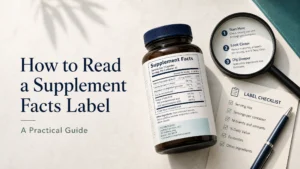
Bring the exact label, including Supplement Facts and other ingredients, to a clinician or pharmacist. Be especially cautious with products promising rapid weight loss, bodybuilding effects, sexual enhancement, or dramatic hormone changes; NCCIH notes that some have contained undeclared drug ingredients.
Stop using a product and seek prompt medical advice for a concerning reaction such as trouble breathing, facial or throat swelling, fainting, severe vomiting, chest pain, confusion, yellowing of the skin or eyes, dark urine, or unusual bleeding. Seek emergency care for severe or worsening symptoms. Do not delay evaluation of a new or serious symptom.
A Practical Way to Read the Gap
Before buying, write the claim in one sentence: symptom relief, a biomarker change, prevention, or general wellness. Check a reliable evidence summary, identify the best human study, compare its population and product with the label, look for meaningful outcomes and follow-up, and note what was not studied. Weigh uncertainty against cost, interaction risk, and safer established options.
Bottom Line
Limited human evidence calls for calibrated language—not hype or automatic dismissal. Match the claim to the evidence: same people, product, outcome, and a long enough timeline. If they do not line up, treat the ingredient as unproven for that purpose. Discuss uncertainty and safety with a qualified professional, keep a list of products and medicines, and remember that a research gap is information.
Sources
- National Center for Complementary and Integrative Health (NCCIH): Using Dietary Supplements Wisely
- NIH Office of Dietary Supplements: Dietary Supplements: What You Need to Know
- U.S. Food and Drug Administration: Questions and Answers on Dietary Supplements
- CDC ACIP GRADE Handbook: Criteria Determining Certainty of Evidence
- Cochrane Handbook: Assessing Risk of Bias Due to Missing Evidence in a Meta-Analysis