In this guide
- Key Takeaways
- Why menopause can cause dryness
- Nonhormonal options: what they do and how evidence fits
- Vaginal moisturizers for ongoing dryness
- Lubricants for sexual activity
- Comfort and sexual-health measures
- What the evidence does—and does not—support
- Safety and when to seek care
- A practical, evidence-aware plan
- References
Vaginal dryness is common during perimenopause and after menopause, but it does not have to be accepted as something you simply “put up with.” Falling estrogen can make vaginal and vulvar tissue thinner, less elastic, and less able to stay moist. The result may be burning, itching, irritation, pain with sex, or small tears. Urinary urgency, painful urination, or repeated urinary tract infections can occur as part of the broader genitourinary syndrome of menopause (GSM).
This article focuses on nonhormonal options and the limits of the evidence. It is general education, not a diagnosis or a personal treatment plan.
Key Takeaways
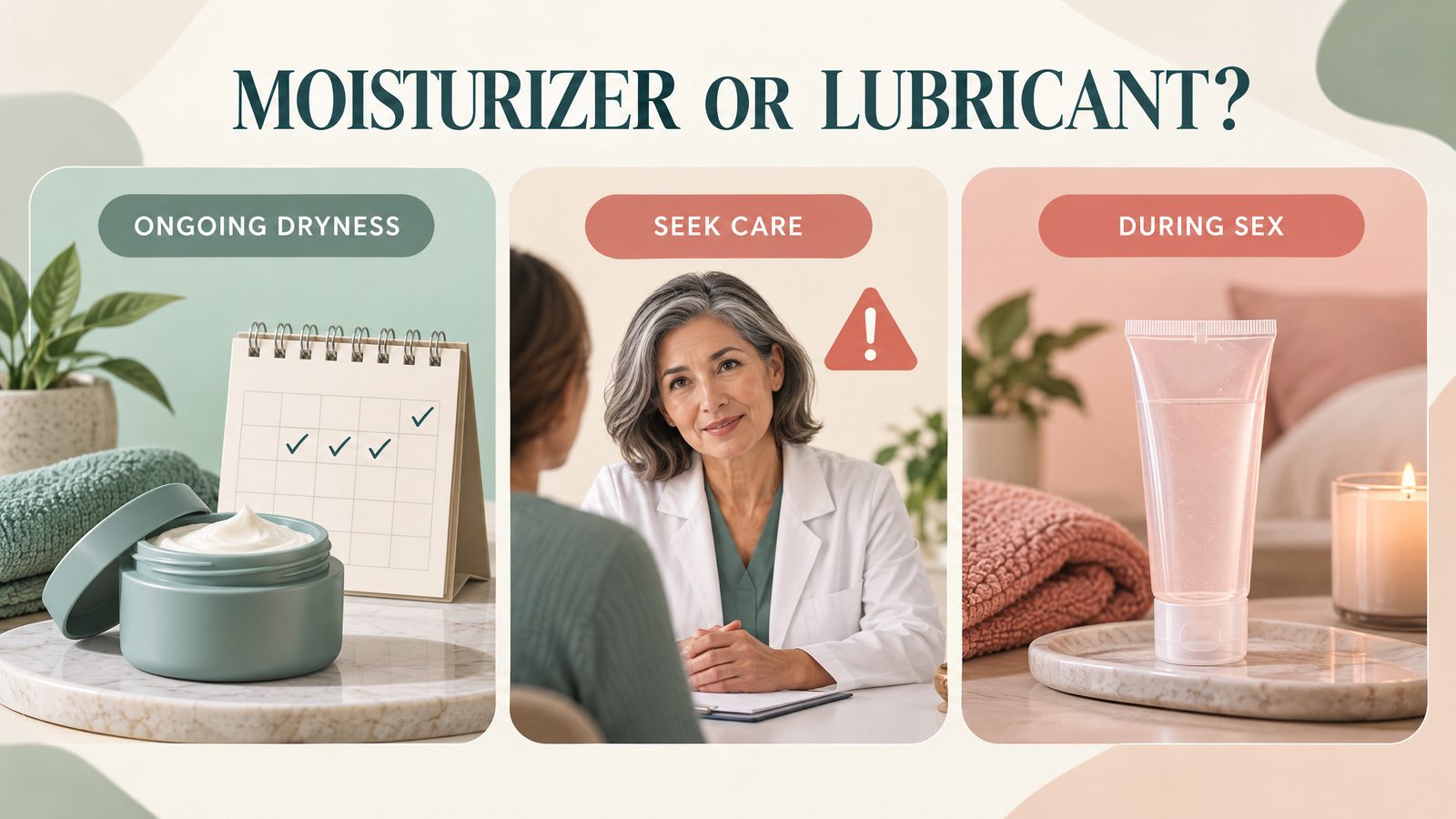
- A vaginal moisturizer is used regularly to reduce day-to-day dryness; a lubricant is used during sexual activity to reduce friction.
- Water-based and silicone-based lubricants can be reasonable options. Oil-based products may weaken latex condoms and can irritate some people.
- Studies suggest moisturizers and lubricants can improve symptoms, especially when symptoms are mild to moderate, but products and study designs vary and long-term evidence is limited.
- “Natural,” probiotic, supplement, and energy-based laser claims should not be treated as proven cures for menopause-related dryness.
- Bleeding after menopause, persistent pain, unusual discharge, sores, or urinary symptoms deserve clinical attention rather than repeated self-treatment.
Why menopause can cause dryness
Estrogen helps maintain the thickness, elasticity, blood flow, and lubrication of vaginal tissue. As estrogen levels change during the menopausal transition, the tissue may become more fragile and less well lubricated. Friction can then cause burning or pain, particularly during penetration.
Menopause is not the only possible explanation. Breastfeeding, some cancer treatments, anti-estrogen medicines, certain allergy or cold medicines, some antidepressants, autoimmune conditions, infections, and skin disorders can also contribute. That is one reason a new, severe, or changing symptom should not automatically be labeled “just menopause.”
Nonhormonal options: what they do and how evidence fits
Vaginal moisturizers for ongoing dryness
Moisturizers are intended for regular use, not only during sex. Internal products are placed in the vagina; external products are made for the vulvar skin. Formulations may contain ingredients such as polycarbophil or hyaluronic acid, although the specific product and its instructions matter.
The Office on Women’s Health describes over-the-counter moisturizers as an option used every few days. A review in Frontiers in Reproductive Health describes typical use one to three times weekly and notes that moisturizers adhere to the mucosa and provide hydration. In clinical studies, some moisturizers improved reported dryness and vaginal measures such as pH. However, the studies are often small, products differ, and symptom improvement does not prove that a moisturizer reverses all of the tissue changes associated with GSM.
A practical approach is to follow the product label, give one product enough time to judge tolerability, and stop if it causes burning, rash, or worsening symptoms. Do not use a product labeled only for external skin inside the vagina.
Lubricants for sexual activity
Lubricants provide short-term reduction of friction. They do not replace a moisturizer and are not expected to create lasting changes in vaginal tissue. Use them before and during sexual activity, and add more if friction returns. A water-based lubricant may be easy to wash off; a silicone-based lubricant often lasts longer. Individual tolerance varies.
If condoms are part of your sexual-health plan, check the lubricant label for compatibility. Oil-based lubricants can weaken latex condoms, reducing their effectiveness. Some products contain fragrances, warming or cooling agents, flavorings, or other additives that irritate sensitive tissue. A simpler, fragrance-free formula may be easier to tolerate. Product quality is not determined by a “natural” label; ingredients and personal tolerance still matter.
Lubricants can make sex more comfortable, but pain that persists despite adequate lubrication should not be ignored. Pain can also be related to pelvic-floor muscle tension, infection, vulvar skin disease, endometriosis, a medication effect, or another condition that needs evaluation.
Comfort and sexual-health measures
Allowing more time for arousal, choosing activities that do not hurt, communicating about pressure and pace, and stopping when pain begins can reduce friction-related injury. Nonpenetrative intimacy is a valid option while symptoms are being addressed. Some people benefit from a clinician referral to pelvic-floor physical therapy or sex therapy, particularly when pain has led to muscle guarding, fear, or relationship strain. These approaches may help the pain cycle and function; they are not substitutes for evaluating unexplained bleeding or discharge.
If vaginal opening tightness or fear of penetration is a major issue, a clinician may discuss gradual, supervised stretching or dilator use. This is not a do-it-yourself requirement, and forcing penetration can worsen pain.
| Option | Main use | Important limit |
|---|---|---|
| Vaginal moisturizer | Regular use for ongoing dryness | Stop for burning, rash, or worsening symptoms. |
| Water- or silicone-based lubricant | Short-term friction reduction during sex | Check compatibility with latex condoms. |
| Clinical evaluation | Persistent, severe, or changing symptoms | Bleeding after menopause or unusual discharge should not be self-treated indefinitely. |
What the evidence does—and does not—support
Supported reasonably well: For mild symptoms, nonprescription lubricants and moisturizers are widely recommended first-line options. ACOG, the National Institute on Aging, and the Office on Women’s Health all describe them as ways to reduce dryness or discomfort. The benefit is usually symptom relief, not a guarantee of normal lubrication or painless sex for everyone.
Still uncertain: Trials comparing moisturizers, lubricants, hyaluronic-acid products, and hormonal treatments have produced mixed results. Reviews report improvements in some outcomes, but differences in formulations, schedules, outcome measures, follow-up time, and placebo response make it hard to identify one best nonhormonal product. Evidence is also less clear for preventing long-term urinary or vaginal complications.
Not established as a cure: Oral supplements, herbal “hormone balance” products, probiotics, essential oils, and vaginal products marketed as detoxifying or tightening have not been shown to reliably correct menopause-related tissue changes. Vaginal laser or other energy-based procedures have attracted attention, but marketing should not be mistaken for established long-term safety and effectiveness. Ask a qualified clinician about the quality of evidence before paying for an invasive or expensive procedure.
Nonhormonal products are not the only medical options. If symptoms are moderate or severe, keep returning, or occur with other menopausal symptoms, a clinician can explain prescription nonhormonal medicines and local hormonal treatments, including their benefits, risks, and suitability for an individual’s history. People with a history of breast or other estrogen-sensitive cancer should not make that decision from an advertisement or general article; it warrants coordinated medical advice.
Safety and when to seek care
Contact a health professional promptly for:
- Any vaginal bleeding or spotting after 12 months without a period. Even light, brown, or post-sex bleeding needs evaluation. Vaginal tissue thinning can cause bleeding, but polyps, uterine-lining problems, and cancer must be considered.
- New or severe pelvic or vaginal pain, pain that prevents sexual activity, or pain that does not improve with a suitable lubricant and moisturizer.
- Foul-smelling or unusual discharge, sores, blisters, fever, significant itching, or symptoms after a new sexual exposure.
- Burning with urination, blood in the urine, urinary urgency with fever or back pain, or recurrent suspected UTIs.
- Symptoms that persist or worsen despite a careful trial of over-the-counter measures. ACOG advises seeing an ob-gyn if irritation and painful sex have not improved after about two months of moisturizer and lubricant use, or sooner if other symptoms occur.
A visit may include a medication and symptom review, an external and pelvic examination, and testing selected for the symptoms. You can ask what each part is for, request a slower examination, and discuss stopping if pain is too intense. You do not need to provide private health information to use general education; share only what is necessary with a licensed care team.
A practical, evidence-aware plan
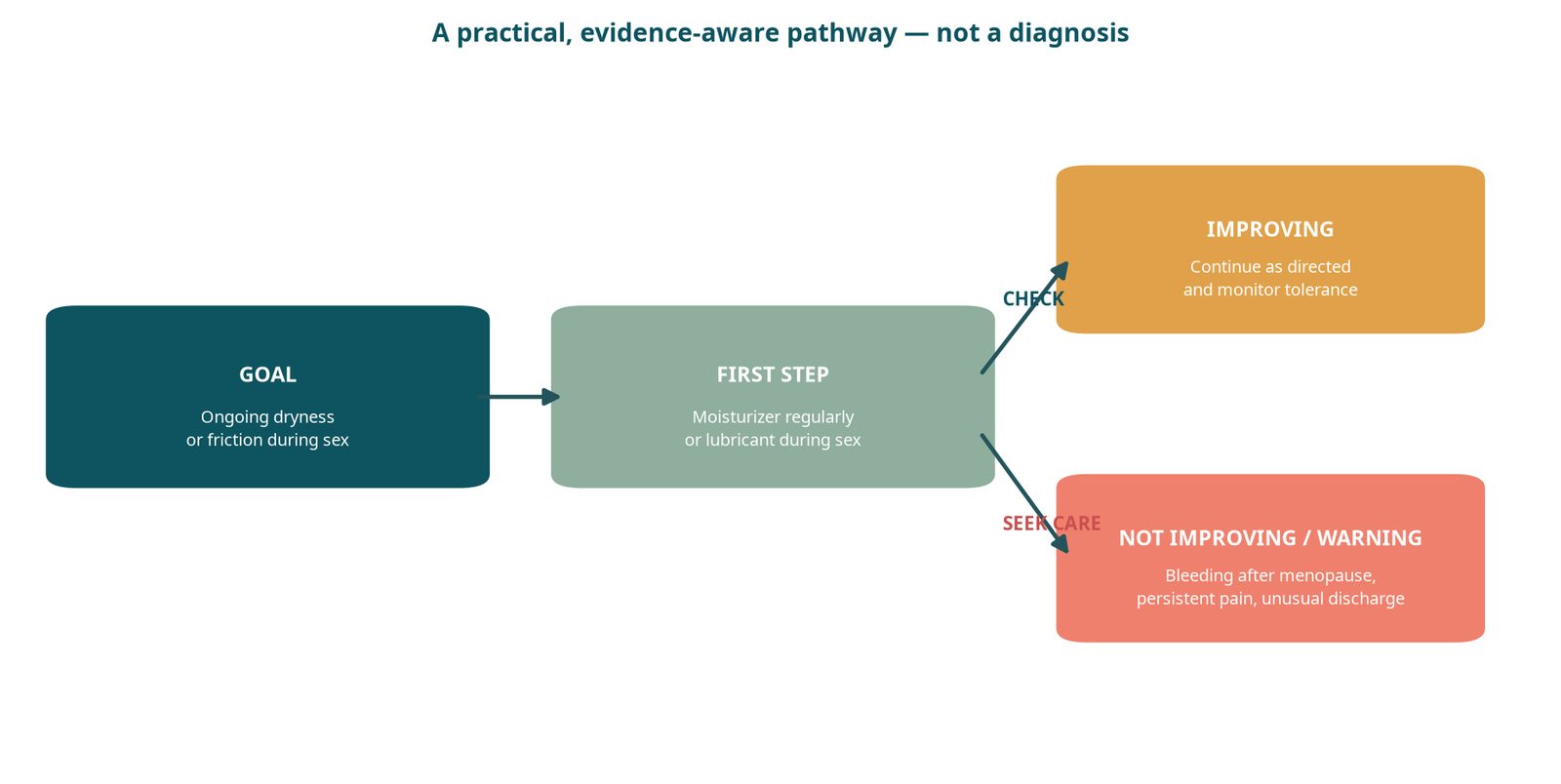
Start by distinguishing the goal: regular moisturizer for ongoing dryness, lubricant for friction during sexual activity, or evaluation for symptoms that do not fit simple dryness. Choose a product made for vaginal or vulvar use, avoid known irritants, and check condom compatibility. Track whether symptoms improve, worsen, or appear with urination, sex, a new medicine, or a new product.
If symptoms remain bothersome, seek care rather than escalating to multiple products or unproven procedures. Vaginal dryness is common, but bleeding, persistent pain, and infection-like symptoms are not problems to diagnose from a label. With an appropriate evaluation, people can choose between nonhormonal self-care, supportive therapies, and prescription options based on their symptoms and health history.
References
- American College of Obstetricians and Gynecologists (ACOG): Experiencing Vaginal Dryness? Here’s What You Need to Know
- Office on Women’s Health: Menopause Symptoms and Relief
- National Institute on Aging: Sex and Menopause—Treatment for Symptoms
- Sarmento et al., “Use of Moisturizers and Lubricants for Vulvovaginal Atrophy,” Frontiers in Reproductive Health (2021), via PubMed Central
- ACOG: Bleeding After Menopause Could Be a Problem. Here’s What to Know