In this guide
- Key Takeaways
- What Progressive Overload Actually Means
- Five Ways to Progress Without Testing a Max
- 1. Add repetitions before adding weight
- 2. Increase sets carefully
- 3. Improve execution and range of motion
- 4. Adjust rest or exercise order with a clear purpose
- 5. Use effort, not ego, to choose the day’s load
- What the Evidence Supports—and What Remains Uncertain
- A Simple Submaximal Progression Framework
- Safety and When to Seek Care
- A Practical Bottom Line
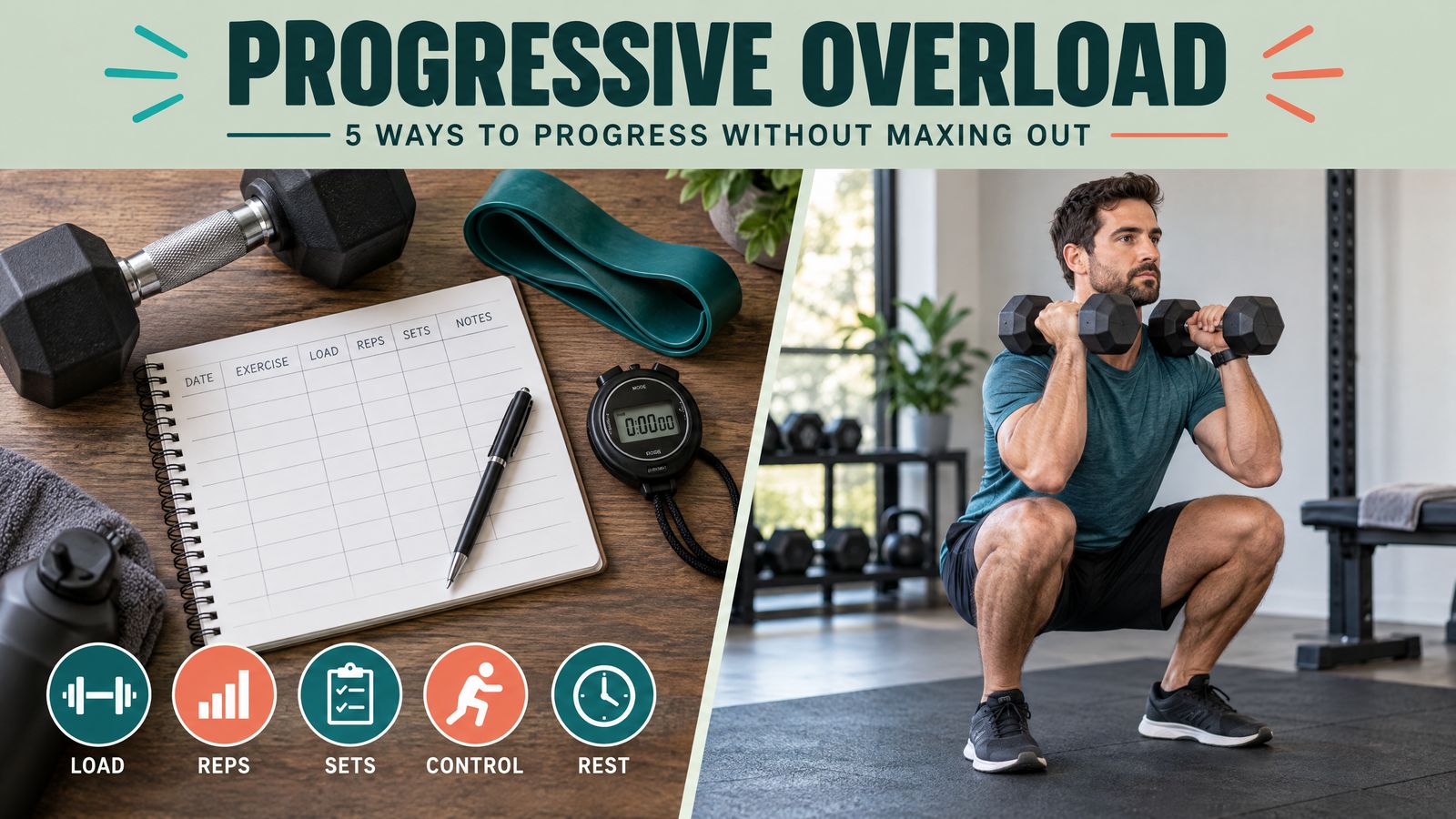
Progressive overload means gradually asking your body to do more work than it has adapted to—not proving your maximum strength every week. You can make training more demanding by adding a small amount of weight, completing more repetitions with the same weight, improving control, or doing comparable work with less rest. These options allow progress while reducing the need for repeated all-out lifts.
The goal is a process challenging enough to stimulate adaptation and controlled enough to repeat. The best choice depends on your goal, experience, equipment, and recovery. This article is general education, not a diagnosis or individualized medical or training plan.
Key Takeaways
- A one-repetition maximum (1RM) test is optional, not a requirement. Progressive overload can be tracked with submaximal sets and consistent exercises.
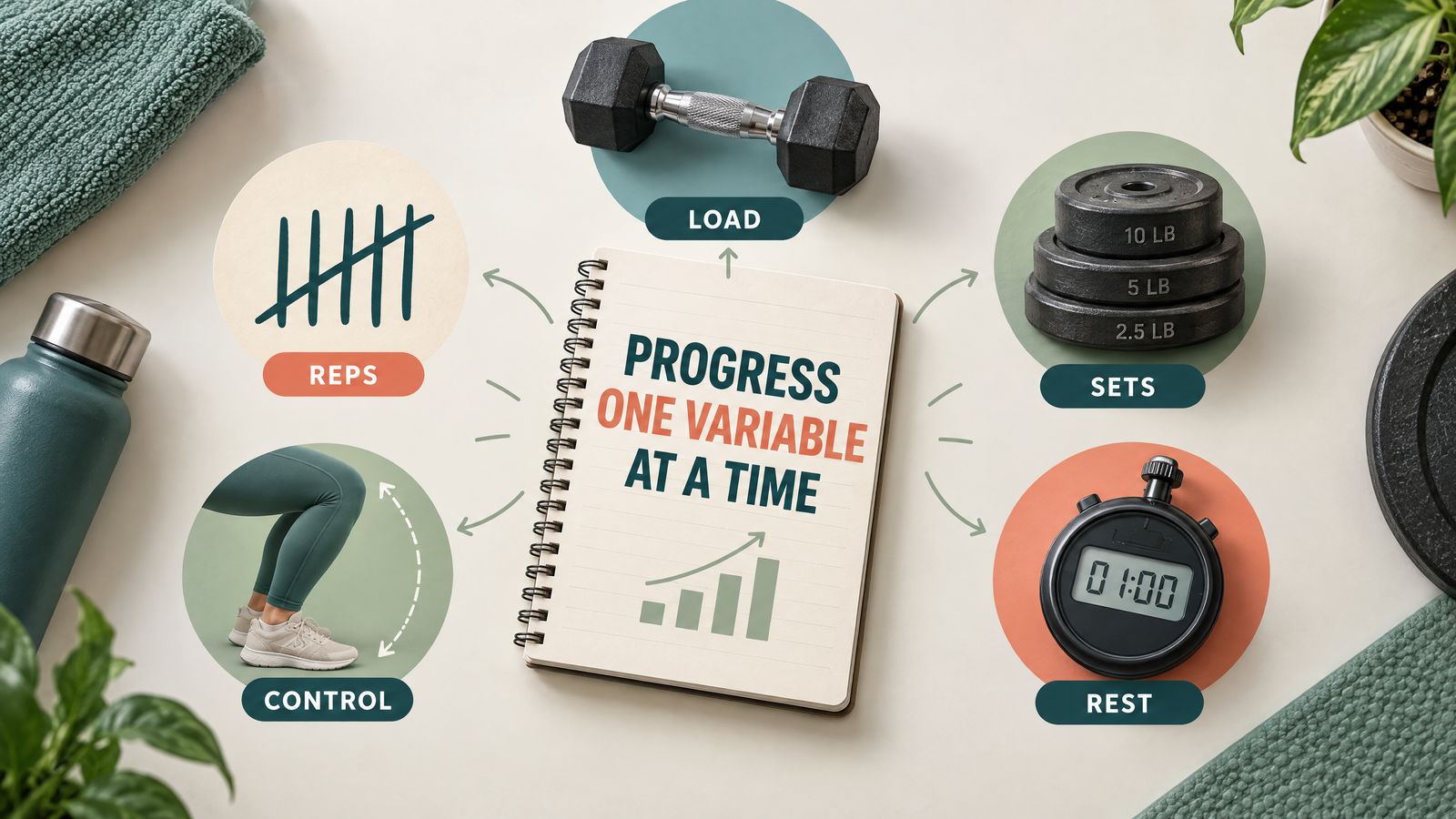
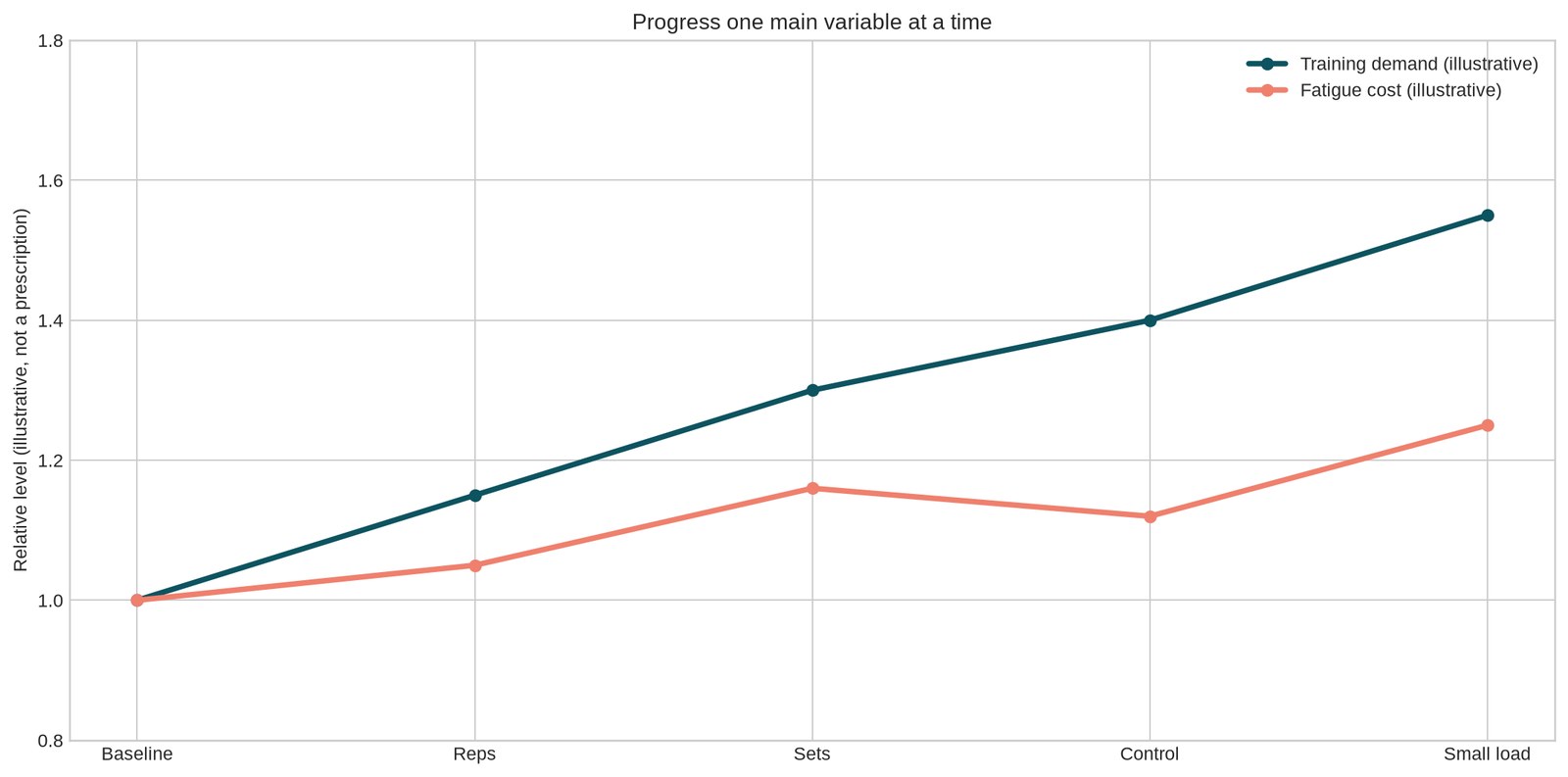
- Change one main variable at a time. Load, repetitions, sets, exercise range of motion, tempo, and rest intervals can all change demand.
- Quality matters. A heavier set is not productive progression if technique breaks down or pain changes the movement.
- Training to failure is not clearly necessary for muscle growth. A systematic review found no evidence that momentary muscular failure is superior to non-failure training for hypertrophy.4
- Use trends, not a single workout, to judge progress. Fatigue, sleep, illness, stress, and schedule can alter performance from day to day.
What Progressive Overload Actually Means
Muscles and the nervous system adapt to repeated training, so the same workload eventually becomes less challenging. Progressive overload is a planned increase after the current workload is reasonably well tolerated; it is not making every session harder.
“More” can mean load, repetitions, sets, range of motion, control, or less rest. The effect is exercise-specific: shorter rest may raise conditioning demand, while slower repetitions may improve control.
The American College of Sports Medicine (ACSM) position stand describes progression as dependent on the person’s goal, physical capacity, and training status. For people using a fixed repetition target, it recommends a modest load increase when they can exceed the desired repetitions by one or two with the current workload.1 That is a framework, not a rule that must be applied to every exercise or every week.
Five Ways to Progress Without Testing a Max
| Lever | A conservative way to progress | Check before repeating |
|---|---|---|
| Repetitions | Add a technically sound repetition within the planned range. | Form remains consistent. |
| Sets | Add one set to a selected exercise, not everything at once. | Recovery and next-session performance. |
| Control or range | Use a controlled, appropriate range of motion. | No new or worsening pain. |
| Rest | Adjust rest only for a clear strength, endurance, or time goal. | Target quality is maintained. |
1. Add repetitions before adding weight
Suppose you perform a dumbbell press for a planned range of repetitions. Rather than increasing the dumbbell at the first sign of a good day, keep the weight steady and gradually complete more technically sound repetitions within the range. Once the upper end is consistently manageable, a small increase in load can bring you back toward the lower end.
This approach avoids a large jump based on one unusually strong session and works with bands, machines, body-weight movements, and home equipment.
2. Increase sets carefully
An additional set increases work without a heavier load. It may help when technique is stable, but it also adds time and fatigue. Adding sets everywhere at once makes the cause of a performance change hard to identify.
Adjust one exercise or movement pattern at a time and observe the next sessions. No universal number of sets is best for everyone; volume should match the goal, experience, schedule, and recovery.3
3. Improve execution and range of motion
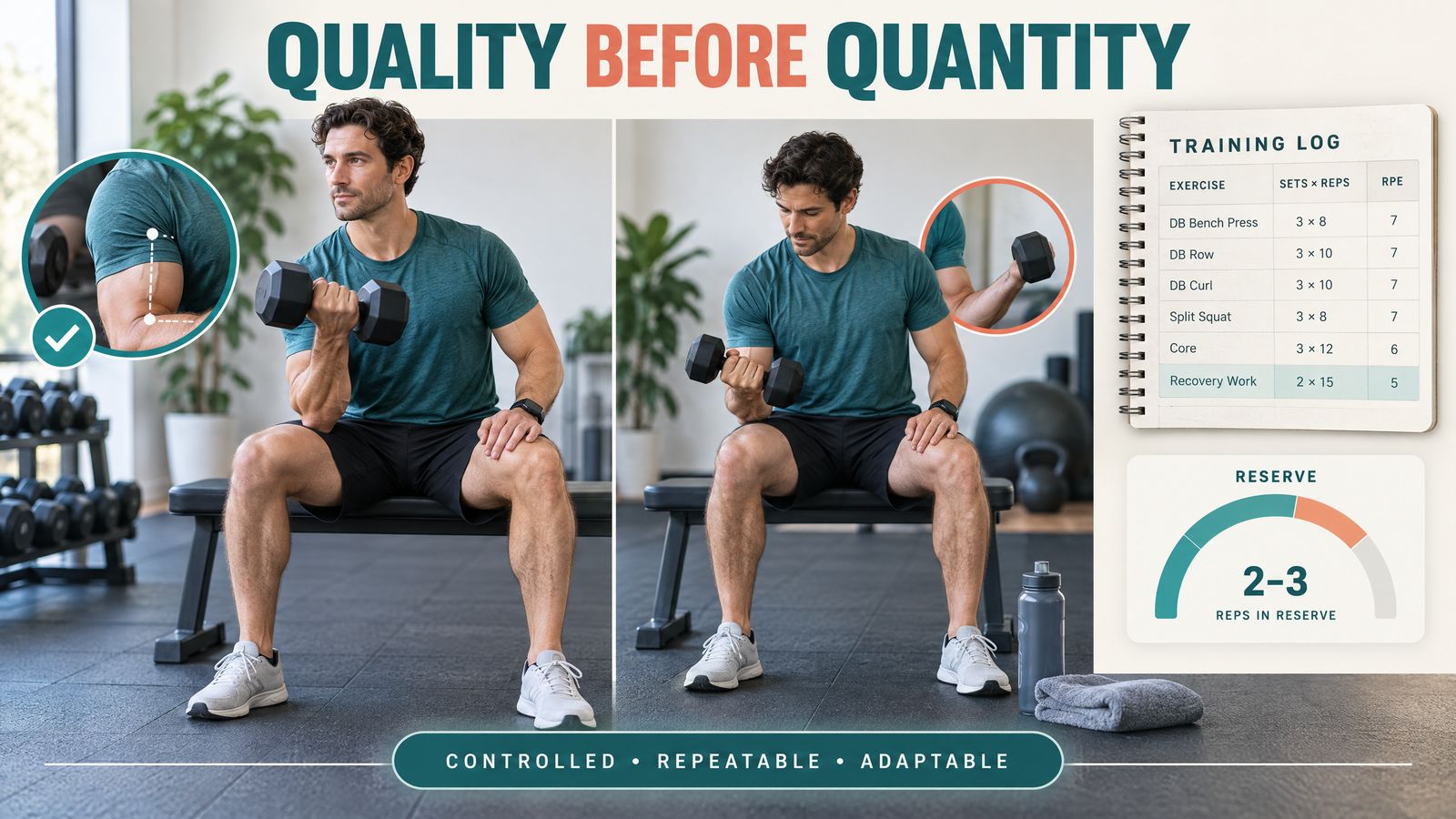
A controlled repetition through an appropriate range of motion can be more demanding than a shortened or rushed repetition. Better setup, balance, tempo, and consistency can make the same load more useful when adding weight would cause compensations or momentum.
“Better technique” does not mean forcing a joint into a painful position or treating discomfort as proof of effectiveness. Range of motion should fit the exercise and the person. A qualified coach or physical therapist can help assess movement when technique problems persist, but pain that is new, severe, or worsening deserves medical attention rather than a more aggressive progression.
4. Adjust rest or exercise order with a clear purpose
Shortening rest can make a session harder but may reduce high-quality repetitions. For strength-focused work, preserving technique may matter more; for endurance or time efficiency, a modest rest adjustment may be reasonable.
Exercise order is another lever. ACSM’s position stand generally places large, multi-joint exercises before smaller or single-joint exercises when preserving intensity is important.1 Changing order can change performance even when weight and repetitions stay the same, so record it.
5. Use effort, not ego, to choose the day’s load
A planned load is a starting point, not a test. If warm-ups feel unusually heavy or technique deteriorates, keeping the load steady—or reducing it—may be safer than forcing progression.
The idea of leaving some capacity in reserve is consistent with evidence that failure is not required for hypertrophy. In the 2023 systematic review and meta-analysis, momentary muscular failure did not produce a superior muscle-growth result compared with non-failure training.4 Because studies defined failure differently, this does not prove that stopping far from a challenging effort works equally for every goal. It does challenge the assumption that every set must end when another repetition is impossible.
What the Evidence Supports—and What Remains Uncertain
The evidence supports progressive resistance training as a way to improve strength and other muscular adaptations, but it does not support a single perfect loading scheme. A review of the repetition continuum concluded that muscle growth can occur across a broad range of loads, at least when the sets are sufficiently challenging, while heavier loads have a more specific advantage for practicing and improving maximal strength.3
If your goal is a 1RM in a particular lift, heavier, specific practice may eventually help. For general strength or muscle development, submaximal training can progress without frequent max testing. Power, endurance, sport skill, and rehabilitation goals may require different progressions.
Researchers still cannot give every adult a precise, universally optimal rate of progression. Studies differ in exercises, participants, training history, and definitions of failure or volume, so results do not transfer perfectly to every person or program.
A Simple Submaximal Progression Framework
Choose repeatable exercises and record load, repetitions, sets, rest, and meaningful symptoms. Use a repetition range when possible. Keep repetitions technically consistent and stop when you cannot maintain the intended movement—not merely when effort feels hard.
Progress one variable at a time. Add a repetition to selected sets; when that is consistent, add the smallest practical load and return to the lower end of the range. If load increases are impractical, consider a set, technique improvement, or carefully chosen rest adjustment.
Review several sessions rather than one result. Stable or improving performance with manageable fatigue suggests an appropriate demand. Repeated performance declines, worsening technique, or unusual difficulty with ordinary activities are reasons to hold or reduce the workload and reassess recovery.
This approach is compatible with CDC guidance: work toward muscle-strengthening activity on at least two days each week, remembering that some activity is better than none.2 Public-health targets and performance programs should both be scaled to ability and context.
Safety and When to Seek Care
Moderate physical activity is safe for most people, but the CDC advises people with chronic conditions such as heart disease, arthritis, or diabetes to discuss suitable types and amounts of activity with a clinician. It also recommends medical guidance before vigorous activity if someone has been inactive, has a disability, or has overweight.5
Stop and seek urgent care for chest pressure or pain, severe disproportionate shortness of breath, fainting, or sudden neurologic symptoms. Seek evaluation for persistent or worsening joint pain, marked swelling, deformity, or an injury that changes how you bear weight or use a limb. Do not “push through” these symptoms.
Keep a training log limited to what you need for safe decision-making. Speak with a qualified professional when medical history, medications, pregnancy, or a chronic condition affects exercise choices.
A Practical Bottom Line
You do not need to find your absolute limit to train productively. Repeatable exercises, sound technique, gradual changes, and tracking can create progressive overload while allowing for normal variation in recovery. Add demand only when the current workload is controlled, and treat a lighter session as responsible training—not failure.
References