In this guide
- Key takeaways
- What is a “proprietary blend”?
- What you will (and won’t) see on the label
- Why the missing numbers matter
- Regulatory limits and reality
- Hidden‑ingredient and safety examples
- Table: How to interpret what’s on a Supplement Facts label
- Practical tips for consumers
- When to contact a clinician or pharmacist
- Limitations and what the FDA does — and does not — do
- Safety disclaimer
- Final takeaways
- Label transparency comparison
- Questions before choosing a blend
- References
- Related VitaEvidence reading
Category: Sleep, Pain, and Everyday Supplements
Key takeaways
- “Proprietary blend” on a supplement label means the manufacturer lists a combined amount for a mix of ingredients, not the specific amount of each ingredient.
- The Supplement Facts panel will show the total weight of the blend but not individual ingredient quantities, which makes it hard to evaluate potency, safety, and interactions.
- Some products marketed as supplements have been found to contain hidden prescription‑drug ingredients; check the FDA Health Fraud Product Database before buying and report suspicious products.
- Talk with your clinician or pharmacist if you take prescription drugs, are pregnant or nursing, have a chronic condition, plan surgery, or experience unexpected side effects after taking a supplement.
What is a “proprietary blend”?
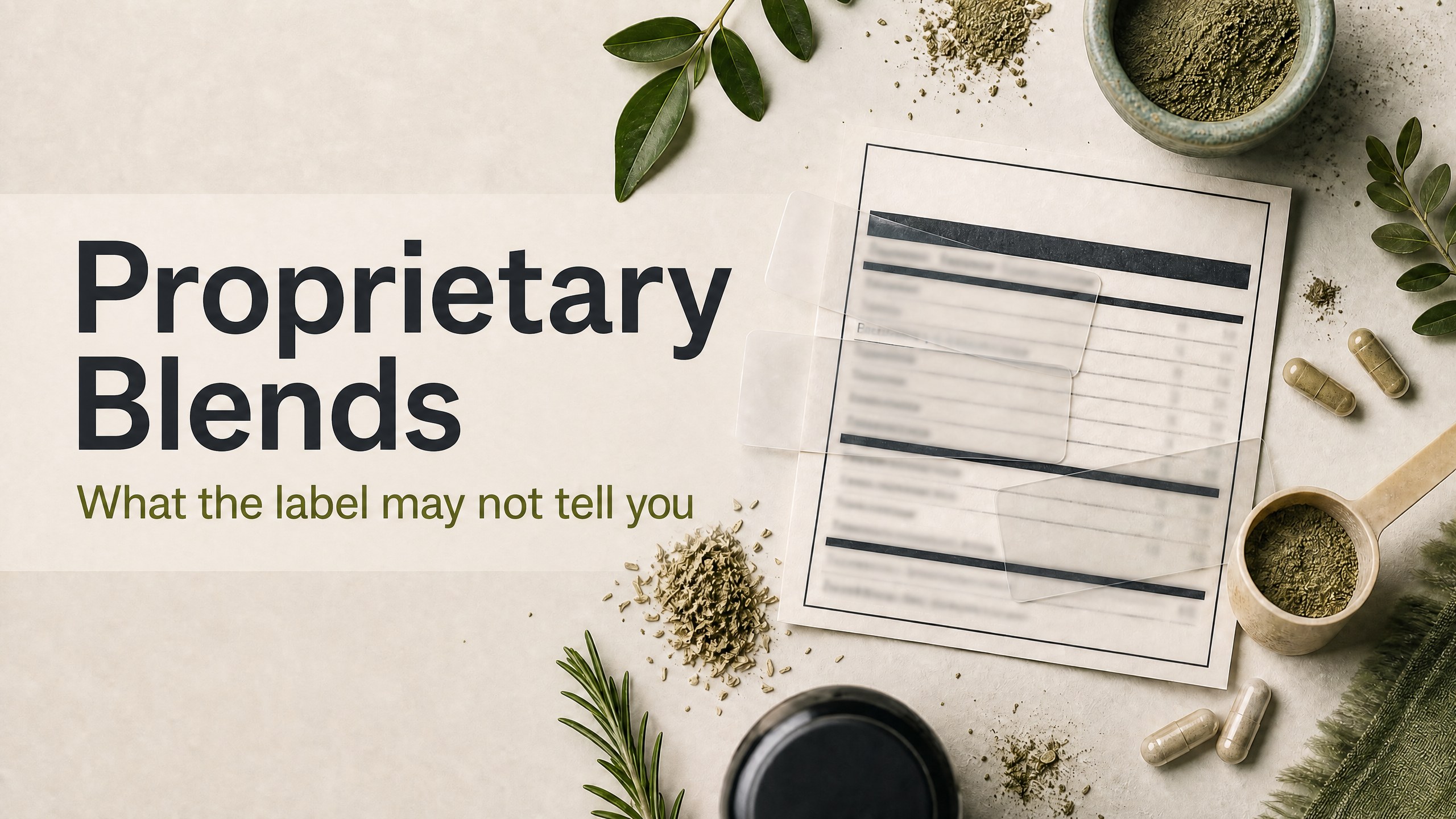
A proprietary blend is a group of ingredients that a supplement manufacturer combines and lists together on the product label. Instead of showing the amount of each ingredient, the label lists the blend name and the total weight for the combined ingredients in that blend. The idea from a business perspective is to protect a formula, but from a consumer and safety standpoint it reduces transparency about exactly what and how much you are taking.
What you will (and won’t) see on the label
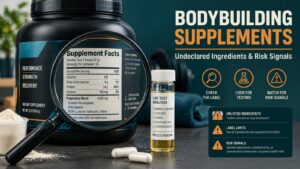
Under U.S. dietary supplement labeling rules, the Supplement Facts panel must list each ingredient, but for proprietary blends manufacturers can declare only the total weight for the blend and list the ingredients in order by predominance. That means the first ingredient in the blend is present in the greatest amount, but you do not know the individual dose of any ingredient inside the blend. (See FDA guidance on dietary supplement labeling for details.) [FDA dietary supplements] [Dietary supplement labeling guide]
Why the missing numbers matter
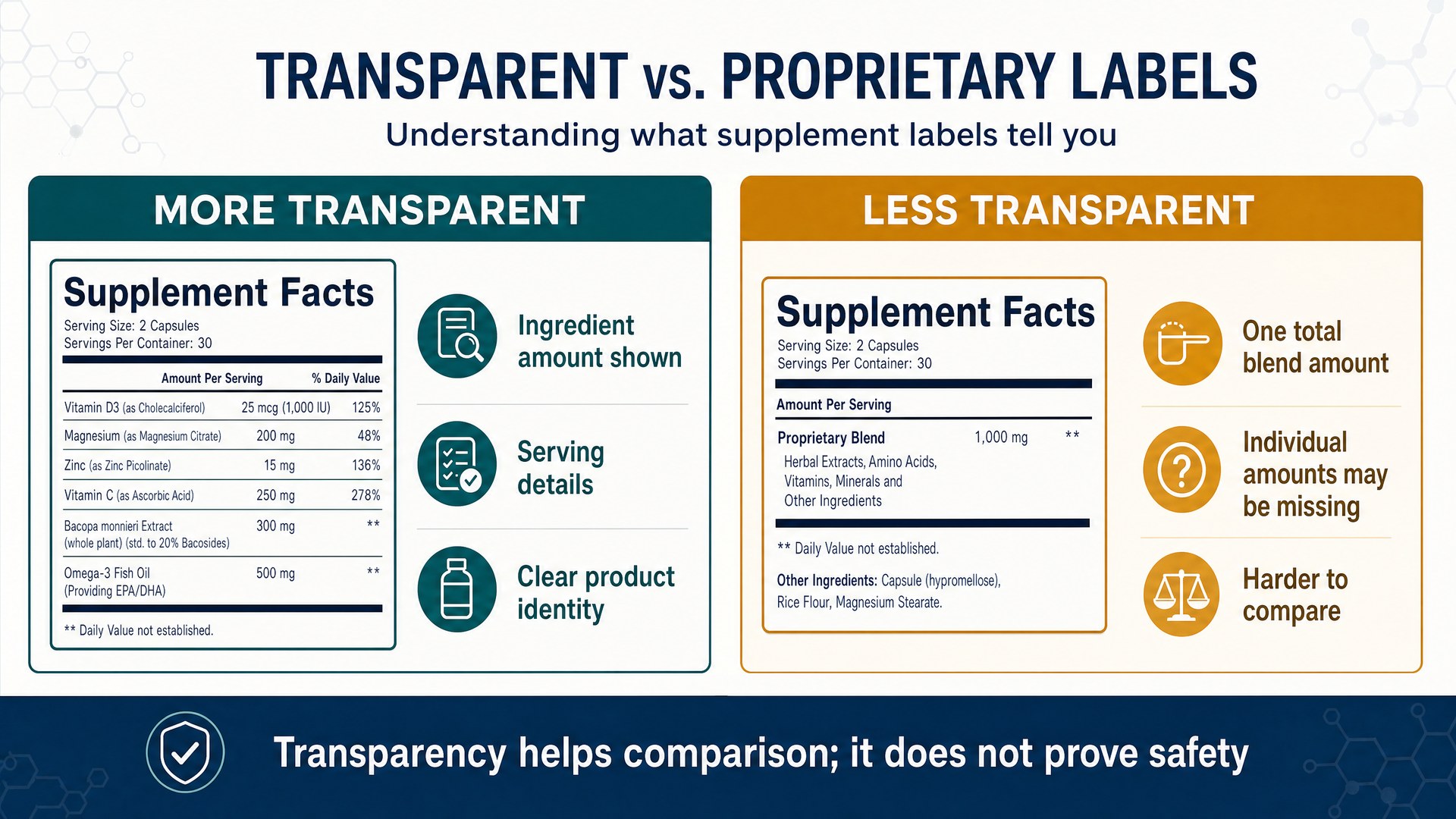
- Dose matters. Many botanical extracts, amino acids, and vitamins have dose‑dependent effects and risks. Without the individual amounts, you can’t compare the product to clinical research or safety guidance.
- Interaction risk. When you’re taking prescription medicines or other supplements, known interaction risk often depends on dose. Unknown amounts make it harder to assess potential interactions.
- Cumulative exposure. If you take several supplements that include the same or similar ingredients in proprietary blends, you may unknowingly exceed safe total amounts.
- Efficacy uncertainty. Some ingredients may be present at levels too low to have the effect advertised; the label won’t tell you.
Regulatory limits and reality
Dietary supplements are regulated differently from prescription drugs in the U.S. Manufacturers are responsible for ensuring safety and truthful labeling, and some labeling requirements exist, but supplements do not require FDA pre‑market approval. The FDA provides consumer guidance about risks including products contaminated with hidden or undeclared drug ingredients; it also maintains a Health Fraud Product Database listing products it has identified as tainted or fraudulent. The Federal Trade Commission (FTC) also enforces truth in advertising for claims about health benefits. [FDA dietary supplements] [FDA hidden ingredients guidance] [FDA health fraud product database] [FTC health claims] [FTC health products compliance guidance]
Hidden‑ingredient and safety examples
The FDA has identified certain marketed products that contained undeclared prescription drugs or other hidden active ingredients. Examples include some honey‑based products, sexual enhancement or energy products, and other items labeled as supplements that were found to contain active drug substances. These findings apply to specific products the FDA has tested and warned about — they do not automatically mean every product with a similar name or packaging contains a hidden drug. Consumers can search the FDA’s Health Fraud Product Database and read FDA notifications about specific product categories. [FDA tainted honey products] [FDA sexual enhancement and energy notifications] [Medication health fraud notifications] [FDA health fraud product database]
Table: How to interpret what’s on a Supplement Facts label
| Label element | What it tells you | What it does not tell you |
|---|---|---|
| Ingredient name (outside a proprietary blend) | Exact amount per serving (mg, IU, etc.) | — |
| Proprietary blend name + total weight | Total milligrams for all items in the blend combined | Amount of each individual ingredient in the blend |
| Ingredient order inside a blend | List is in descending order by weight | Exact dose or potency of each item |
| Serving size, other nutrients | Total serving and amounts of listed vitamins/minerals | Amounts of ingredients only inside blends are not specified |
Practical tips for consumers
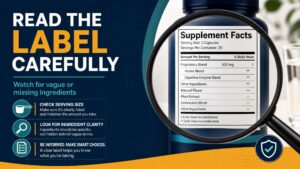
- Read the Supplement Facts panel first. If an ingredient you care about is listed inside a “proprietary blend,” the label will not tell you how much is present. Consider this when comparing products. (See our guide on how to read a Supplement Facts label: /how-to-read-supplement-facts-label/)
- Prefer full disclosure for key ingredients. For ingredients where dose matters (e.g., melatonin for sleep, magnesium, certain botanicals), look for products that list the milligrams or micrograms of each ingredient rather than hiding them in a blend.
- Check for third‑party testing. Independent lab testing or seals from reputable organizations do not guarantee safety but can provide extra transparency on content and contaminants.
- Search the FDA database. Before buying a product, especially new or unusual items, check the FDA Health Fraud Product Database for products the agency has identified as tainted or fraudulent; a product’s absence from the database does not prove safety. [FDA health fraud product database]
- Be cautious when products make “drug‑like” claims. The FTC and FDA enforce against unsupported health claims. If a supplement promises dramatic, immediate results, it’s worth checking official sources.
- Keep a single list of what you take. Share it with your clinician or pharmacist so they can check for potential interactions or duplications. See our resource on supplement‑drug interactions for common questions: /supplements-medication-interactions-questions/
- Avoid assuming “natural” is safe. Natural ingredients can interact with medications or have side effects, particularly at higher doses.
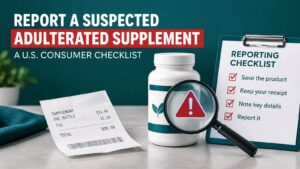
- Report suspicious products. If you suspect a supplement is contaminated, adulterated, or causes unexpected adverse effects, report it to the FDA via their contact pathways. [FDA reporting suspicious products]
When to contact a clinician or pharmacist
Contact a healthcare professional if you:
– Are taking prescription medicines, especially blood thinners, antiplatelet agents, antidepressants, anticonvulsants, immunosuppressants, or hormone therapies.
– Are pregnant, breastfeeding, or planning pregnancy.
– Have a chronic health condition (e.g., heart disease, liver or kidney disease, diabetes).
– Are scheduled for surgery (some supplements can affect bleeding or anesthesia).
– Have new or severe symptoms after starting a supplement — allergic reactions, chest pain, fainting, severe headache, irregular heartbeat, or signs of liver injury (e.g., yellowing of the skin/eyes, dark urine).
Limitations and what the FDA does — and does not — do
The FDA can act when it has evidence that a product is adulterated or misbranded, or that a product poses a significant safety risk. The agency publishes notifications about specific tainted products and maintains databases and consumer guidance. But not every supplement is tested before it reaches the market, and many products are never evaluated by the FDA until a complaint, adverse event, or targeted inspection triggers review. That means transparency on the label and caution by the consumer remain important. [FDA dietary supplements] [FDA hidden ingredients guidance] [Medication health fraud notifications]
Safety disclaimer
This article is educational and not medical advice. It does not diagnose or treat conditions. Talk with a healthcare provider before starting, stopping, or combining supplements with prescription medicines.
Final takeaways
Proprietary blends can make labels less informative and leave you uncertain about how much of each ingredient you’re taking. Use the Supplement Facts panel, check for full disclosure when dose matters, consult your clinician or pharmacist about interactions, and consult FDA resources if you suspect a product is tainted or unsafe. When in doubt, prioritize transparent labeling and independent testing.
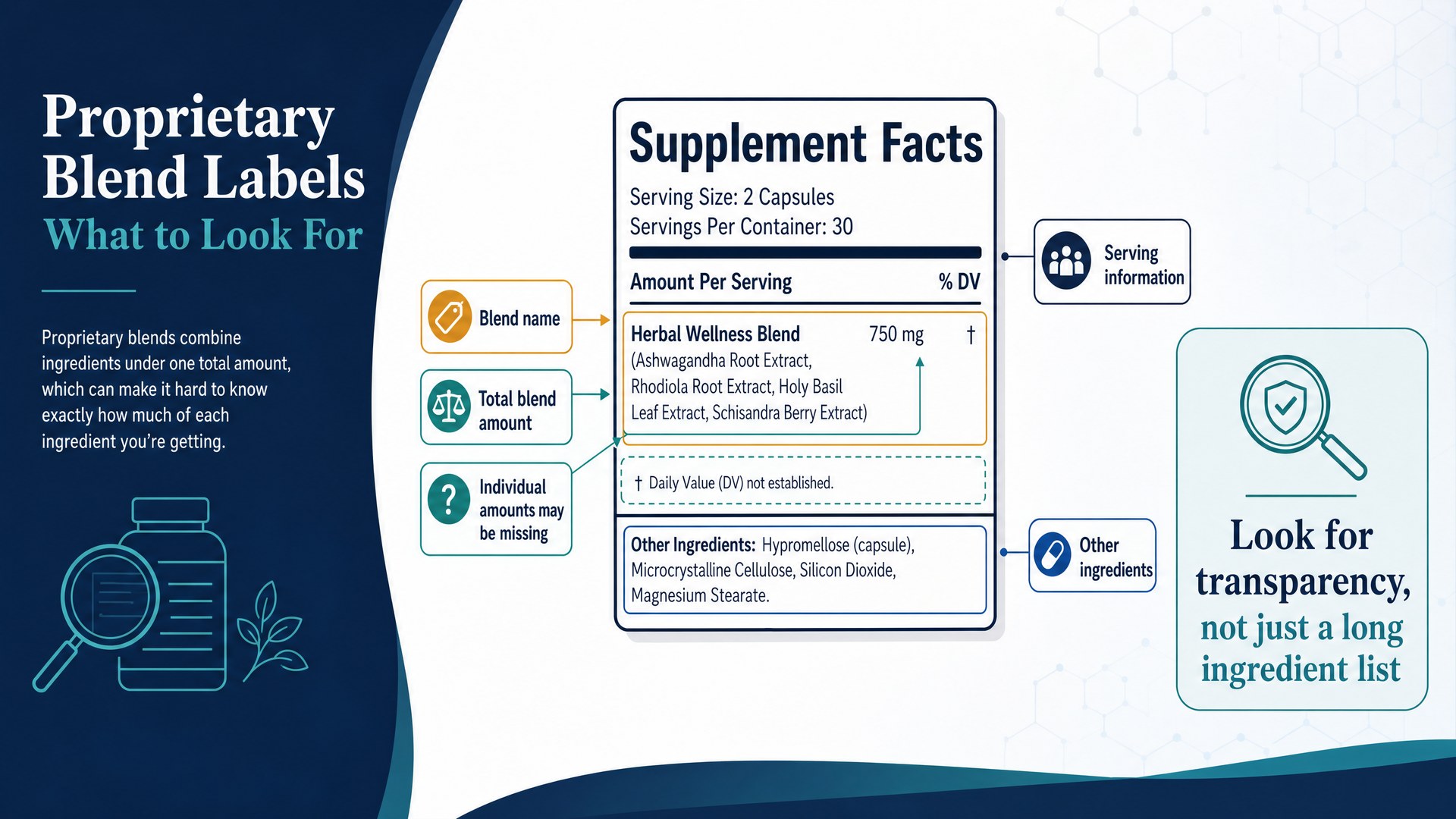
Label transparency comparison
| Label feature | Why it helps |
|---|---|
| Individual ingredient amounts | Makes products easier to compare. |
| One total blend amount | May leave individual amounts unclear. |
| Serving information | Defines the labelled serving context. |
Questions before choosing a blend
- Are individual amounts listed?
- Is the serving size clear?
- Can the exact product be identified and traced?
- Could the blend overlap with another product I use?
References
- FDA: Dietary Supplement Labeling Guide, Chapter IV
- FDA: Questions and Answers on Dietary Supplements
- FDA: Health Fraud Product Database
- FDA: Avoiding Products Contaminated with Hidden Ingredients
- FTC: Health Products Compliance Guidance
Last reviewed: August 2026
VitaEvidence Editorial Team