In this guide
- Key takeaways
- Why report a suspicious product?
- What to look for before you report
- What information to include when you report
- How to submit a report
- What happens after you report
- Practical tips to protect yourself and others
- When to contact a clinician or seek urgent care
- Limitations and what to expect
- Safety disclaimer
- References
- Related VitaEvidence reading
Category: Supplement Safety Basics
Key takeaways
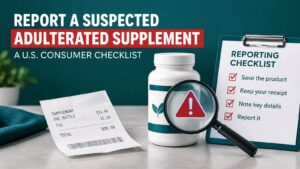
- If a dietary supplement or health product seems unsafe, adulterated (contains hidden drug ingredients), mislabeled, or makes questionable health claims, you can report it to federal agencies so they can investigate.
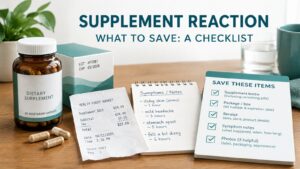
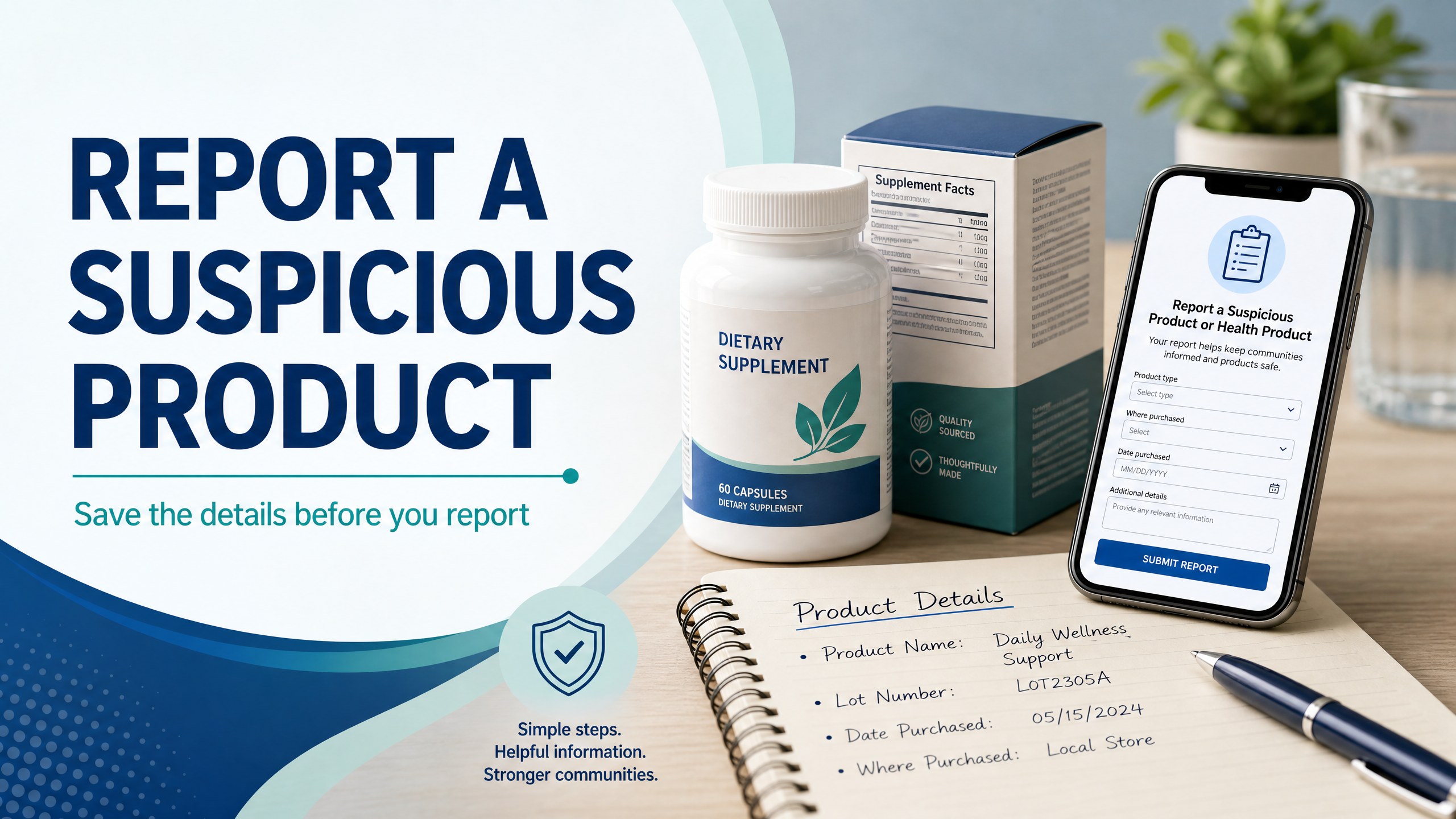
- Preserve the product and any packaging, take clear photos (label, lot number, expiration date), and document where and when you bought it and any symptoms.
- Use the FDA’s reporting pages and the Health Fraud Product Database to check whether a product has been flagged previously; the FTC handles misleading advertising issues.
- Seek prompt medical care for serious or worsening symptoms; this article is educational, not medical advice.
Why report a suspicious product?
Dietary supplements and other consumer health products are widely available, but some may be contaminated, deliberately adulterated with unapproved drugs, or misbranded. The U.S. Food and Drug Administration (FDA) and Federal Trade Commission (FTC) rely on consumer reports, retailer information, and laboratory testing to identify products that pose safety risks or violate laws. Reporting helps regulators detect patterns, remove dangerous items from the market, and warn other consumers.
The FDA has posted guidance and notifications about products found to contain hidden active drug ingredients (for example, certain honey-based products and sexual‑enhancement or weight‑loss products). The agency also maintains a Health Fraud Product Database with items it has flagged. Use these resources to learn whether a product has already been reported or investigated.
What to look for before you report
You don’t need to be certain a product caused a problem to file a report. Consider reporting when you notice any of the following:
– New, unexplained symptoms after using a supplement or health product.
– Packaging that looks counterfeit, damaged, or inconsistent with the manufacturer’s usual labeling.
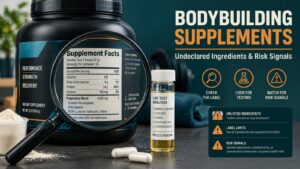
– Missing or incomplete Supplement Facts or ingredient list.
– Claims that sound like a quick cure or promise dramatic results.
– Advertising that seems deceptive (e.g., “FDA‑approved” claims for a supplement).
– A product sold under multiple brand names or repackaged without clear labeling.
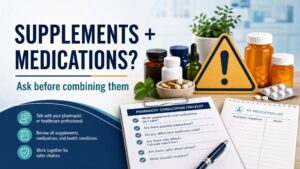
If you want help understanding a supplement label before reporting, see our guide on how to read a Supplement Facts label (/how-to-read-supplement-facts-label/) or ask your clinician about potential supplement–medication interactions (/supplements-medication-interactions-questions/).
What information to include when you report
Providing specific details makes a report more useful to regulators. The table below summarizes the most helpful items to collect.
| What to include | Why it helps |
|---|---|
| Product name, brand, and any variation (flavor, strength) | Identifies the exact product |
| Photos of the front/back of package, label, and Supplement Facts panel | Shows ingredients, claims, lot/lot number and expiration |
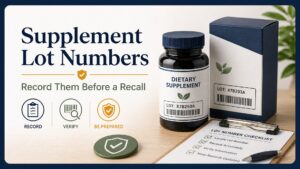
| Lot or batch number and expiration date (if present) | Helps trace distribution and test specific lots |
| UPC or barcode and National Drug Code (if present) | Aids identification in retail systems |
| Place and date of purchase, and receipt if available | Shows distribution channel and timeframe |
| Description of packaging (sealed, foil, tamper‑evident) | May indicate repackaging or counterfeit |
| Exact wording of claims or marketing materials (screenshots) | Helps assess deceptive advertising |
| Your symptoms, when they started, and medical treatment sought | Useful for safety signals and clinical follow‑up |
| Any other products taken at same time | Helps rule out alternative causes |
| Your contact information (optional, but helpful) | Allows investigators to follow up for more details |
How to submit a report
-
Start at the FDA’s contact page for consumer reports about human drugs and health products. That page lists official ways to contact the FDA and the appropriate forms or phone lines: https://www.fda.gov/about-fda/cder-contact-information/ways-consumers-contact-fda-about-human-drugs
-
Check the FDA Health Fraud Product Database to see if the product is already listed: https://www.fda.gov/consumers/health-fraud-scams/health-fraud-product-database
-
If you suspect the product contains a hidden drug ingredient or is adulterated, include photos and label information in your report. The FDA’s guidance on avoiding products contaminated with hidden ingredients explains why these reports matter: https://www.fda.gov/drugs/medication-health-fraud/avoiding-products-contaminated-hidden-ingredients
-
For products making sexual‑enhancement or energy claims, or other medication‑like promises, review the FDA’s recent notifications in these categories and consider including specific advertising examples in your report: https://www.fda.gov/drugs/medication-health-fraud-notifications/sexual-enhancement-and-energy-product-notifications
-
If the problem involves misleading advertising (false claims, unsupported health benefits), you can also report to the Federal Trade Commission, which enforces truth‑in‑advertising rules: https://www.ftc.gov/news-events/topics/truth-advertising/health-claims and https://www.ftc.gov/business-guidance/resources/health-products-compliance-guidance
-
Keep the product and packaging in case the FDA or other agencies request a sample for testing.
What happens after you report
When you submit a report, the FDA reviews it along with other reports and laboratory findings. If the agency finds a safety concern or evidence of hidden drugs, it may issue warnings to the public, work with manufacturers and retailers to remove products from sale, or take enforcement actions. The FDA publishes medication health fraud notifications when it identifies specific problematic products or categories: https://www.fda.gov/drugs/medication-health-fraud/medication-health-fraud-notifications
The timing and outcome of an investigation vary. Some reports lead to rapid recalls or consumer alerts; others require laboratory testing and coordination with manufacturers and foreign regulators, which can take longer. Reporting helps build the evidence regulators need to act.
Practical tips to protect yourself and others
- Preserve the original product, packaging, and receipt. Do not discard them unless a public health official advises otherwise.
- Photograph the product from multiple angles, including close‑ups of ingredient lists, lot numbers, and any seals.
- Save any leftover product in a sealed container or the original packaging.
- If you bought the product online, save the webpage, screenshots, or emails that show the product description and seller details.
- Notify the seller or platform where you purchased the product—many retailers will cooperate with recalls or investigations.
- Consider checking the FDA Health Fraud Product Database before reporting to see if the product is already under review: https://www.fda.gov/consumers/health-fraud-scams/health-fraud-product-database
When to contact a clinician or seek urgent care
If you experience new or severe symptoms after using a supplement or health product (for example, severe allergic reaction, difficulty breathing, chest pain, fainting, uncontrolled bleeding, or high fever), seek emergency medical care immediately. If symptoms are less severe but concerning, contact your primary care clinician or the health care professional who manages your medications.
Be sure to bring the product or photos of the label and list of ingredients to any medical visit; this can help clinicians assess potential causes and interactions. For questions about interactions between supplements and medications, see our resources on supplement–medication interactions (/supplements-medication-interactions-questions/).
Limitations and what to expect
- Filing a report does not guarantee rapid removal of a product. Regulators prioritize based on the severity and number of reports and on laboratory evidence.
- Not every questionable product will be illegal or recalled—many supplements are regulated differently than prescription drugs, and manufacturers are responsible for ensuring safety and labeling accuracy. See the FDA’s dietary supplement guidance for more on how these products are regulated: https://www.fda.gov/food/dietary-supplements and https://www.fda.gov/food/information-consumers-using-dietary-supplements/questions-and-answers-dietary-supplements
- The FTC focuses on deceptive advertising. If your concern is primarily about false marketing claims, include copies of the advertising when you contact the FTC: https://www.ftc.gov/business-guidance/resources/health-products-compliance-guidance
- For specific questions about label requirements, consult the FDA’s dietary supplement labeling guide: https://www.fda.gov/food/dietary-supplements-guidance-documents-regulatory-information/dietary-supplement-labeling-guide
Safety disclaimer
This article is for educational purposes and does not substitute for professional medical advice. If you experience concerning health effects after using a supplement or health product, seek medical care. Reporting a product to regulatory authorities may help identify safety problems but does not replace clinical evaluation or treatment.
References
- https://www.fda.gov/drugs/medication-health-fraud/avoiding-products-contaminated-hidden-ingredients
- https://www.fda.gov/consumers/health-fraud-scams/tainted-honey-based-products-hidden-active-drug-ingredients
- https://www.fda.gov/consumers/health-fraud-scams/health-fraud-product-database
- https://www.fda.gov/food/dietary-supplements
- https://www.fda.gov/food/information-consumers-using-dietary-supplements/questions-and-answers-dietary-supplements
- https://www.fda.gov/food/dietary-supplements-guidance-documents-regulatory-information/dietary-supplement-labeling-guide
- https://www.fda.gov/drugs/medication-health-fraud-notifications/sexual-enhancement-and-energy-product-notifications
- https://www.fda.gov/drugs/medication-health-fraud/medication-health-fraud-notifications
- https://www.ftc.gov/news-events/topics/truth-advertising/health-claims
- https://www.ftc.gov/business-guidance/resources/health-products-compliance-guidance
- https://www.fda.gov/about-fda/cder-contact-information/ways-consumers-contact-fda-about-human-drugs
Last reviewed: August 2026
VitaEvidence Editorial Team