

In this guide
- Key Takeaways
- What the Two Splits Mean
- Full-body workouts
- Upper/lower workouts
- What the Evidence Supports—and What It Does Not
- Choose by Your Actual Week
- If you reliably have two days
- If you have three days, but the days move around
- If you have four predictable days
- If your week includes substantial cardio or sport
- A Practical Way to Decide
- Safety and When to Seek Care
- Bottom Line
- References
Meta title: Full-Body vs. Upper/Lower Workouts: Choose by Schedule
Meta description: Compare full-body and upper/lower strength splits, what research supports, and how to match training frequency to a realistic weekly schedule.
Primary keyword: full-body vs. upper/lower workouts
Full-Body vs. Upper/Lower Workouts: Choosing a Strength Split by Schedule
The best strength split is usually the one you can repeat consistently while training all major muscle groups and recovering between sessions. A full-body workout trains most major movement patterns in each session. An upper/lower split alternates workouts that emphasize the upper body with workouts that emphasize the legs and hips. Neither format has a universal advantage.
A 2024 systematic review and meta-analysis of 14 studies found similar strength and muscle-growth results for split and full-body routines when training volume was equated. 1 That finding shifts the practical question from “Which split is scientifically superior?” to “Which plan fits my available days, session length, and recovery?”
Key Takeaways
- Full-body training is often practical when you can lift two or three nonconsecutive days per week or when your schedule changes often.
- An upper/lower split can make longer or more frequent training weeks easier to organize, especially when a full-body session would become crowded.
- Research does not show a consistent strength or hypertrophy winner when comparable training volume is performed.
- Frequency can help because it creates more opportunities to distribute work. It is not automatically better when the total work is similar.
- A plan should leave room for technique, gradual progression, rest, and other physical activity rather than turning every session into a test.
What the Two Splits Mean
Full-body workouts
A full-body session normally includes a lower-body movement, an upper-body push, an upper-body pull, and additional work for the hips, trunk, or other priorities. The exercises can be performed with weights, machines, bands, or body weight. The defining feature is not a particular exercise list; it is that the session addresses multiple major muscle groups.
This format gives each muscle group repeated exposure across the week without requiring a separate “leg day” or “upper-body day.” It can be efficient for people who have only a few dependable training windows. It also provides some insurance against missing an entire body region when one workout is canceled.
Upper/lower workouts
An upper/lower split separates sessions by region. Upper-body days may include pushing and pulling for the chest, shoulders, back, and arms. Lower-body days may include movements for the thighs, hips, and calves, plus trunk work as appropriate.
The split can make it easier to give a region more attention without making every workout equally long. It may also suit someone who has four predictable training days and prefers a clear weekly rhythm. The main scheduling issue is that missing one session can create an imbalance unless the person is willing to move or combine workouts.
What the Evidence Supports—and What It Does Not
The strongest direct comparison currently points to similar outcomes, not a decisive winner. In the 2024 meta-analysis, split and full-body routines produced comparable changes in bench-press strength, lower-body strength, several measures of muscle size, and lean body mass when volume was matched. 1 The studies were conducted in healthy adults, so results may not transfer exactly to every age, training history, sport, or health condition.
Training frequency is related but not identical to the split. A systematic review of resistance-training frequency found that higher frequencies were associated with greater strength gains overall, but the apparent advantage was no longer significant in studies where training volume was equated. The authors concluded that more frequent training may help mainly by allowing more total work to be completed or distributed, while the independent effect of frequency remained uncertain. 2
That distinction matters. A four-day schedule is not automatically better than a two-day schedule. Four days may be useful if they allow high-quality work without exhausting one session. But if extra visits reduce sleep or make attendance less reliable, the theoretical advantage may disappear. Research also has limitations: studies differ in exercise selection, participant experience, program length, and how strength and muscle growth are measured.
For general health, the CDC recommends muscle-strengthening activity on at least two days each week that works all major muscle groups. 3 This is a public-health minimum, not a requirement to follow a particular split or a promise about a specific physique or performance outcome. The federal Physical Activity Guidelines also emphasize that adults benefit from moving more and sitting less, and that muscle-strengthening activity can include weights, resistance bands, or body-weight exercises. 4
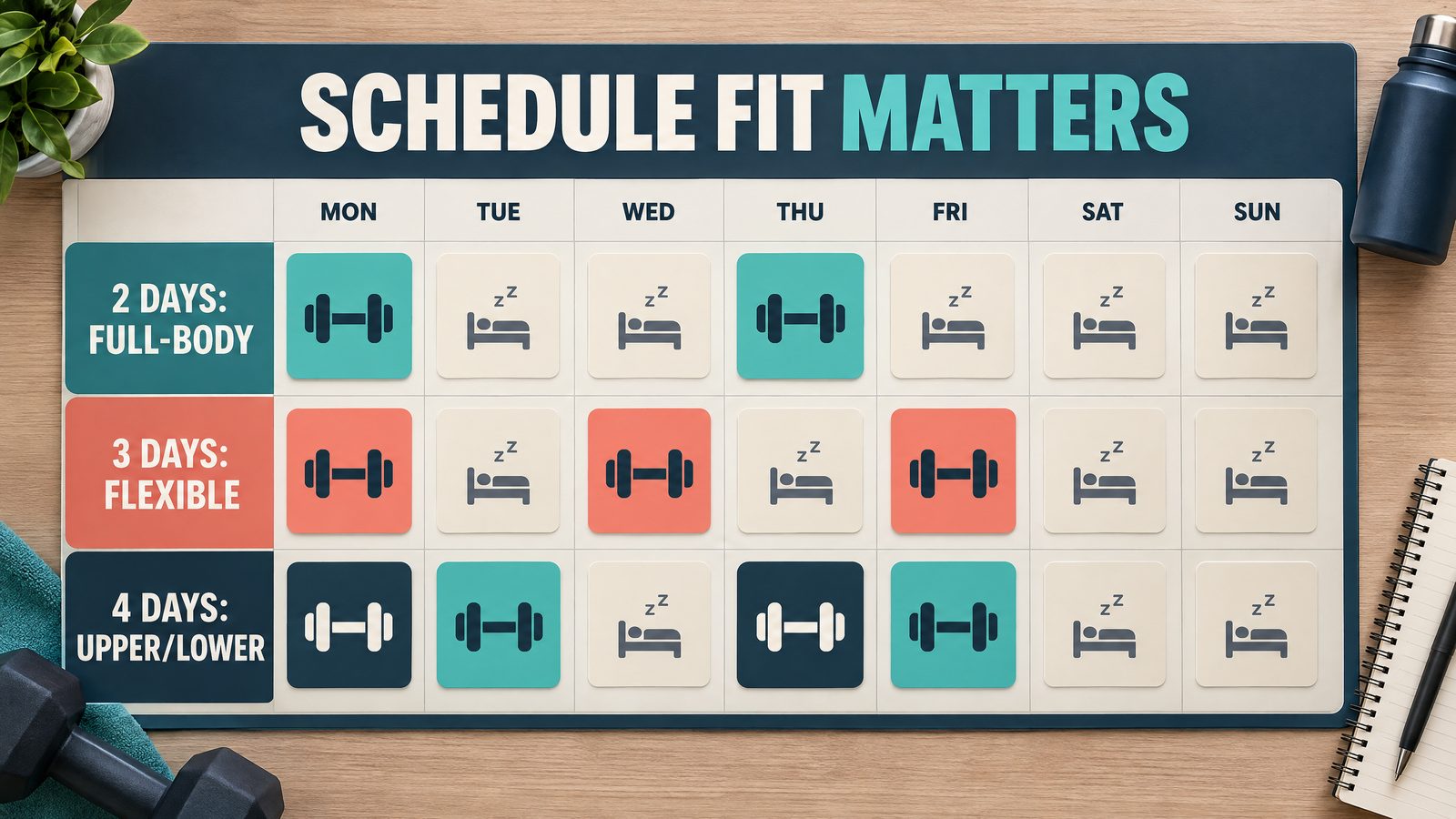
Choose by Your Actual Week
| Your week | Starting option | Main trade-off |
|---|---|---|
| Two reliable days | Full-body | Keep sessions compact and cover major patterns. |
| Three variable days | Full-body or rotating | Prioritize continuity; do not double up to catch up. |
| Four predictable days | Upper/lower | Distribute work while monitoring fatigue. |
| Heavy cardio or sport | Either, based on interference | Protect the hardest sessions and recovery. |
If you reliably have two days
A full-body format is usually the simpler starting point because both sessions can cover the major movement categories. Leave at least some recovery between challenging sessions when possible. Keep the plan compact enough that you can perform the key exercises with controlled technique rather than rushing through a long checklist.
If you have three days, but the days move around
Full-body training often matches a variable calendar. You can rotate two or three session templates and complete the next planned workout when time allows. The goal is continuity, not forcing a Monday-Wednesday-Friday pattern that does not fit your life.
A rotating upper/lower plan is also possible, but track which region was trained most recently. Avoid stacking demanding sessions simply to “catch up.” A missed workout can usually be moved to the next available day rather than doubled.
If you have four predictable days
An upper/lower split can distribute work across the week: upper, lower, rest or easier activity, then upper and lower again. This may create shorter sessions and more room for specific exercises. A full-body plan can still be effective, particularly if you prefer practicing major lifts more often, but four full-body sessions may require careful management of fatigue and exercise overlap.
If your week includes substantial cardio or sport
Choose the split that reduces interference with your hardest sessions. For example, avoid placing a demanding lower-body workout immediately before a sport practice that depends on sprinting or jumping if the combination repeatedly degrades performance or recovery. The right answer depends on the total week, not the lifting split in isolation.
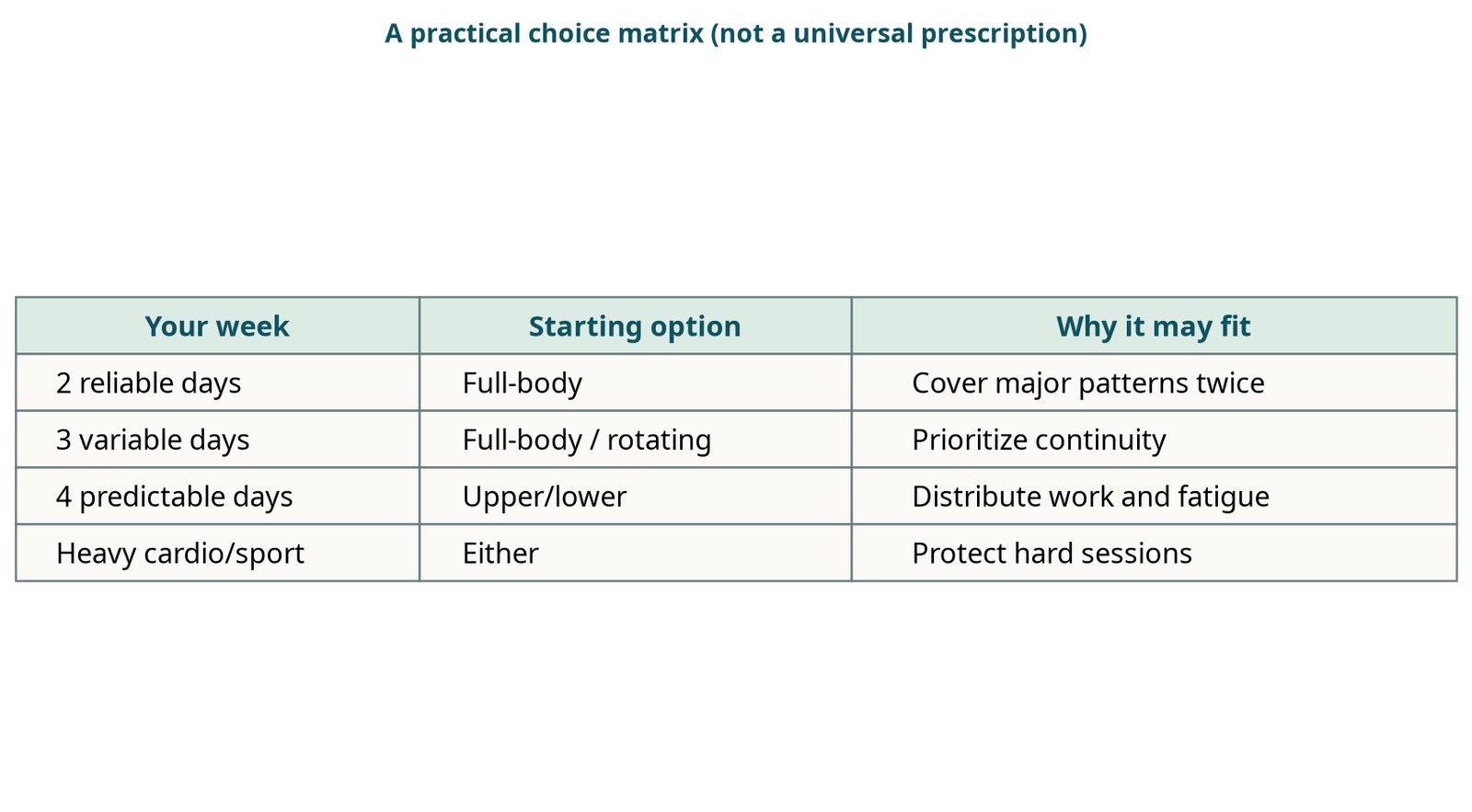
A Practical Way to Decide
Start with three questions: How many sessions can I attend most weeks? How long can each session last? Which days already contain demanding work? Then choose the simplest split that trains all major muscle groups and leaves enough recovery to repeat it.
For either format, keep a brief record of exercises, sets or repetitions, perceived effort, and how the next session feels. Use it to make gradual changes rather than changing the split every time progress slows. A missed week does not require an aggressive catch-up session.
Evidence supports flexibility, not a single formula. A full-body plan may be the most resilient choice for a busy or unpredictable schedule. An upper/lower plan may be more comfortable for a stable week with four training windows. If both fit, personal preference, session length, equipment, and enjoyment are legitimate deciding factors.
Safety and When to Seek Care
Use an appropriate warm-up, learn the movement pattern, and increase training demands gradually. Stop an exercise that causes sharp, sudden, or worsening pain rather than trying to push through it. Seek medical advice for chest pressure, fainting, severe shortness of breath, new neurologic symptoms, or an injury with marked swelling, deformity, or inability to use the area normally. Anyone with a chronic condition, recent surgery, pregnancy-related questions, or a prolonged return from illness may need individualized guidance from a qualified health professional before changing training demands.
This article is general education, not a diagnosis or personal treatment plan. It does not require sharing health information, and a strength split should not be used to self-manage a concerning symptom.
Bottom Line
Full-body and upper/lower workouts can both support strength when the program is consistent, appropriately challenging, and organized around comparable weekly work. Use full-body training when fewer or unpredictable sessions make coverage and simplicity important. Consider upper/lower training when four or more predictable sessions let you spread work without making workouts too long. The evidence does not justify treating either split as magic. Schedule fit, recovery, sound technique, and the ability to keep showing up matter more than the label on the plan.