In this guide
- What this guide covers
- Key points at a glance
- What “serving size” vs. “dose” means
- How often to take supplements (frequency and timing)
- Interpreting label claims and numeric cues
- Practical examples and comparison framework
- Safety limits, uncertainties, and when to ask a clinician
- How to compare products later
- Bottom line
- Editorial note
- References
- Related VitaEvidence reading
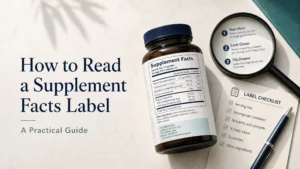
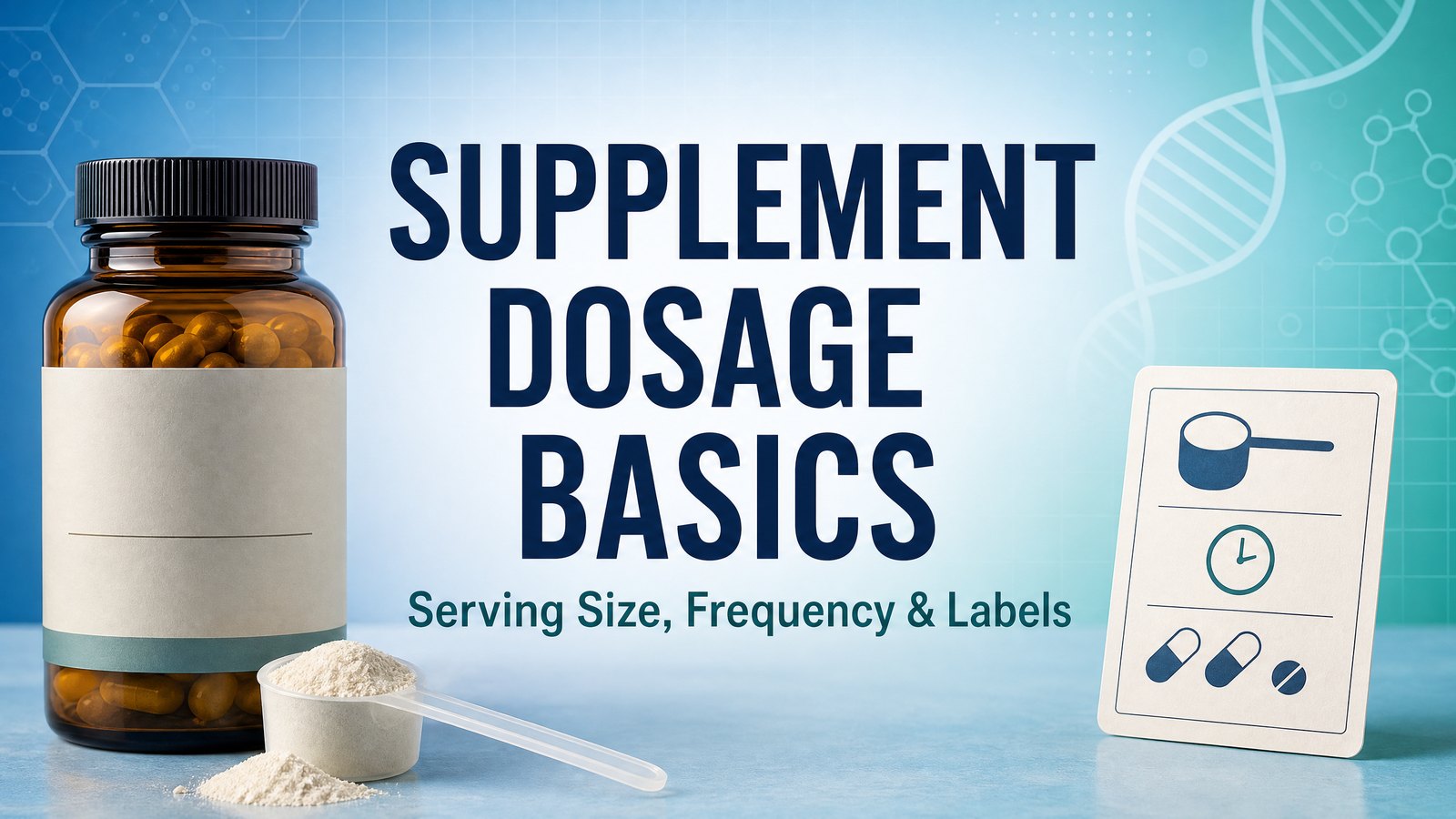
Many people buy supplements but find the label language—“serving size,” “take two capsules,” “% Daily Value”—confusing. This guide explains how to translate label wording into an actual daily supplement dose, how often to take common supplements, and practical checks to prevent under- or overdosing.
What this guide covers
- How to read serving sizes and calculate the true daily supplement dose.
- Common dosing patterns (daily, loading, split dosing) and when each is used.
- Label items that affect how you take a product (units, servings per container, directions, warnings).
- Practical examples and a comparison framework for later shopping.
- Limits of labels and when to check with a clinician.
Key points at a glance
- “Serving size” on the label is not always the same as the dose you should take—read the directions and do the math to get the daily supplement dose. (FDA, NIH ODS)
- Frequency and timing (once daily, split doses, with meals) can affect absorption and safety—some nutrients are best taken with food, others on an empty stomach. (NIH ODS)
- Compare label units (mg, mcg, IU) and % Daily Value (DV) to recognized intake targets and Tolerable Upper Intake Levels (ULs); labels don’t replace clinical advice. (NIH ODS, FDA)
- Ask a clinician before taking supplements if you’re pregnant, breastfeeding, under 18, have kidney or liver disease, take prescription meds, or have complex health issues.
What “serving size” vs. “dose” means
Many people assume serving size equals the amount you should take. Labels list a serving size (for regulatory consistency) and separately provide “Suggested Use” or “Directions” that tell you how many servings to take.
H3: How to calculate the daily supplement dose
1. Find “Amount per serving” (e.g., 400 IU vitamin D, or 500 mg magnesium per serving).
2. Check “Serving size” (e.g., 1 capsule, 2 tablets).
3. Read “Directions” to see how many servings/day (e.g., “Take 2 servings daily”).
4. Multiply amount per serving × servings per day = daily supplement dose.
Practical example: Label shows “Serving size: 1 softgel. Vitamin D: 1,000 IU per serving. Directions: Take 2 softgels daily.” True daily dose = 1,000 IU × 2 = 2,000 IU/day.
H3: Units matter—mcg, mg, IU
Different nutrients use different units. Vitamin D may be listed in IU or micrograms (mcg); 1 mcg = 40 IU for vitamin D. Pay attention to units when comparing products.
How often to take supplements (frequency and timing)
Frequency affects absorption, efficacy, and safety.
H3: Daily maintenance dosing
Most multivitamins and single-nutrient supplements give a daily dose (once daily). This is intended to replace usual dietary shortfalls or maintain steady blood levels.
H3: Split dosing and absorption
For minerals with absorption limits (e.g., calcium, magnesium), split doses (morning and evening) may increase total absorbed amount versus a single large dose. Some vitamins (B-complex) may be taken once daily; water-soluble vitamins are less likely to cause toxicity but can cause GI effects in large single doses.
H3: Loading doses and medical contexts
Some regimens use a short “loading” period followed by maintenance (e.g., high initial vitamin D prescriptions sometimes used under medical supervision). Follow clinician instructions—labels don’t replace medical dosing for deficiency treatment.
H3: With food, without food, and timing
– Fat-soluble vitamins (A, D, E, K) are better absorbed with a meal containing fat.
– Iron is often better absorbed on an empty stomach but may cause stomach upset; taking with vitamin C can help absorption. Avoid taking iron with calcium or high-calcium meals.
– Probiotics may have timing suggestions (before/after meals) based on product formulation.
Refer to nutrient-specific guidance from NIH ODS for detailed timing and absorption notes.
Interpreting label claims and numeric cues
Labels include several elements that affect dose interpretation.
H3: % Daily Value (%DV)
%DV compares the nutrient amount in a serving to a general daily target for adults. It’s useful for comparing products but is not a personalized recommendation—targets vary by age, sex, pregnancy status, and clinical needs.
H3: “Serving size” vs. “Directions” vs. “Amount per serving”
Always use “Directions” to convert serving size into a daily dose. “Amount per serving” lists nutrients for one serving only.
H3: Proprietary blends and unspecified quantities
If a label lists a proprietary blend without amounts for each ingredient, you can’t tell how much of an active ingredient you’re getting—exercise caution and prefer products that list exact amounts.
H3: “Natural,” “clinically studied,” and structure/function claims
These are marketing terms. They don’t quantify the active nutrient dose or establish safety or effectiveness. Verify dose and evidence via NIH ODS or peer-reviewed sources.
Practical examples and comparison framework
Example 1 — Vitamin D:
– Product A label: Serving = 1 capsule; Vitamin D = 50 mcg (2,000 IU) per serving; Directions = take 1 capsule daily → daily dose = 2,000 IU.
– Product B label: Serving = 2 drops; Vitamin D = 400 IU per drop; Directions = take 2 drops daily → daily dose = 800 IU.
Compare potency, units, and whether the daily dose is in line with your clinician’s recommendation or general guidance (see NIH ODS).
Example 2 — Fish oil/EPA+DHA:
Look at total omega-3s and the EPA/DHA amounts per serving, not just “fish oil mg.” If label lists “1,000 mg fish oil” that could be 180 mg EPA + 120 mg DHA; check the actual EPA/DHA numbers.
Comparison framework (quick checklist when shopping):
– Serving size on supplement label (how many units = one serving)
– Amount per serving for each active ingredient (and units used)
– Directions: servings per day and any timing instructions
– %DV and whether it’s appropriate for your age/sex/pregnancy status
– Proprietary blends or unspecified ingredient amounts
– Third-party testing seals, lot numbers, expiration date, storage instructions
– Contraindications/warnings and medication interaction notes
Safety limits, uncertainties, and when to ask a clinician
Labels do not replace personalized advice. Ask a clinician if any of the following apply: pregnancy or breastfeeding; children or adolescents; chronic kidney or liver disease; current prescription medications (risk of interactions); history of eating disorders; autoimmune conditions; organ transplant; or if you’re planning high-dose or long-term supplementation.
Be aware of Tolerable Upper Intake Levels (ULs) for nutrients—exceeding ULs can cause harm. Use NIH ODS factsheets for nutrient-specific ULs and RDA/RIs. If a label’s daily supplement dose plus dietary intake approaches or exceeds a UL, talk with your clinician.
If a product recommends doses much higher than typical maintenance amounts (e.g., multiple grams daily for a vitamin or herbal ingredient), seek medical review and evidence for safety and efficacy.
How to compare products later
When you’re ready to shop or re-evaluate, compare these label attributes side-by-side:
– Serving size on supplement label (units per serving)
– Exact amount per serving for each active nutrient (include units)
– Directions and calculated daily supplement dose (do the multiplication)
– %DV and whether you fall into a different target group (age/pregnancy)
– Presence of proprietary blends vs. explicit quantities
– Third-party testing or certificate of analysis notation
– Warnings, interactions, storage, expiration, and lot number traceability
[Affiliate product comparison block—add verified iHerb links after approval]
Bottom line
Supplement labels contain useful information, but you must translate “serving size” and “amount per serving” through the directions to get the true daily supplement dose. Compare units, %DV, and ingredient listings carefully, and consider timing and split dosing to improve absorption or reduce side effects. Labels don’t replace clinical judgment—ask a clinician before starting or changing doses if you have medical conditions, take medicines, are pregnant or breastfeeding, or plan to use high doses.
Editorial note
VitaEvidence Editorial Team. Last reviewed: August 2026. For general education, not personal medical advice. Read our Editorial Policy.
References
[1] NIH Office of Dietary Supplements — List of All Fact Sheets. https://ods.od.nih.gov/factsheets/list-all/
[2] NIH Office of Dietary Supplements — Vitamin D (Consumer). https://ods.od.nih.gov/factsheets/VitaminD-Consumer/
[3] U.S. Food and Drug Administration — Dietary Supplements. https://www.fda.gov/food/dietary-supplements
[4] Centers for Disease Control and Prevention — Physical Activity: About. https://www.cdc.gov/physical-activity/about/index.html
[5] U.S. Department of Agriculture & HHS — Dietary Guidelines for Americans 2020–2025. https://www.dietaryguidelines.gov/
[6] Nutrients (2025). Systematic review and meta-analysis of dietary supplement interventions and sleep quality. https://doi.org/10.3390/nu17243952
[7] Frontiers in Nutrition (2025). Systematic review of supplements and elite-athlete performance. https://doi.org/10.3389/fnut.2025.1675654