In this guide
- What this guide covers
- Key points at a glance
- How light controls your circadian rhythm
- Morning light: timing, types, and practical steps
- Evening light and blue light at night: what to avoid and practical alternatives
- Tools and products: bulbs, glasses, apps, and dawn simulators
- Limitations and when to ask a clinician
- How to compare products later
- Bottom line
- Editorial note
- References
- Related VitaEvidence reading
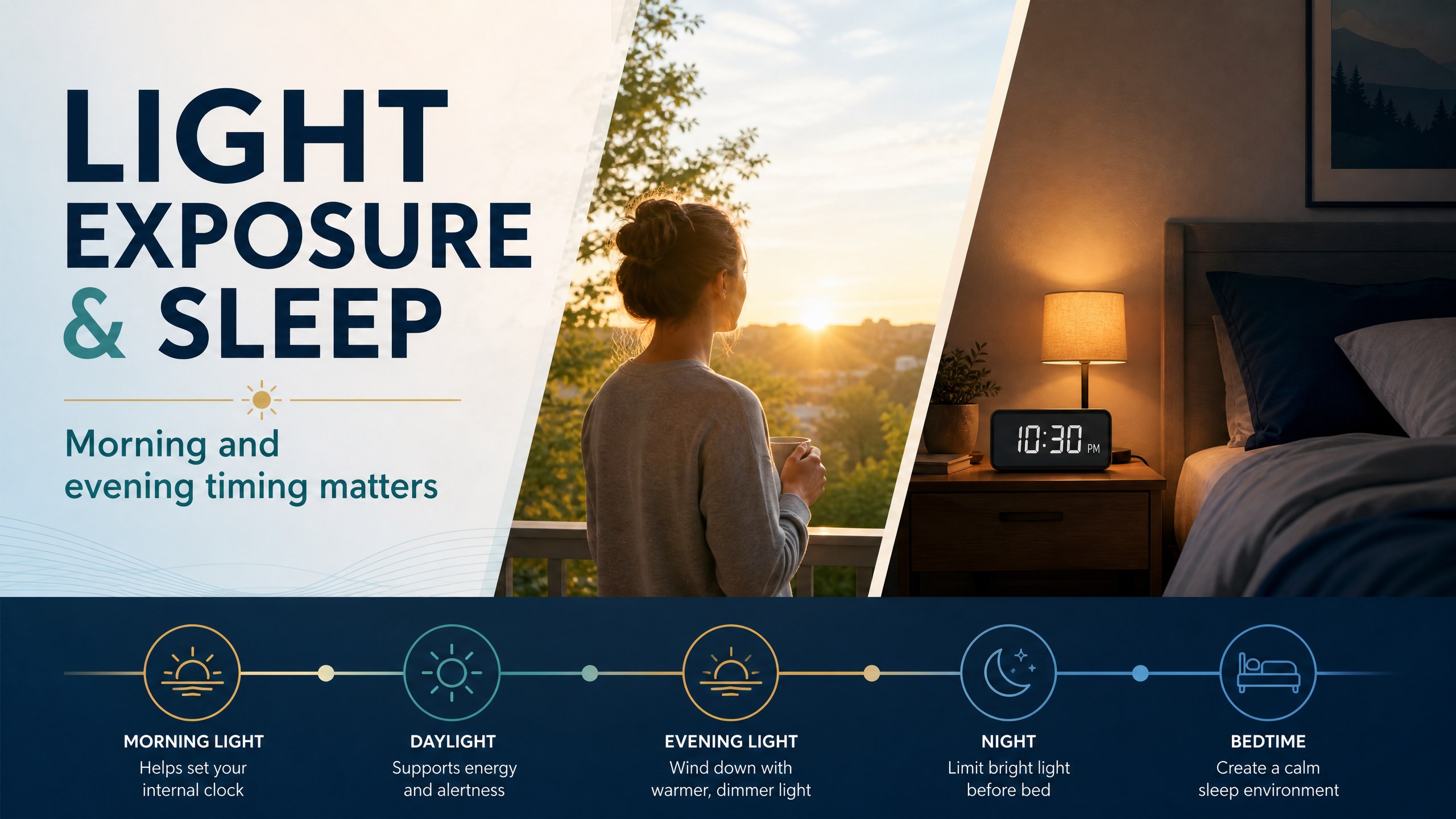
Light exposure and sleep are tightly linked: timing, intensity, and color of light help set your internal clock (circadian rhythm) and influence how alert or sleepy you feel. Small, practical changes — especially to morning and evening light — can improve sleep timing and daytime energy for many people, though individual needs vary.
What this guide covers
- How circadian rhythm responds to morning and evening light
- Practical ways to use morning light to support sleep timing and daytime alertness
- How evening light and blue light at night can interfere with sleep, and mitigation strategies
- A comparison framework for light-related products (bulbs, apps, glasses, dawn simulators) and when to talk with a clinician
Key points at a glance
- Bright, short-wavelength (blue-enriched) light in the morning tends to advance the circadian clock and increase daytime alertness; exposure soon after waking is usually most helpful [1].
- Evening exposure to blue light can suppress melatonin and delay sleep onset; reducing screen time or using warmer, dimmer lighting in the evening can help [1,2].
- Tools (dawn simulators, blue‑blocking glasses, screen filters) can be useful but vary in evidence and quality; consider practical fit and safety before buying.
- Melatonin supplements are widely used for timing sleep but have variable regulation and dosing; consult a clinician if pregnant, breastfeeding, taking medications, or managing chronic conditions [3,4].
- If you have serious sleep problems, shift work, eye disease, or mood disorder, seek individualized care — light adjustments alone may not be enough.
How light controls your circadian rhythm
Light is the primary environmental cue (zeitgeber) that synchronizes the circadian rhythm to the 24-hour day. Specialized retinal cells detect short-wavelength (blue) light and send signals to the brain’s suprachiasmatic nucleus, which regulates sleep–wake timing, hormone release (including melatonin), and body temperature. Bright morning light tends to advance the phase (shift sleep earlier), while bright evening light — especially blue light — tends to delay sleep.[1]
Practical example: someone who consistently wakes up later than desired may benefit from increasing morning light exposure and reducing evening light to nudge the internal clock earlier.
Morning light: timing, types, and practical steps
Why it helps
– Morning light suppresses melatonin and boosts alertness, which reinforces an earlier sleep–wake schedule. For many people, getting light within the first hour or two after waking is most effective.[1]
Practical steps
– Go outside for natural light: a 10–30 minute walk after waking exposes you to much higher light levels than indoor lighting and also provides activity and fresh air. Even cloudy daylight is brighter than indoor lamps.
– Eat breakfast by a sunny window or seat yourself in a bright room while you read or plan your day.
– If outdoor exposure isn’t possible (night shifts, weather, limited mobility), consider a light therapy box designed for circadian use; use according to product instructions and clinician guidance.
Real-world example: If your alarm is 7:00 a.m., try stepping outside between 7:15–7:45 a.m. for a short walk and coffee rather than scrolling on a dim phone in bed.
Evening light and blue light at night: what to avoid and practical alternatives
Why blue light at night matters
– Evening exposure to blue-enriched light (typical of many LEDs and electronic screens) can suppress evening melatonin and shift sleep later, making it harder to fall asleep at your planned bedtime.[1,2]
Mitigation strategies
– Power down screens 60–90 minutes before bed when possible. Replace screen time with low‑arousal activities (reading a paperback, light stretching, relaxing bath).
– Dim lights and switch to warmer color temperatures in the evening. Use lamps with warm bulbs (lower color temperature) rather than overhead bright white LEDs.
– Use built-in “night shift” or “night mode” screen settings — they reduce blue light but may not fully replicate darkness; also lower screen brightness.
– For people who must use screens late (shift workers), consider blue‑blocking glasses or app-based filters; evidence is mixed and depends on timing, spectral properties, and user adherence.[2]
Practical example: Set a “bedtime routine” alarm 90 minutes before lights-out as a reminder to reduce screen use, turn on a bedside lamp with a warm bulb, and practice a calming activity.
Tools and products: bulbs, glasses, apps, and dawn simulators
What these tools aim to do
– Dawn simulators: mimic sunrise by gradually increasing light in the morning to help wakefulness and shift sleep timing earlier.
– Light therapy boxes: provide standardized bright light (usually fixed lux levels) for morning exposure when natural daylight is unavailable.
– Blue‑blocking glasses and screen filters: reduce short-wavelength light in the evening.
– Smart lighting and bulbs: let you change color temperature and brightness through schedules.
Comparison framework (what to compare)
– Intended use: morning phase-advance vs. evening reduction of blue light.
– Spectrum and intensity: look for specifications (color temperature in Kelvin, lux for intensity, spectral power distribution if available). Higher lux is needed for therapeutic morning light; warm (lower Kelvin) is better in the evening.
– Timing and control: can the device be scheduled to match your sleep–wake goals?
– Safety and comfort: check for flicker, glare, or eye strain; consider photosensitivity or retinal conditions.
– Evidence and claims: avoid devices that promise to resolve sleep problems; prefer products with user manuals and safety data.
– Price and warranty: consider cost, return policies, and customer support.
Practical examples
– If mornings are dark where you live, a light box for 20–30 minutes after waking may help — follow the device’s instructions and avoid using it while driving.
– For heavy evening screen users, combine reduced screen time, night-mode settings, and warm ambient lighting rather than relying on a single intervention.
Caveats on melatonin
– Melatonin supplements can help with jet lag or circadian rhythm shifts in some people, but product quality and dosing vary. The FDA regulates supplements differently than prescription drugs; quality and labeling can be inconsistent [3]. Consult a clinician before starting melatonin if you are pregnant, breastfeeding, a child, have liver disease, take prescription medications, or have an autoimmune or bleeding disorder.[3,4]
Limitations and when to ask a clinician
- Established vs. uncertain: It is well established that light timing affects circadian timing and sleepiness; the optimal “dose” (exact minutes, lux) varies individually and across conditions. Evidence on consumer products (glasses, apps) is mixed and product-specific.
- See a clinician or sleep specialist if you have: severe or persistent insomnia; excessive daytime sleepiness; shift work disorder; suspected circadian rhythm disorders; mood disorders linked to seasonal changes; visual or retinal disease; or if you are considering strong interventions like high‑intensity light therapy or melatonin for a child.
- Also consult your clinician if you are taking medications that affect light sensitivity (some antibiotics, antipsychotics, or diuretics) or if you have conditions where light therapy could be contraindicated.
How to compare products later
When you’re ready to explore devices or accessories, consider these label attributes and questions:
– What is the light intensity (lux) and does the manufacturer state the recommended distance and duration?
– What is the color temperature (Kelvin) and does the product provide spectral information (short‑wavelength/blue content)?
– Is there an evidence base or clinical guidance cited, and are claims specific (e.g., “may help shift sleep timing”) rather than absolute?
– What safety information and contraindications are provided?
– Does the product offer a warranty, return policy, and customer support?
– Compare price, durability, and user reviews from independent sources.
[Affiliate product comparison block—add verified iHerb links after approval]
Bottom line
Light is a powerful, non‑pharmacologic influence on sleep timing and daytime alertness. Prioritize bright, natural morning light to support an earlier sleep–wake schedule and reduce bright, blue‑enriched light in the evening to help sleep onset. Tools such as dawn simulators, light boxes, and blue‑blocking strategies can be helpful for some people, but their benefits depend on timing, product quality, and individual circumstances. If sleep problems are persistent, severe, or complicated by medical conditions, seek individualized medical advice.
Editorial note
VitaEvidence Editorial Team. Last reviewed: August 2026. For general education, not personal medical advice. Read our Editorial Policy.
References
[1] Centers for Disease Control and Prevention. About Sleep. https://www.cdc.gov/sleep/about_index.html
[2] U.S. Food and Drug Administration. Dietary Supplements. https://www.fda.gov/food/dietary-supplements
[3] National Institutes of Health — Office of Dietary Supplements. Dietary Supplement Fact Sheets (list). https://ods.od.nih.gov/factsheets/list-all/
[4] Nutrients. Mini‑review: Sleep, Nutrition and Supplementation (2025). https://doi.org/10.3390/nu17111779
[5] Nutrients. Systematic Review and Meta‑analysis: Dietary Supplement Interventions and Sleep Quality (2025). https://doi.org/10.3390/nu17243952
[6] Frontiers in Nutrition. Systematic Review: Supplements and Elite‑Athlete Performance (2025). https://doi.org/10.3389/fnut.2025.1675654