In this guide
- What this guide covers
- Key points at a glance
- CDC-recommended sleep hours and sleep needs by age
- Quick reference example
- How to estimate your personal sleep need
- A 2–3 week sleep test (practical example)
- Signs you’re getting enough sleep
- Factors that change how much sleep adults need
- Sleep quality vs. quantity: why both matter
- What to measure
- Practical steps to reach your target sleep duration
- Plan sleep opportunity
- Nighttime routine and environment (examples)
- If you can’t reach your hours
- Limitations, evidence gaps, and when to ask a clinician
- How to compare products later
- Bottom line
- Editorial note
- References
- Related VitaEvidence reading
Most adults need enough sleep to feel alert, perform well, and stay healthy; for many people this falls in a range rather than a single number. This guide explains recommended sleep hours by age, how to find your personal sleep need, practical steps to reach it, and when to ask a clinician for help.
What this guide covers
- Official age-based recommendations and what they mean for adults.
- A simple, practical way to estimate your individual sleep need.
- Factors that change sleep requirements and how to weigh sleep quality vs quantity.
- Actionable steps to increase sleep opportunity and common limits to expect.
- When to see a clinician and how to compare sleep-related products or supplements safely.
Key points at a glance
- Public health guidance recommends most adults get at least about 7 hours of sleep nightly; older adults may need slightly different ranges [1].
- Individual sleep need varies; test yours with a planned 2–3 week sleep opportunity and track daytime alertness.
- Sleep quality (how restorative your sleep is) matters as much as total hours — use both to judge adequacy.
- Supplements or devices may help some people short-term, but evidence and safety are mixed; consult reliable labels and a clinician for medical conditions or medications [2,4].
CDC-recommended sleep hours and sleep needs by age
CDC guidance provides age-based ranges to help set goals rather than rigid rules. For adults:
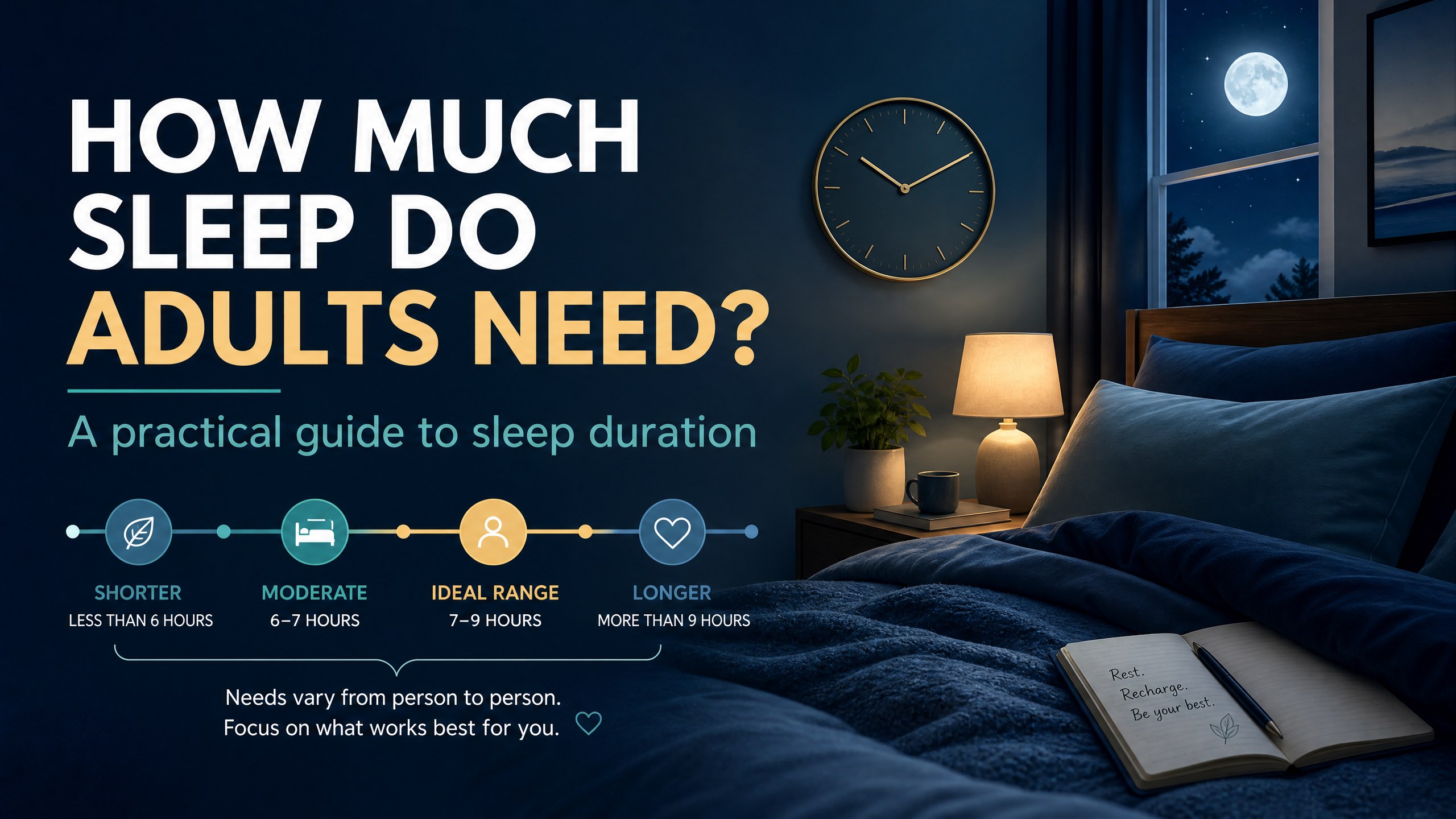
– Adults 18–60 years: at least 7 hours per night.
– Adults 61–64 years: 7–9 hours per night.
– Adults 65 years and older: 7–8 hours per night.
These recommendations are population-level guidance intended to reduce risks linked to short sleep (accidents, cardiovascular and metabolic issues) and poor daytime functioning [1].
Quick reference example
- A healthy 35-year-old aiming for “at least 7 hours” might try a target of 7–9 hours to find the sweet spot for daytime energy.
- A healthy 70-year-old may feel best with 7–8 hours and should focus equally on sleep consolidation (fewer awakenings) as on total hours [1].
How to estimate your personal sleep need
People vary. Here’s a practical, low-tech approach to find your own target.
A 2–3 week sleep test (practical example)
- Pick a 2–3 week window with relatively stable obligations (no major travel or shift changes).
- Set a consistent wake-up time and allow yourself a fixed sleep opportunity (time in bed) that’s realistically achievable — start with 8 hours.
- Record bedtime, wake time, naps, caffeine/alcohol, and a daily sleepiness/alertness rating (0–10).
- After 2 weeks, average total sleep time (TST) and note daytime function. If you feel alert and perform well, your average TST approximates your need. If still sleepy, increase sleep opportunity by 15–30 minutes and repeat.
This method emphasizes stable wake times because consistent circadian timing helps consolidate sleep and reveals true need.
Signs you’re getting enough sleep
- Sustained daytime alertness without caffeine dependence.
- Ability to concentrate, manage mood, and complete daily tasks reliably.
- Falling asleep within 20–30 minutes at night and not needing long naps to function.
Factors that change how much sleep adults need
Sleep need isn’t fixed. Common modifiers include:
- Acute illness, infection, recovery from surgery — sleep need often increases.
- Pregnancy and postpartum changes — many pregnant people experience increased sleep need and disrupted sleep patterns; discuss symptoms with a clinician.
- Shift work or irregular schedules — circadian misalignment can require more sleep opportunity and strategic scheduling.
- Aging — older adults may sleep less at night but still need restorative sleep; fragmented sleep may increase daytime naps without reducing need.
- Medications and medical conditions (depression, thyroid disease, sleep apnea) — these can alter both quantity and quality of sleep; medical review is appropriate when changes are pronounced.
Be cautious: persistent excessive daytime sleepiness, loud snoring with gasping, or falling asleep unintentionally (e.g., during conversations or driving) can indicate sleep disorders needing evaluation.
Sleep quality vs. quantity: why both matter
Getting “7 hours” is one thing; how restorative those hours are matters too.
What to measure
- Total sleep time (TST): hours asleep.
- Sleep efficiency: percentage of time in bed spent asleep (ideally >85%).
- Number of awakenings and how long they last.
- Daytime functioning: alertness, mood, work performance.
Example: Two people both sleep 7 hours. Person A sleeps uninterrupted and feels refreshed; Person B wakes multiple times from sleep apnea and feels tired — their effective recovery is different. Treating underlying sleep fragmentation can be as important as increasing hours.
Practical steps to reach your target sleep duration
Small, consistent changes often produce the biggest gains.
Plan sleep opportunity
- Choose a fixed wake time and count backwards to set a bedtime. If your target is 8 hours, bedtime = wake time minus 8 hours plus ~30 minutes buffer for falling asleep.
- Protect that opportunity: schedule evenings similarly to work commitments (e.g., defend bedtime like an appointment).
Nighttime routine and environment (examples)
- Wind down 30–60 minutes before bed with low-stimulation activities (reading, light stretching).
- Keep the bedroom cool, dark, and quiet; reserve the bed for sleep and intimacy.
- Limit heavy meals, nicotine, and alcohol close to bedtime; limit caffeine at least 6–8 hours before planned sleep if it affects you. (Diet and activity patterns also affect sleep; general healthy-eating and regular activity are consistent with better sleep [5]).
If you can’t reach your hours
- Prioritize consistent wake time over “catch-up” sleeping on weekends; large swings upset circadian timing.
- Use short (20–30 minute) naps strategically for alertness; avoid long naps late in the day.
- Consider a progressive change (shift bedtime earlier by 15 minutes every few days) to adapt more naturally.
Limitations, evidence gaps, and when to ask a clinician
What’s established: Short sleep is associated with poorer daytime function and higher risk of some chronic diseases; public health guidance offers age-based targets [1].
What’s less certain: The optimal sleep duration for every individual and the long-term benefits/risks of sleep supplements remain areas of active research. Systematic reviews of dietary supplements for sleep show mixed and modest effects for some agents, and study quality varies [4]. Safety profiles and interactions are not always well-documented for every product — check authoritative sources and consult clinicians when needed [2,4].
Ask a clinician if you have:
– Excessive daytime sleepiness despite what should be adequate sleep.
– Loud snoring, witnessed apneas, choking, or gasping during sleep.
– Persistent insomnia lasting weeks to months or causing impairment.
– Complex medical conditions (heart, lung, kidney, liver disease), pregnancy, breastfeeding, or use of multiple prescription medicines — safety and treatment differ in these situations.
How to compare products later
If you consider supplements, OTC sleep aids, mattresses, or sleep trackers, compare objective label attributes and safety features rather than marketing claims. For supplements and OTC products, check:
– Active ingredient(s) and dose per serving; compare to clinical research and safety guidance.
– Supplement Facts/Drug Facts panel, serving size, and number of servings.
– Warnings, contraindications, and interactions (especially with prescription medicines).
– Third-party testing or certification and accessible contact information for the manufacturer.
– Expiration date, lot number, and return policy.
For devices (trackers) and mattresses, compare validated accuracy, main metrics reported (TST, sleep stages, sleep efficiency), data privacy policies, and return periods. Be skeptical of dramatic claims and prioritize products with transparent methods and independent verification.
[Affiliate product comparison block—add verified iHerb links after approval]
Bottom line
Public health guidance recommends most adults aim for at least about 7 hours of sleep, with modest age-related variations; many people do best in a 7–9 hour range. Individual needs vary — use a 2–3 week, consistent-wake approach to find your target, prioritize sleep quality as well as quantity, and seek medical evaluation for persistent daytime sleepiness, symptoms suggesting sleep-disordered breathing, or complex medical issues. Supplements and devices can be tools for some people but have mixed evidence and safety considerations; compare labels and consult a clinician when in doubt.
Editorial note
VitaEvidence Editorial Team. Last reviewed: August 2026. For general education, not personal medical advice. Read our Editorial Policy.
References
[1] Centers for Disease Control and Prevention. How much sleep do I need? https://www.cdc.gov/sleep/about_sleep/how_much_sleep.html
[2] U.S. Food and Drug Administration. Dietary supplements: What you need to know. https://www.fda.gov/food/dietary-supplements
[3] National Institutes of Health, Office of Dietary Supplements. Fact sheets — list of all. https://ods.od.nih.gov/factsheets/list-all/
[4] Nutrients. Mini-review: Sleep, nutrition and supplementation. https://doi.org/10.3390/nu17111779
[5] U.S. Department of Agriculture / HHS. Dietary Guidelines for Americans 2020–2025. https://www.dietaryguidelines.gov/
[6] Nutrients. Systematic review and meta-analysis: Dietary supplement interventions and sleep quality. https://doi.org/10.3390/nu17243952