

In this guide
- Key Takeaways
- What “nocturia” can—and cannot—tell you
- The most useful distinction: what woke you?
- What to track for several nights
- 1. Sleep timing and awakenings
- 2. Bathroom trips and approximate urine amount
- 3. Urgency, pain, leakage, and other urinary symptoms
- 4. Evening fluids and common triggers
- 5. Medications and leg swelling
- 6. Daytime impact and sleep quality
- What the evidence supports—and what remains uncertain
- Safety: When to Seek Care
- A practical next step
- References
Waking up to urinate can leave you tired, frustrated, and unsure what happened to your sleep. It is tempting to label the problem “insomnia,” especially when you lie awake after returning to bed. But nighttime urination—often called nocturia—can be the event that interrupts sleep, a consequence of another health issue, or one part of a two-way relationship between sleep and bladder symptoms.
That distinction matters. Insomnia generally involves persistent difficulty falling asleep, staying asleep, or waking too early despite having a reasonable opportunity to sleep, along with daytime effects. If a full bladder, urgency, or a bathroom trip is repeatedly waking you, a sleep diary alone may miss useful clues. A short, simple bladder-and-sleep record can help you describe the pattern without trying to diagnose yourself.
Key Takeaways
- Nocturia means waking from sleep to urinate; it is a symptom, not a diagnosis.
- Track whether urination woke you or whether you were already awake and then decided to use the bathroom.
- Record timing, approximate amount, urgency, leakage, fluids, caffeine, alcohol, medications, swelling, and daytime symptoms.
- The evidence supports looking for patterns and evaluating possible contributors; it does not support assuming that every nighttime awakening is caused by the bladder—or that every case is insomnia.
- Seek prompt medical advice for symptoms such as fever, back or side pain, vomiting, shaking chills, visible blood in the urine, marked thirst with unexplained weight loss, or a sudden major change.
What “nocturia” can—and cannot—tell you
Nocturia is commonly defined as waking one or more times during the night to pass urine. It becomes more common with age, but age alone does not explain a new or bothersome change. The symptom can reflect several different patterns:
- More urine made at night: The kidneys may produce a larger share of the day’s urine during sleeping hours.
- Bladder storage or emptying problems: Urgency, overactive bladder symptoms, reduced capacity, obstruction, or incomplete emptying can make smaller amounts feel urgent.
- A whole-body contributor: Diabetes, kidney or heart problems, leg swelling, pregnancy, menopause-related changes, or other conditions may be relevant.
- A sleep-first pattern: Insomnia, sleep apnea, pain, anxiety, noise, or an irregular schedule may wake you first. Once awake, you may notice bladder sensations and urinate even when the bladder was not the original trigger.
These categories can overlap. A clinical review describes nocturia as multifactorial and notes that a frequency-volume chart—recording bathroom trips and voided amounts—can help clinicians distinguish patterns. That chart is a discussion tool, not a home test that identifies a cause.

The most useful distinction: what woke you?
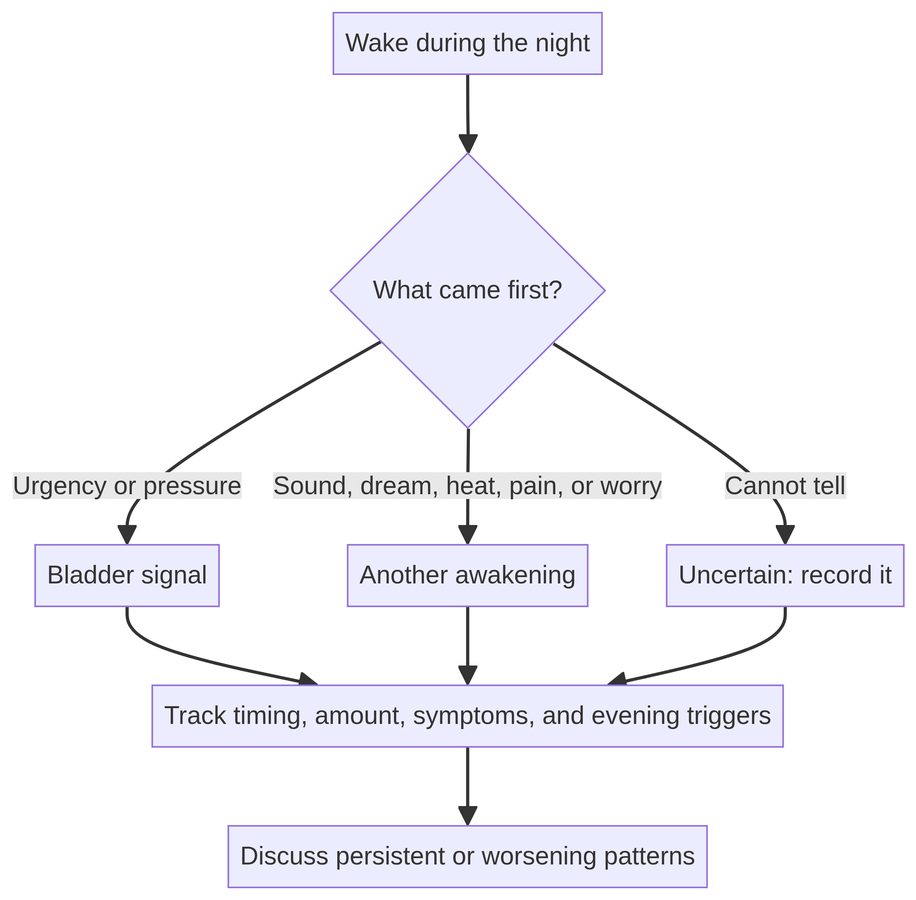
When you wake, ask yourself—without forcing an answer—what came first:
- A clear bladder signal: urgency, pressure, discomfort, or a strong need to urinate woke you.
- A non-bladder awakening: you woke because of a sound, dream, heat, pain, breathing problem, or worry, then chose to use the bathroom.
- Uncertainty: you cannot tell. That is still useful information.
Do not stare at the clock all night to collect data. A quick note in the morning is usually enough. The goal is to see whether bathroom trips consistently precede waking, follow another awakening, or vary from night to night.
| Record | Example | Why it matters |
|---|---|---|
| What woke you? | Urgency first, another awakening, or uncertain | Helps distinguish a bladder signal from a sleep-first awakening. |
| Bathroom trip | Time and small, moderate, or large amount | Provides a pattern without false precision. |
| Symptoms | Burning, pain, leakage, weak stream, blood | May change how soon to seek medical advice. |
| Evening context | Fluids, caffeine, alcohol, medicines, swelling | Shows factors to discuss without changing treatment alone. |
| Daytime impact | Sleepiness, concentration, safety-sensitive tasks | Connects the night pattern with daily function. |
What to track for several nights
A practical record can be brief. Use paper, a private note, or a standard sleep diary. NHLBI and CDC resources include bedtime, awakenings, morning wake time, naps, medicines, exercise, alcohol, and caffeine. For nighttime urination, add:
1. Sleep timing and awakenings
Record intended bedtime, each awakening, final wake time, and whether you returned to sleep easily. Exact minute-by-minute estimates are unnecessary; consistency is more valuable than false precision.
2. Bathroom trips and approximate urine amount
For each nighttime trip, record the time and whether the amount seemed small, moderate, or large. If a clinician asks for measured volumes, follow those instructions; otherwise, rough categories are enough. Also note daytime frequency.
3. Urgency, pain, leakage, and other urinary symptoms
Note urgency, burning, difficulty starting, a weak stream, a feeling of incomplete emptying, accidental leakage, cloudy urine, or visible blood. These details can change how soon you should seek medical advice. Avoid trying to interpret them as proof of a urinary tract infection or another condition.
4. Evening fluids and common triggers
Write down the timing—not just the total—of afternoon and evening drinks. Include caffeine and alcohol, which can affect sleep and urination. Do not start extreme fluid restriction; hydration needs differ, and people with heart or kidney conditions should seek guidance before changing fluids.
5. Medications and leg swelling
List medication names and timing if known; never change a prescribed schedule based on a diary. “Water pills” and some other medicines may affect urine timing, but moving a dose can be unsafe. Note new or evening-worse ankle or lower-leg swelling.
6. Daytime impact and sleep quality
Record morning refreshment, daytime sleepiness, concentration, mood, and any drowsiness during safety-sensitive tasks. CDC describes quality sleep as uninterrupted and refreshing, not merely a certain number of hours.
What the evidence supports—and what remains uncertain
The evidence supports a pattern-based evaluation. A diary can help separate nighttime urine production from bladder urgency and show whether caffeine, alcohol, medication timing, or evening fluids consistently coincide with symptoms. It can also reveal that the first awakening is not urinary.
The evidence does not support a single universal cutoff for when nighttime urination is “normal” for every adult. A single trip can have many explanations, while repeated or newly worsening trips may deserve evaluation. A diary also cannot prove causation: a large amount after a long awakening does not necessarily mean the bladder woke you.
Research links nocturia with poorer sleep and quality of life, but association is not a single cause. Sleep disorders may increase awareness of bladder sensations, while urinary symptoms may fragment sleep. Track when the situation is stable, then use the pattern to guide a healthcare conversation rather than self-treating from a chart.
Safety: When to Seek Care
Contact a healthcare professional promptly if nighttime urination is new, persistent, worsening, or changing your daily activities—especially if it occurs with urgency, leakage, pain, or a noticeable change in urine output. A clinician may review your history and medications and may consider a urine test or other evaluation based on your symptoms.
Seek urgent medical advice for fever, back or side pain, vomiting, shaking chills, or visible blood in the urine. Increased thirst or appetite, fatigue, and sudden unexplained weight loss also warrant prompt attention. Seek immediate help for severe illness, confusion, fainting, breathing difficulty, or inability to urinate.
If you are pregnant, have kidney or heart disease, diabetes, significant leg swelling, or take diuretics, discuss a new pattern rather than changing fluids or medication timing on your own. If daytime sleepiness makes driving unsafe, do not drive until you have sought advice.
A practical next step
For several nights, keep one concise record that links sleep, the bathroom trip, fluids, relevant symptoms, and next-day function. At the end, look for three questions: What seemed to wake me? How much urine was produced? What else changed that evening or that week?
Bring the pattern—not necessarily every personal detail—to a healthcare professional if symptoms persist or concern you. The goal is not to earn a label from a diary. It is to avoid assuming insomnia when nighttime urination may be the main disruptor, while also avoiding the opposite mistake of dismissing a sleep problem or medical symptom as “just needing the bathroom.”
References
- Centers for Disease Control and Prevention (CDC): About Sleep
- National Heart, Lung, and Blood Institute (NIH): Sleep Diary
- MedlinePlus (National Library of Medicine): Frequent or Urgent Urination
- Chang TL, et al. Nocturia, nocturnal polyuria, and nocturnal enuresis in adults: a review (PMC)
- Everaert K, et al. International Continence Society consensus on the diagnosis and treatment of nocturia (PubMed)