
In this guide
- Key Takeaways
- What to Record at Night and in the Morning
- Separate “got into bed” from “tried to sleep”
- Describe nighttime awakenings without chasing exact minutes
- Add quality and function
- Daytime Factors Worth Tracking
- Naps and dozing
- Caffeine, alcohol, nicotine, and other substances
- Medicines and supplements
- Exercise, light, meals, and schedule changes
- Symptoms and Context: The “Why” Behind the Numbers
- What the Evidence Supports—and What It Does Not
- A Practical, Low-Burden Format
- Safety / When to Seek Care
- Bottom Line
- References
A sleep diary is more useful than a pair of timestamps. Bedtime and wake time show the outline of a night, but not whether you spent an hour trying to fall asleep, woke repeatedly, napped, or felt sleepy the next day. A consistent record can reveal patterns and give a clinician a clearer starting point.
The goal is not a perfect sleep score or proof that one habit caused another. It is a structured memory aid. The National Heart, Lung, and Blood Institute (NHLBI) suggests keeping one for 1 to 2 weeks before a medical visit when sleep is a concern. 1
Key Takeaways
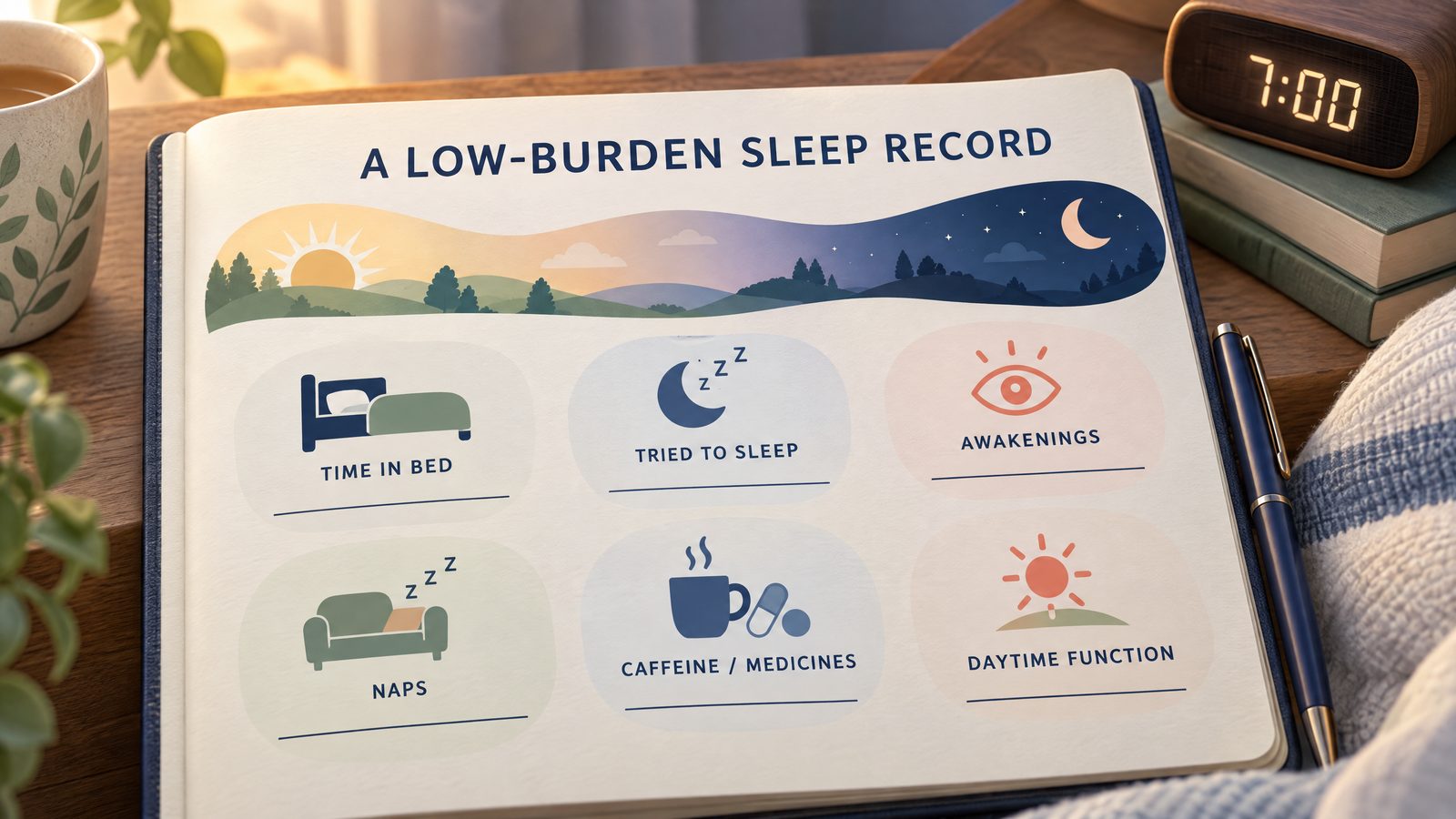
- Record time in bed, attempted sleep, awakenings, final awakening, and time out of bed, not just “bedtime” and “wake time.”
- Add daytime factors that can affect sleep: naps, caffeine, alcohol, nicotine, medicines, exercise, light exposure, and unusual schedule changes.
- Note sleep quality, morning refreshment, daytime sleepiness, and symptoms such as snoring, gasping, pain, hot flashes, restless legs, or nightmares.
- Use the diary to identify patterns and prepare for a conversation; it cannot diagnose insomnia, sleep apnea, circadian disorders, or another condition by itself.
- Keep the record proportionate. If tracking makes you anxious or keeps you awake, simplify it and discuss the problem with a healthcare professional.
What to Record at Night and in the Morning
Separate “got into bed” from “tried to sleep”
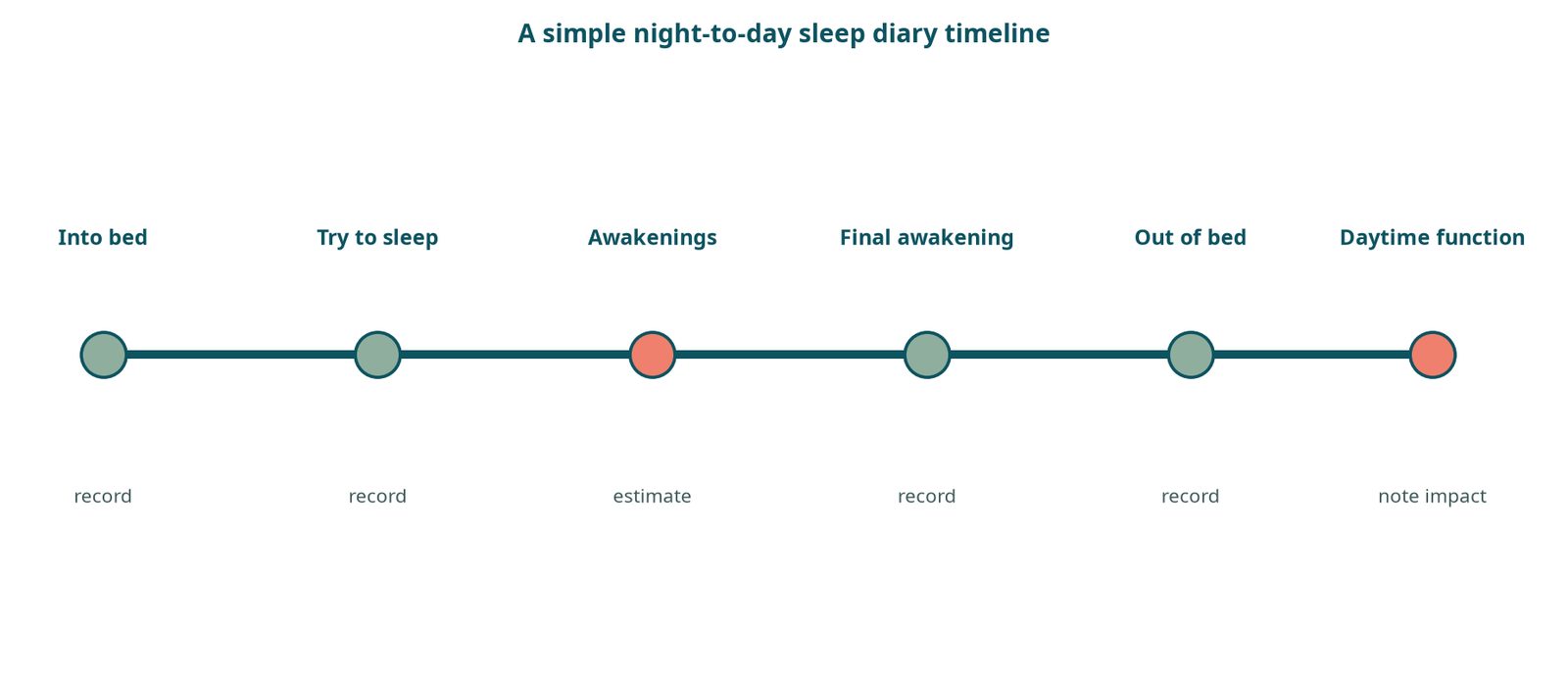
Write down when you got into bed and when you actually began trying to sleep. Those may differ if you read, watched television, talked, or used a phone first. This helps distinguish time awake in bed from time spent asleep.
In the morning, record your best estimate of when you fell asleep, your final awakening, and when you got out of bed. The Consensus Sleep Diary also separates sleep-onset latency, number and duration of awakenings, perceived quality, and open-ended comments. 2
Describe nighttime awakenings without chasing exact minutes
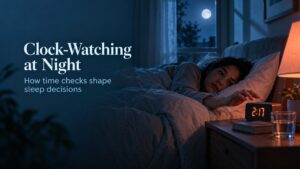
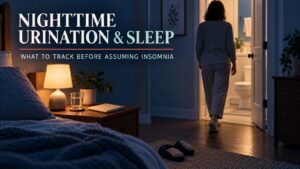
For each meaningful awakening, note an approximate time or part of the night, how long you think you were awake, and a possible reason: bathroom use, noise, temperature, pain, reflux, a dream, or no clear reason. Estimates are fine; you do not need to check the clock repeatedly.
If you wake early and cannot return to sleep, record when you stopped trying and whether you stayed in bed or started the day. That information is different from simply writing “woke at 5:00 a.m.”
Add quality and function
Use a simple rating for how restorative the night felt. Note whether you felt refreshed, tired, foggy, or alert, plus daytime sleepiness, dozing, trouble concentrating, or difficulty staying awake while driving.
These details matter because sleep health is not only hours in bed. CDC describes poor sleep quality as trouble falling asleep, repeated waking, or feeling tired despite enough time asleep. 3
Daytime Factors Worth Tracking
Naps and dozing
Record every nap or unplanned doze, with its start time, approximate duration, and whether it helped. Timing and length may affect nighttime sleep, but a pattern matters more than one nap.
Caffeine, alcohol, nicotine, and other substances
Record what you used and when, rather than only “coffee” or “alcohol.” Include tea, energy drinks, soda, pre-workout products, nicotine, cannabis, or other substances when relevant and when you are comfortable documenting them for your own care.
NHLBI specifically includes caffeine and alcohol in its sleep-diary guidance. 1 The diary cannot establish an individual’s exact sensitivity, but it may show whether late-day use repeatedly occurs on nights with delayed sleep or more waking.
Medicines and supplements
Record prescription medicines, over-the-counter products, and supplements, including timing. Do not change or stop a medicine based on a diary pattern; a clinician or pharmacist can interpret possible effects in context.
“Usual medicines—morning” may be enough. Flag anything new, taken at a different time, or used only as needed.
Exercise, light, meals, and schedule changes
Record exercise timing and general intensity, unusually bright evening light, late shifts, travel, time-zone changes, workday versus day-off schedules, and unusually late or large meals. Do not turn the diary into a detailed food log unless advised.
CDC lists exercise, naps, caffeine, alcohol, and medicines among habits that may belong in a diary. 3 Schedule context can separate a recurring pattern from a one-night disruption.
Symptoms and Context: The “Why” Behind the Numbers
Leave a short comments field for loud snoring, breathing pauses, gasping, morning headaches, restless legs, pain, reflux, hot flashes, nightmares, anxiety, illness, or stress. Note whether the symptom occurred before sleep, during an awakening, or the next day.
People who menstruate or are in perimenopause or menopause may also note cycle timing, sleep-disrupting bleeding, hot flashes, or night sweats when relevant. This is context, not proof of one universal pattern.
What the Evidence Supports—and What It Does Not
Sleep diaries are widely used because they collect repeated, person-reported information close to when it occurred. A standardized format can make entries more consistent and highlight relationships among sleep, behavior, and daytime function. 2
The evidence does not support treating a diary as a direct measurement of brain sleep. People may misestimate sleep and wake time. An AASM review found that actigraphy can provide information distinct from sleep logs, while NHLBI notes that actigraphy or a sleep study may be considered when evaluation requires more than a diary. 4 Consumer wearables are not a substitute for clinical assessment.
A diary shows associations, not proof of cause. If poor sleep repeatedly follows late caffeine, that is a useful topic to discuss or test cautiously, but it does not prove caffeine is the only contributor. Look for repeated patterns and avoid changing several variables at once.
| What to record | When | Why it helps |
|---|---|---|
| Time in bed, tried to sleep, estimated sleep | Morning | Separates time awake in bed from estimated sleep. |
| Awakenings and final awakening | Morning | Shows the pattern without requiring exact minutes. |
| Naps, caffeine, alcohol, medicines, exercise | Daytime or evening | Adds context to repeated patterns. |
| Sleep quality, alertness, symptoms | Morning and daytime | Connects the night with daytime function and safety. |
A Practical, Low-Burden Format
Complete daytime entries in the evening and finish the sleep section within about an hour of getting up. Keep the same core fields each day:
- Time into bed; time tried to sleep; estimated time asleep.
- Number and approximate length of awakenings; final awakening; time out of bed.
- Naps or unplanned dozing.
- Caffeine, alcohol, nicotine, medicines, and supplements with timing.
- Exercise, unusual light exposure, late meals, travel, or schedule changes.
- Sleep quality, morning refreshment, daytime sleepiness, and relevant symptoms.
If you miss a day, write “forgot” rather than reconstructing it from memory. Bring the diary to a clinician if you seek care, and use a private paper record or digital tool with appropriate privacy settings.
Safety / When to Seek Care
A sleep diary is not a diagnosis. Talk with a healthcare professional if sleep difficulty affects work, mood, safety, or daily activities; if you have trouble falling or staying asleep at least three nights a week; or if the problem persists. NHLBI describes chronic insomnia as at least three nights a week for 3 months or longer, but you do not need to wait that long when symptoms are disruptive. 5
Seek prompt guidance for loud habitual snoring with gasping or breathing pauses, severe daytime sleepiness, sleep-related injuries, or falling asleep while driving. Do not drive or operate machinery when too sleepy. Seek urgent care for severe breathing symptoms, chest pain, fainting, or confusion rather than trying to explain them with a diary.
Bottom Line
The most useful sleep diary goes beyond bedtime and wake time. It connects the night to what happened before it and how you functioned afterward: awakenings, naps, substances, medicines, exercise, schedule changes, symptoms, and daytime alertness. Keep it simple, use it to spot patterns, and treat it as information to share—not a score or a substitute for professional evaluation.