In this guide
- Key takeaways
- What is third‑party testing?
- What third‑party testing can show
- What third‑party testing cannot prove
- How to read a COA or test report — a practical checklist
- Limitations and common caveats
- Practical steps for consumers
- How to report suspicious or harmful products
- When to contact a clinician
- Final note and safety disclaimer
- Safety disclaimer
- Testing scope versus broad claims
- Evidence pathway
- References
- Related VitaEvidence reading
Category: Consumer Protection and Product Verification
Many people buy dietary supplements to support health, fitness, or wellness goals. Because the U.S. Food and Drug Administration (FDA) does not approve dietary supplements for safety and effectiveness before they are marketed, consumers often look for third‑party testing or certification seals as an extra check. Third‑party testing can provide useful information — but it also has limits. This article explains what independent testing can and cannot prove, how to read test results, and practical steps you can take to evaluate supplement products.
Key takeaways
- Third‑party testing may provide evidence about identity, potency, or selected contaminants in a tested sample and may be summarized in a certificate of analysis (COA).
- Testing is limited to the specific samples and methods used; a passing test on one lot does not guarantee every bottle or batch is identical or permanently safe.
- The FDA has found some marketed products containing hidden drug ingredients despite labeling claims; consumers should still be cautious and know how to report suspicious products.
- Ask for a COA, check which tests were run and which lot was tested, and consult your clinician before using supplements if you are pregnant, nursing, taking prescription drugs, or have chronic health issues.
What is third‑party testing?
Third‑party testing means a laboratory or independent organization — not the manufacturer — analyzes a product and reports results. Tests may look for:
– Ingredient identity (does the product contain the named active ingredients?),
– Potency (are ingredient amounts consistent with the label?),
– Common contaminants (heavy metals, certain pesticides, microbes),
– Specific adulterants (for example, pharmaceutical ingredients sometimes added to products marketed for sexual enhancement or weight loss).
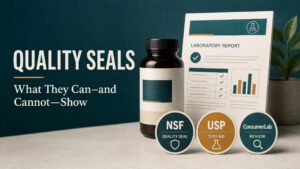
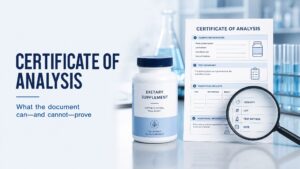
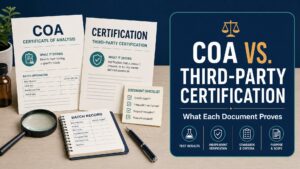
A laboratory may issue a certificate of analysis (COA) or test report summarizing findings for a particular lot or sample; the report should be checked for scope, methods, date, and limitations.
Note: In the U.S., dietary supplement manufacturers are responsible for ensuring product safety, labeling accuracy, and good manufacturing practices; FDA does not give premarket approval to dietary supplements. For more on how supplements are regulated, see FDA guidance and consumer Q&A pages. (See References.)
What third‑party testing can show
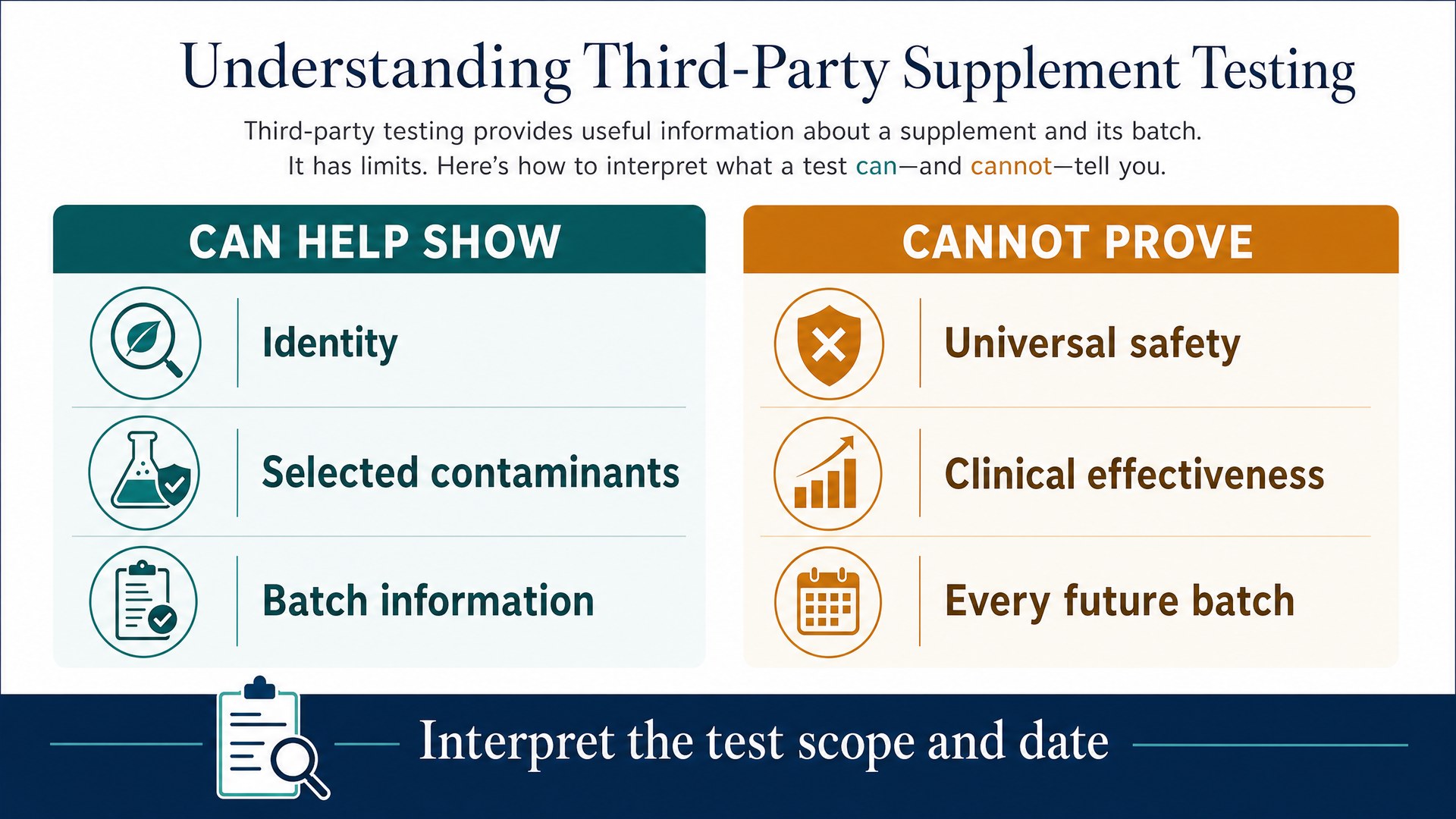
- Identity and label accuracy for the specific sample tested: A COA can confirm whether the sample contains the ingredients listed on the label and whether measured amounts match the declared amount for that lot.
- Detection of some contaminants or adulterants: Labs can test for heavy metals (lead, arsenic, cadmium), microbial contamination, and specific undeclared pharmaceutical compounds when those tests are included.
- That a specific lot passed the methods and limits used by that lab at the time of testing.
These results can be useful when you want evidence a particular product lot was tested and met certain criteria. They also help clinicians and consumers assess potential risks like contamination or undeclared drugs.
What third‑party testing cannot prove
- Safety or effectiveness for you personally: Passing lab tests do not prove a supplement is safe or effective for every person, nor do they replace clinical guidance from a clinician.
- Permanence or consistency across lots: A COA applies to the specific sample and lot tested. Another bottle from a different lot might not have identical results.
- That a product is FDA‑approved or endorsed: Supplements are not FDA‑approved in the same way prescription drugs are; a testing seal or COA does not change that regulatory status.
- That a product will be free of problems in the future: Contamination can occur after testing (for example during shipping or storage), or manufacturing practices can change.
- That the product does not interact with medicines or medical conditions: Lab testing does not evaluate drug interactions, contraindications, or suitability during pregnancy or chronic disease.
Because the FDA has found marketed products that contained hidden active drug ingredients despite labeling claims, testing of one lot is not an absolute guarantee of safety across all purchases or over time (see References).
How to read a COA or test report — a practical checklist
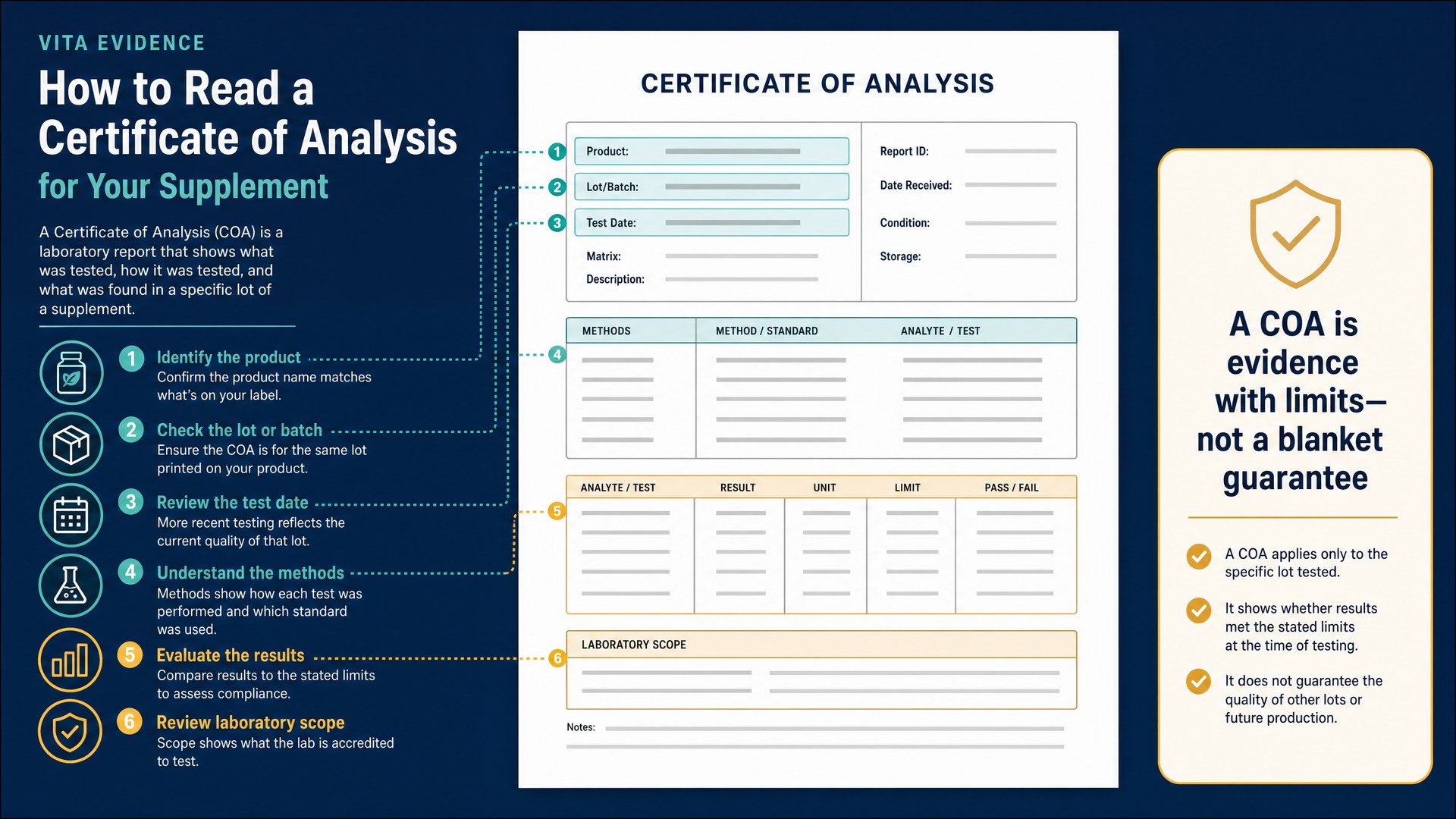
Ask the manufacturer or retailer for the COA if it’s not publicly available and check that the report includes:
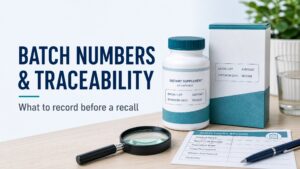
– Lot or batch number that matches your container,
– Date of testing,
– Tests performed and methods used (e.g., assay for potency, screening for specific contaminants),
– Quantitative results and the acceptance criteria or limits,
– Identification of the testing laboratory and any accreditation information,
– Any notes or disclaimers about the sample or methods.
If a COA omits lot numbers, testing dates, or details about what was measured, the report is less useful. If you need help interpreting the COA, consider contacting a pharmacist, a clinician, or the testing lab for clarification.
Table: What to look for in a COA and what it tells you
| Item on COA | What it can show | What it does not show |
|---|---|---|
| Lot or batch number | That the tested sample matches the product you bought | That other lots/bottles are the same |
| Tests performed (e.g., heavy metals, potency) | Which hazards or attributes were assessed | Other hazards not tested for |
| Quantitative results vs limits | Whether the sample met the lab’s acceptance criteria | Clinical safety or individual risk |
| Lab identification and accreditation | Who performed the analysis and possible competence info | Government approval or complete guarantee |
Limitations and common caveats
- Scope of testing varies: Not every lab checks for every possible contaminant or adulterant. For example, detecting a hidden pharmaceutical requires the lab to target that compound.
- Single‑lot testing: Most COAs apply to a single lot. Consistent manufacturing practices reduce variability, but they do not eliminate it.
- Misleading seals or fake reports: Fraudulent products and deceptive marketing exist. The FDA has issued warnings and taken action against products found to contain hidden drug ingredients (including some honey‑based products and supplements marketed for sexual enhancement, energy, or weight loss). Do not assume a seal or a label alone proves safety. (See References.)
- Advertising claims: Truthful advertising and claims about health effects are governed by the Federal Trade Commission; claims must be supported by reliable evidence. Third‑party testing does not validate health benefit claims unless the claim is backed by appropriate clinical research and regulatory review.
Practical steps for consumers
- Ask for a COA and verify it applies to the lot you bought. If the supplier cannot provide a COA, that is a reason for caution.
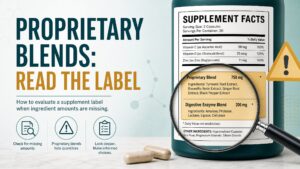
- Read the product label and the Supplement Facts panel (for help, see our guide: /how-to-read-supplement-facts-label/).
- Check the FDA’s Health Fraud Product Database and Medication Health Fraud Notifications for warnings about products and ingredients (see References).
- Talk with your clinician or pharmacist before starting supplements if you are pregnant, breastfeeding, taking prescription medications, have a chronic condition, or are planning surgery. For common interactions and questions, see /supplements-medication-interactions-questions/.
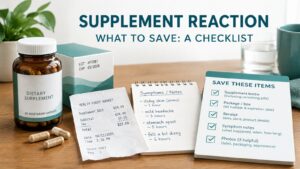
- If you suspect an adverse effect after taking a supplement, stop use and contact your clinician promptly.
How to report suspicious or harmful products
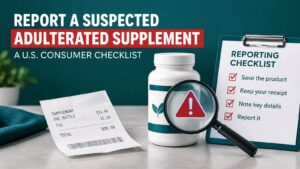
If you believe a product is contaminated, adulterated, mislabeled, or caused harm:
– Report it to the FDA through the contact options listed on the FDA site so the agency can investigate (see References).
– Check the FDA’s Health Fraud Product Database for prior alerts about the product or similar products.
– Consider reporting misleading advertising or false claims to the Federal Trade Commission (FTC). The FTC provides guidance for consumers and businesses about health claims and compliance (see References).
When to contact a clinician
Consult a clinician before using or continuing a supplement if you:
– Are pregnant, trying to conceive, or breastfeeding,
– Are taking prescription or over‑the‑counter medications (including anticoagulants, antiplatelets, seizure medications, or drugs with narrow therapeutic windows),
– Have liver, kidney, heart disease, diabetes, or other chronic conditions,
– Are preparing for surgery, or
– Develop new or concerning symptoms after starting a supplement.
Final note and safety disclaimer
Third‑party testing provides helpful information about the specific samples tested, but it does not replace clinical judgment or regulatory review. Testing can reduce uncertainty but cannot guarantee that every bottle of a product is free of contaminants, effective for a given condition, or safe for every person. This article is educational and not individualized medical advice. Contact your healthcare provider for personalized guidance.
Safety disclaimer
This article provides general information and is not medical advice. It is not a substitute for professional medical evaluation. If you have health concerns, consult a licensed clinician.
Testing scope versus broad claims
| Test detail | Question to ask |
|---|---|
| Identity | Was the tested material the stated product? |
| Method | What method and standard were used? |
| Batch and date | Does the report match the product lot and testing period? |
Evidence pathway
- Identify the exact product and batch.
- Check what the test actually covered.
- Compare results with stated limits.
- Do not treat one report as a guarantee for every batch.
References
- https://www.fda.gov/drugs/medication-health-fraud/avoiding-products-contaminated-hidden-ingredients
- https://www.fda.gov/consumers/health-fraud-scams/tainted-honey-based-products-hidden-active-drug-ingredients
- https://www.fda.gov/consumers/health-fraud-scams/health-fraud-product-database
- https://www.fda.gov/food/dietary-supplements
- https://www.fda.gov/food/information-consumers-using-dietary-supplements/questions-and-answers-dietary-supplements
- https://www.fda.gov/food/dietary-supplements-guidance-documents-regulatory-information/dietary-supplement-labeling-guide
- https://www.fda.gov/drugs/medication-health-fraud-notifications/sexual-enhancement-and-energy-product-notifications
- https://www.fda.gov/drugs/medication-health-fraud/medication-health-fraud-notifications
- https://www.ftc.gov/news-events/topics/truth-advertising/health-claims
- https://www.ftc.gov/business-guidance/resources/health-products-compliance-guidance
- https://www.fda.gov/about-fda/cder-contact-information/ways-consumers-contact-fda-about-human-drugs
Last reviewed: August 2026
VitaEvidence Editorial Team