In this guide
Introduction
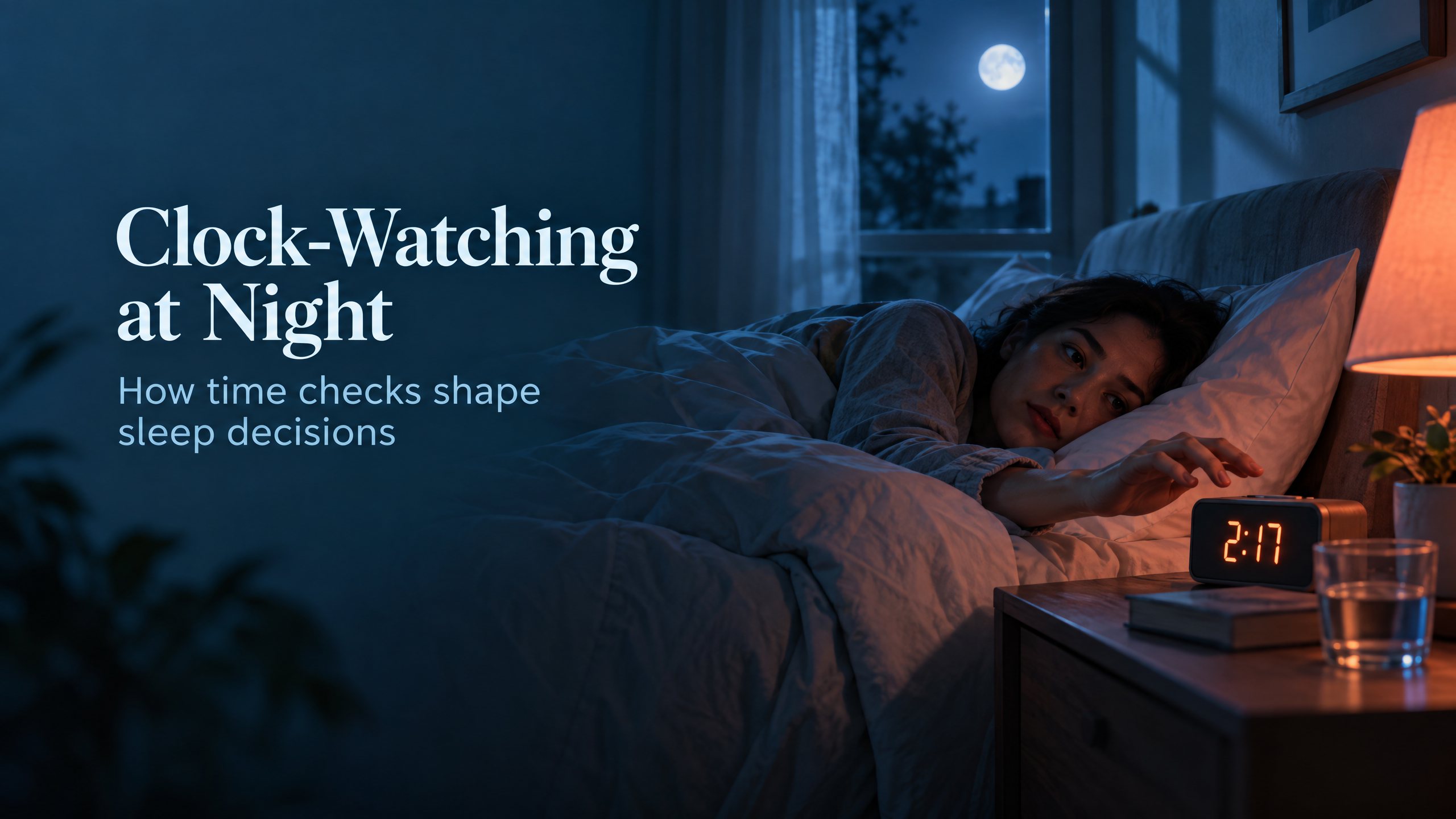
A nighttime awakening can seem harmless until the eyes go to the clock. “It is 1:10.” Then, after what feels like a long stretch awake: “Now it is 1:47.” A person may start calculating how many hours remain or whether tomorrow will be manageable. The clock has become part of the decision-making environment around sleep.
Researchers call repeated checking of the time at night time-monitoring behavior or clock-watching. It is common among people who report insomnia, but it is not proof of a sleep disorder. It can be a response to poor sleep, a habit that adds pressure, or both. The question is whether checking helps a useful decision or keeps the brain focused on threat and lost sleep.
Key Takeaways
- Clock-watching can make wakefulness feel more urgent by turning the night into a countdown.
- Small experimental studies found more sleep-related worry and longer perceived time to fall asleep when participants monitored a clock. Objective sleep findings were less consistent.
- Time checks are associated with insomnia severity in clinical samples, but association does not prove that clock-watching causes insomnia.
- A low-pressure plan—such as keeping the clock out of view and using stimulus-control principles—may reduce unhelpful decisions without promising an instant fix.
- Repeated sleep problems, loud snoring or gasping, restless legs, or unsafe daytime sleepiness deserve a conversation with a health care professional.
Why a time check can change the next decision
Sleep usually depends on reduced effort and lower alertness. A bright phone screen, smartwatch vibration, or clock calculation can shift attention toward monitoring. “How much sleep can I still get?” may become a pass–fail test: enough sleep if the number is high, disaster if it is low.
The number may influence behavior. Someone might stay rigidly in bed, check again, reach for a product, or decide that the next day is already ruined. These reactions are understandable, but they are not reliable measures of how much sleep has occurred. Quiet wakefulness can feel longer when attention is fixed on passing minutes.
What the evidence supports
A frequently cited experimental study by Tang and colleagues tested clock monitoring in two experiments involving people who differed in sleep quality. Participants who monitored a clock reported more worry and longer estimated sleep-onset times than people who did not. In a second experiment, the clock-monitoring group reported more pre-sleep worry and a larger gap between perceived and actigraphy-estimated time to fall asleep. Monitoring the clock also appeared more frustration-provoking than monitoring a comparison display. 1
The study did not show that every clock check causes insomnia. Some findings relied on self-reported estimates, and objective actigraphy did not consistently mirror the perceived delay. Actigraphy can also miss quiet wakefulness. The study supports a plausible feedback loop—monitoring, worry, and a more threatening interpretation of wakefulness—but not a universal cause-and-effect rule.
A separate retrospective chart review examined 1,078 patients at a sleep medical center. Insomnia and time-monitoring severity were greater among patients who also reported moderate to severe post-traumatic stress symptoms, and the measures were correlated. However, it was not a randomized test, so it cannot show whether clock-watching caused insomnia or resulted from it. 2
The broader evidence supports treating chronic insomnia as more than a problem of “trying harder” to sleep. The American College of Physicians recommends cognitive behavioral therapy for insomnia (CBT-I) as initial treatment for adults with chronic insomnia. CBT-I combines cognitive work with stimulus control, sleep education, and, when appropriate, sleep consolidation. 3 NHLBI describes stimulus control as going to bed when sleepy, getting out of bed when unable to sleep, and using the bed for sleep and sexual activity. 4
Repeated measurements in bed are not the same as an evidence-based sleep plan.
What remains uncertain
Research has not established one universally correct rule for clock use. Briefly checking an alarm may differ from checking every few minutes. Experiences may also differ by anxiety, work schedule, medical conditions, and whether the clock is paired with a bright phone or stimulating content.
It is uncertain how much hiding the clock alone changes sleep outcomes. Studies are relatively small and measure sleep differently. The strongest conclusion is modest: for some people, repeated monitoring appears to increase worry and distort the experience of how long they have been awake. It is not evidence that clocks are inherently harmful or that removing one will cure insomnia.
A sleep tracker, phone app, or wearable does not automatically solve the problem. More data can help in a clinician-guided evaluation, but checking numbers during the night may reproduce the same monitoring loop. The CDC notes that sleep quality includes uninterrupted, refreshing sleep and that regular sleep problems warrant discussion with a health care provider. 5
A practical, low-pressure approach
A general educational strategy is to move time information out of the center of the night:
- Set the morning alarm before bed. Keep the clock face or phone screen out of direct view, and avoid opening messages or news after an awakening.
- Notice the urge to calculate. A neutral reminder—“The exact minute is not necessary right now”—can interrupt the countdown without arguing with the thought.
- Use stimulus-control principles rather than a stopwatch. If wakefulness is becoming frustrating, leave the bed for a quiet, dim-light activity and return when sleepy. NHLBI presents this as part of CBT-I. 4
- Keep daytime decisions steady. Consistent wake timing, a sleep-friendly bedroom, regular daytime activity, and limiting caffeine, nicotine, and alcohol near bedtime are among NHLBI’s general recommendations. 4
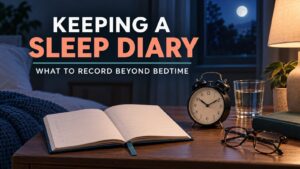
- Track patterns outside the night. If a sleep diary is useful, record sleep and wake patterns in the morning. A clinician can use that information alongside symptoms, medicines, schedule, and possible sleep disorders.
Adults generally need at least seven hours of sleep, although needs vary with age and circumstances. 5 One short night does not precisely forecast performance. If driving or another safety-sensitive task is involved, treat pronounced sleepiness as a safety issue rather than relying on the clock.
Safety and When to Seek Care
Clock-watching is not an emergency symptom by itself. Seek routine medical advice when sleep difficulty is frequent, persistent, or interfering with mood, concentration, work, school, or safe activities. A clinician can consider insomnia as well as contributors such as pain, mood symptoms, medication effects, restless legs, circadian-schedule problems, or sleep apnea.
Ask for evaluation sooner if there is loud habitual snoring, gasping or witnessed pauses in breathing, repeated uncomfortable leg sensations, episodes of falling asleep unintentionally, or severe daytime sleepiness. Do not start, stop, or combine sleep medicines or supplements based only on a nighttime time check. NHLBI notes that over-the-counter sleep products and supplements can have risks, and ACP recommends discussing benefits, harms, and costs before adding medication to insomnia care. 3
Practical Bottom Line
The clock does not create every sleep problem, but repeated nighttime time checks can shape the meaning of wakefulness and the decisions that follow. Evidence supports a careful interpretation: clock monitoring is linked with more sleep-related worry and longer perceived sleep latency in some studies, while cause and effect and objective sleep changes remain uncertain.
For many adults, a reasonable experiment is to set the alarm, hide the display, avoid turning an awakening into a calculation, and use low-pressure stimulus-control principles. If the pattern continues or daytime safety and functioning suffer, the next useful step is not a stronger sleep product or more nighttime data. It is an evidence-based evaluation, with CBT-I as a recommended first-line option for chronic insomnia.