

In this guide
- Key Takeaways
- What “spotting” can and cannot tell you
- What to record before the visit
- 1. Timing and cycle context
- 2. Amount and appearance
- 3. Associated symptoms
- 4. Pregnancy possibility and reproductive context
- 5. Contraception, medicines, and health history
- What a clinical visit may involve
- Safety: When to Seek Care
- A practical summary for your appointment
- References
Meta title: Spotting Between Periods: What to Record Before a Clinical Visit
Meta description: Learn which details about spotting between periods can help a clinician assess timing, amount, symptoms, pregnancy risk, medications, and next steps.
Primary keyword: spotting between periods
Spotting Between Periods: What to Record Before a Clinical Visit
Spotting between periods can mean a few drops of blood, pink or brown discharge, or bleeding that is clearly different from your usual period. It is considered a form of abnormal uterine bleeding when it occurs outside expected menstruation, although the word “abnormal” describes the pattern—not the cause. Some causes are temporary or easy to address; others need prompt evaluation. A short, organized record can help a clinician understand the pattern without asking you to rely on memory. 1
This article is educational, not a diagnosis or a personal treatment plan. It focuses on useful observations for a visit and situations that should not wait.
Key Takeaways
- Record the date, timing in your cycle, duration, amount, and appearance of each episode.
- Note pain, fever, unusual discharge, dizziness, bleeding after sex, and any effect on daily activities.
- Include pregnancy possibility, contraception, recent changes in medicines, and relevant medical or family history.
- Tracking can clarify a pattern, but it cannot identify the cause by itself. A clinician may need an exam or testing.
- Seek urgent care for very heavy bleeding, faintness, trouble breathing, severe or one-sided pelvic pain, shoulder pain, or bleeding with a possible pregnancy.
What “spotting” can and cannot tell you
Spotting is a description of a small amount of bleeding, not a diagnosis. Bleeding between periods may be related to hormonal or ovulatory changes, birth control, an intrauterine device, polyps or fibroids, infection, pregnancy-related conditions, or other causes. A person may have more than one contributing factor. ACOG also lists thyroid problems, bleeding disorders, and—less commonly—conditions involving the uterine lining among possible explanations. 1
A normal cycle varies among individuals and across life stages. The Office on Women’s Health describes regular cycles as commonly occurring every 24 to 38 days, while ACOG’s patient guidance uses a typical range of 21 to 35 days. These differences reflect different reference definitions, not a reason to diagnose yourself from one number. Puberty, perimenopause, breastfeeding, and changes in hormonal contraception can all alter bleeding patterns. 1
The evidence supports documenting the change and discussing it; it does not support assuming that spotting is automatically ovulation, “hormone imbalance,” an infection, or cancer. The same appearance can occur with different causes, and a tracking log cannot distinguish them.
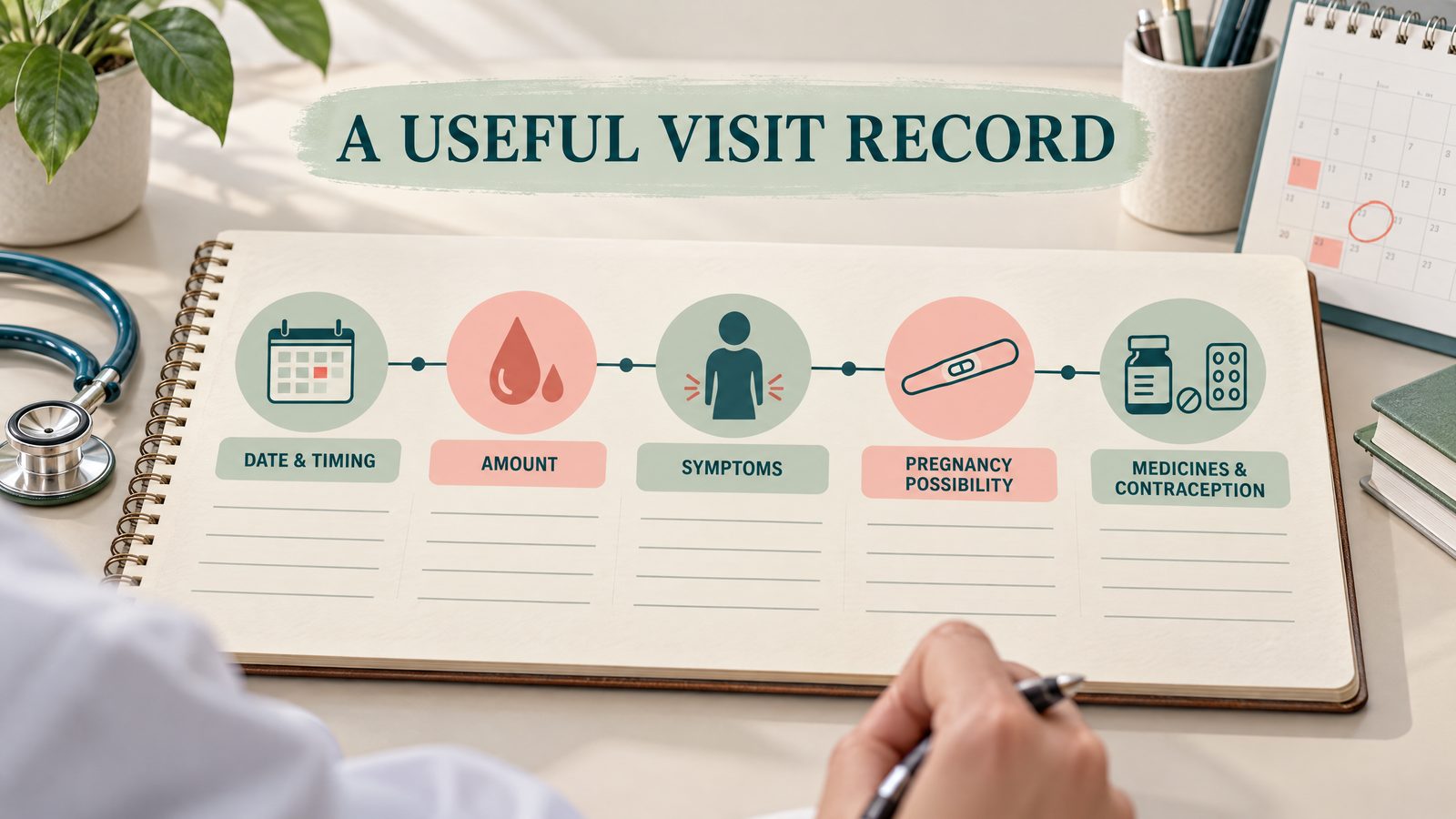
What to record before the visit
You do not need a perfect chart. A calendar, private note, or paper log is enough. If you use an app, review its privacy settings before entering sensitive information or sharing data.
1. Timing and cycle context
For every episode, write down:
- The date and approximate time it began and ended.
- The first day of your most recent period and the start date of the prior period, if known.
- Whether the bleeding occurred just before an expected period, soon after one ended, or in the middle of the cycle.
- Whether it happened once or has recurred, and how many days separated episodes.
Also record whether the episode followed a missed or late period. If you are not sure when a period was due, say so; uncertainty is useful information.
2. Amount and appearance
Describe the amount in ordinary terms: a few spots when wiping, staining underwear, needing a liner, or needing a pad or tampon. If bleeding becomes heavier, record how often you need to change a product and whether it leaks through. Do not try to convert products into an exact volume. Product absorbency differs, and visual estimates are imprecise.
Note the color—pink, red, dark red, or brown—and whether you saw clots or tissue. Color alone does not identify the cause. A menstrual pictogram may help describe bleeding, but it is a communication aid, not a diagnostic test. 3
Record whether the bleeding is different from your usual period in duration, heaviness, or timing. ACOG recommends tracking dates, length, and whether flow is light, medium, heavy, or spotting for several weeks when possible. 1
3. Associated symptoms
Write down symptoms that occurred at the same time, including:
- Pelvic or abdominal pain, its location, severity, and whether it is constant or comes in waves
- Pain with sex or bleeding after sex
- Fever, chills, foul-smelling discharge, itching, or burning with urination
- Nausea, weakness, dizziness, shortness of breath, or fainting
- New headaches, breast tenderness, acne, hot flashes, or other cycle-related changes
Also note whether symptoms made you miss work, school, exercise, or sleep. Functional impact is clinically relevant even when the amount of blood seems small. The Office on Women’s Health advises contacting a clinician for unusual bleeding, including spotting at a time other than a period and repeated bleeding after sex. 2
4. Pregnancy possibility and reproductive context
If pregnancy is possible, record the date of the last menstrual period, any pregnancy test result and date, and whether you recently gave birth, had a miscarriage, or had a pregnancy procedure. Do not delay urgent care while trying to complete a log.
Mention whether you are breastfeeding or in perimenopause. These contexts can change ovulation and bleeding, but they do not make every new bleeding pattern harmless. Bleeding after menopause should be evaluated rather than tracked indefinitely. 1
5. Contraception, medicines, and health history
List your current birth-control method and when it was started, stopped, missed, replaced, or changed. Include an IUD and whether it is copper or hormonal, if you know. Breakthrough bleeding can occur with hormonal birth control, and copper IUDs can increase menstrual bleeding, especially early after insertion. 1
List prescription medicines, over-the-counter products, and supplements, including blood thinners and aspirin. Do not stop a prescribed medicine because of spotting unless the prescribing clinician tells you to. Note recent emergency contraception or fertility treatment if relevant.
Finally, record a history of fibroids, polyps, endometriosis, thyroid disease, polycystic ovary syndrome, pelvic infections, bleeding disorders, or prior pelvic procedures. Family history of bleeding problems or gynecologic cancers may also matter. A clinician commonly asks about medical history, pregnancy history, medicines, and contraception when evaluating abnormal bleeding. 1
| Record | Why it helps | Do not wait if… |
|---|---|---|
| Date, cycle timing, duration | Shows whether the episode is isolated or recurring. | Bleeding is rapidly worsening. |
| Amount and appearance | Gives a practical description without guessing exact volume. | It soaks a pad or tampon hourly with concerning symptoms. |
| Pain, fever, dizziness, discharge | Highlights symptoms that may change urgency. | Severe pain, faintness, or trouble breathing occurs. |
| Pregnancy possibility, medicines, contraception | Provides context for clinical assessment. | Pregnancy is possible with severe or one-sided pain. |
What a clinical visit may involve
The record helps establish the bleeding pattern, but it does not replace an evaluation. Depending on age, symptoms, pregnancy possibility, and medical history, a clinician may consider a physical or pelvic examination, pregnancy testing, tests for sexually transmitted infections, or a complete blood count to look for anemia or infection. Ultrasound or other testing may be considered when the history and examination suggest it. 1
Guidelines and reviews support assessing pregnancy and the source of bleeding, then using the history to guide further evaluation. The range of causes is broad, and the best next step depends on the clinical picture. 1 A tracking record does not identify the cause.
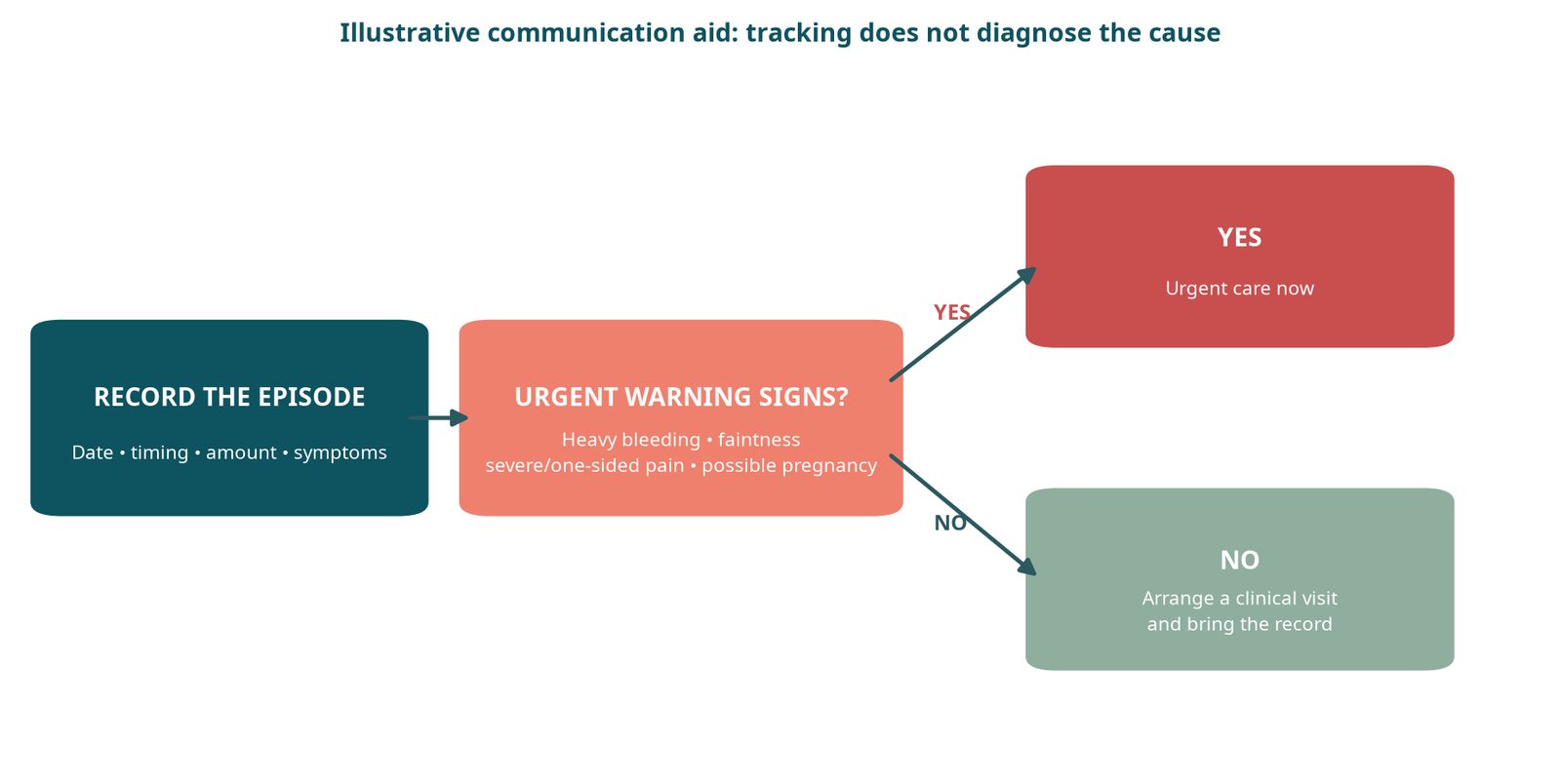
Safety: When to Seek Care
Seek emergency care now for bleeding that soaks through a pad or tampon every hour for more than two hours, especially with chest pain, shortness of breath, lightheadedness, or dizziness. 1 Severe weakness, fainting, or signs of significant blood loss also require urgent attention.
If pregnancy is possible, contact a health professional promptly for abnormal bleeding with pelvic or abdominal pain. Go to an emergency department for sudden or severe pain, one-sided pain that is worsening, shoulder pain, weakness, dizziness, or fainting. These can be warning signs of an ectopic pregnancy, which can cause life-threatening internal bleeding. 3
Arrange clinical care for repeated spotting, bleeding after sex, bleeding that is heavier or longer than usual, or any bleeding after menopause. Fever, severe pain, or foul-smelling discharge makes prompt assessment more important. Do not wait for several weeks of tracking when symptoms are severe or rapidly changing.
A practical summary for your appointment
Bring a brief timeline rather than a long narrative: “Spotting began on [date], occurred [number] times, lasted [duration], and was [description]. It happened [cycle timing or uncertainty]. I had [symptoms or none]. My contraception or medicines changed [when or not]. Pregnancy is [possible, not possible, or uncertain].”
That summary gives a clinician a starting point while leaving room for questions and examination. The most useful record is consistent, private, and honest about uncertainty. Tracking helps describe what happened; it does not assign a cause or determine treatment. A clinical visit is the appropriate place to interpret the pattern and decide whether testing or follow-up is needed.