In this guide
- What federal sources say about supplements and claims
- How the scientific evidence differs for skin versus joints
- Why labels may not tell the whole story
- How to read a collagen peptide label: practical checklist
- Interactions, contraindications, and safety considerations
- When to seek care
- Bottom line
- References
Products labeled as “collagen,” “collagen peptides,” or “hydrolyzed collagen” are commonly promoted for skin appearance (for example, elasticity or hydration) and for joint comfort or mobility. Federal agencies regulate how these products may be marketed and what must appear on their labels, but they do not evaluate or approve supplements for safety and effectiveness before sale. That means the strength of the scientific evidence and the information shown on labels can differ — sometimes substantially.
What federal sources say about supplements and claims
The U.S. Food and Drug Administration (FDA) treats dietary supplements differently than prescription drugs. Manufacturers are responsible for ensuring product safety and label accuracy, but the FDA does not approve supplements for effectiveness before they reach the market. Products may carry structure/function claims (for example, “supports skin health” or “helps joint comfort”) but such claims must be truthful and not imply treatment of a disease. If a structure/function claim is used, labels must include a required disclaimer noting that the claim has not been evaluated by the FDA.
For consumers looking up label information, two federal databases can be useful: the Dietary Supplement Label Database (DSLD) contains label images and ingredient lists for many products, and the Dietary Supplement Ingredient Database (DSID) provides analytical data about ingredient amounts in tested products. These resources help compare what manufacturers claim on labels with laboratory analyses and provide transparency about ingredients and serving sizes.
How the scientific evidence differs for skin versus joints
Public federal resources emphasize that evidence for many dietary supplements varies by outcome and is often incomplete. Authoritative guidance on specific ingredients or health outcomes is limited when a dedicated federal factsheet is not available. In the case of collagen peptides, marketed claims span both skin and joint outcomes. Scientific studies have looked at a range of outcomes, but consensus statements and broad federal consumer guidance stress caution: the overall evidence base can be mixed, studies may use different collagen preparations and dosages, and long-term safety data are often limited.
In short, while some research studies have examined collagen peptides for skin or joint-related endpoints, federal consumer guidance underscores that supplements are not approved treatments and that study results may not generalize across products. Consumers should interpret product claims with awareness of these limitations.
Why labels may not tell the whole story
- Labels must list the Supplement Facts panel, ingredient names, serving size, and amount per serving, but they do not provide evidence summaries.
- Structure/function claims are allowed without FDA preapproval; the required disclaimer must be present, but claims can still be prominent on packaging or advertising.
- Manufacturers are required to ensure the label is truthful, but independent verification of identity, purity, and potency is not required before sale.
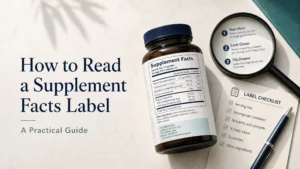
How to read a collagen peptide label: practical checklist
- Look for the exact ingredient name in the Supplement Facts (“collagen peptides,” “hydrolyzed collagen,” or specific collagen types) and the amount per serving.
- Check the serving size and number of servings per container to calculate total intake.
- Find the source: bovine, porcine, marine (fish), or poultry — this matters for allergies, dietary restrictions, and cultural preferences.
- Scan for other active ingredients often included with collagen (for example, vitamin C, which is sometimes added to support collagen synthesis) and for any inactive ingredients or additives.
- Note allergen statements (for example, “contains fish”) and whether the label lists common allergens like soy, milk, or shellfish.
- Check for manufacturer contact information, lot number, expiration date, and whether the product lists third-party testing or certification (for identity, purity, or potency).
- Review any structure/function claims and confirm the presence of the FDA disclaimer required for such claims.
Interactions, contraindications, and safety considerations
Federal consumer guidance recommends caution when taking any dietary supplement. For collagen peptides, key safety considerations include:
- Allergies or sensitivities to the ingredient source (for example, fish-derived collagen in someone with a fish allergy).
- Pregnancy or breastfeeding: federal guidance generally advises consulting a health care provider before using supplements during these times.
- Chronic medical conditions or multiple medications: discuss supplements with a clinician, as product ingredients or added compounds may interact with medical conditions or therapies.
- Product quality: because federal premarket review is limited, consider products that undergo independent third-party testing for identity and purity.
When in doubt, consult a health care professional about whether a supplement is appropriate for you and how it might fit with medications or health conditions.
When to seek care
- Stop using a supplement and contact a health care professional if you develop signs of an allergic reaction (hives, swelling, difficulty breathing) after taking it.
- See your clinician if you have new or worsening joint pain, skin problems, or other concerning symptoms while taking any supplement.
- Report serious adverse events to the FDA using the MedWatch program and inform your clinician.
Understanding the difference between label claims and the underlying science helps consumers make informed choices. Use the federal label databases and talk with your health care provider when considering collagen peptide supplements for skin or joint goals.
Bottom line
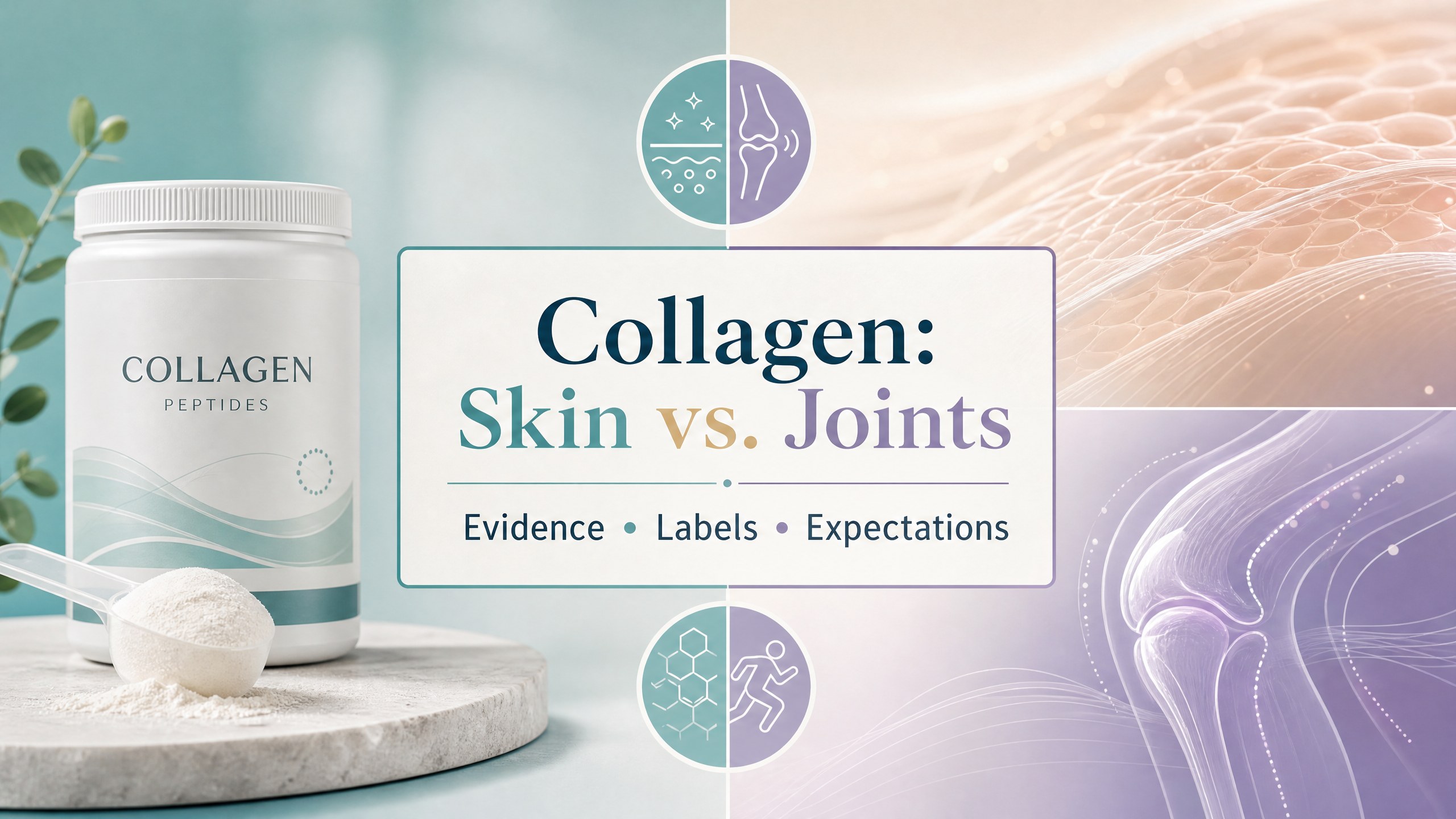
Collagen peptide supplements are commonly marketed for skin and joint benefits, but federal sources show differences in the evidence, regulation, and what labels must — and don’t — tell you. Learn how to read labels, spot key ingredients and warnings, and when to check with a health professional.
References
- FDA — Dietary Supplements
- FDA — Dietary Supplement Products & Ingredients (Labeling and Claims)
- Dietary Supplement Label Database (DSLD)
- Dietary Supplement Ingredient Database (DSID)
- Office of Dietary Supplements — What You Need To Know About Dietary Supplements
- National Center for Complementary and Integrative Health — A to Z